Today’s Roman Station Church is San Sisto Vecchio: the Old Church of Saint Sixtus.
IF READING FROM EMAIL, CLICK on TITLE OF ARTICLE here to access today’s YouTube video
Welcome back to Crux Stationalis, the Roman Station Church Network, where the history, art, and spirituality of Rome converge. Today, we embark on a journey to uncover the hidden treasures of Rome’s Basilica di San Sisto Vecchio. After years of meticulous renovation, the nuns opened the doors to this paleo-Christian marvel during Lent of 2023, revealing a rich tapestry of history, architectural evolution, and spiritual significance.

Dedicated to Pope St. Sixtus II, a martyr in 258, the basilica’s roots extend back to the 4th or early 5th century. While uncertainties persist about its identification as one of the tituli, the first parish churches in Rome, the possibilities of Titulus Crescentianae and titulus Tigridis emerge. The 6th-century relocation of Pope St. Sixtus II’s relics from the catacombs to here solidified the church’s importance, setting the stage for Pope Hadrian I’s 8th-century renovation, certainly a Roman Station Church since that time.
The original basilica boasted a classic plan, featuring a nave, side aisles, and a semi-circular apse. However, a significant transformation occurred under Pope Innocent III in the 12th century. The present structure, a result of remodeling, exhibits a reduced size with a single nave and its apse.
In 1218, St. Dominic de Guzmán took charge, aiming to reform Roman nunneries at San Sisto Vecchio. Despite Pope’s desires, St. Dominic established the first Dominican nunnery here in 1221, leading to a miraculous event in the refectory where angels provided sustenance when the Dominicans returned empty-handed from alms.
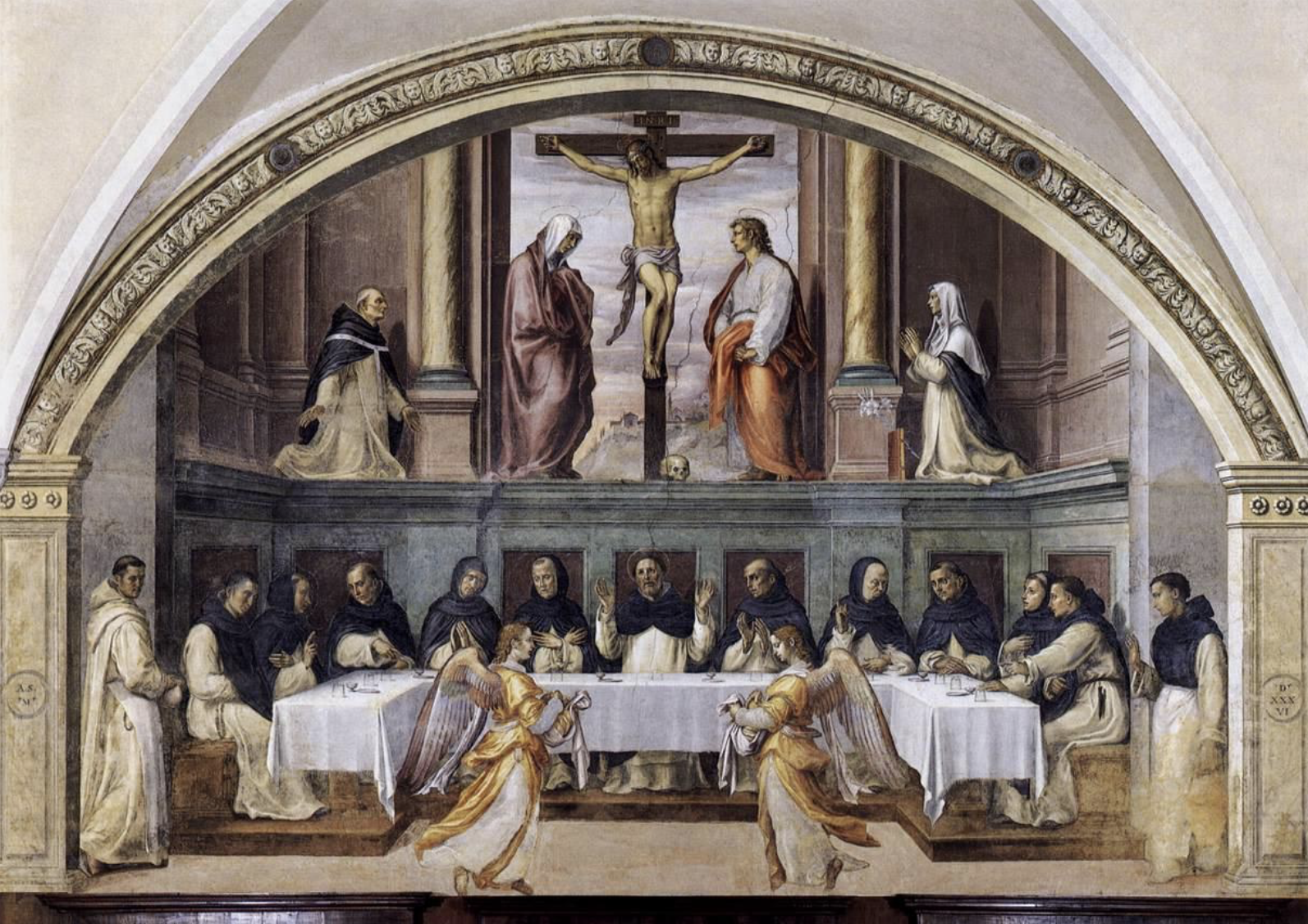
The basilica’s four side altars, adorned with 18th-century paintings, remain a testament to its artistic legacy. Notable dedications include the Holy Dominicans, Our Lady of the Rosary, St. Dominic, and St. Vincent Ferrer. The frescoes within the sanctuary depict scenes from the legends of Pope St. Sixtus and St. Lawrence, offering a glimpse into the basilica’s rich artistic heritage despite varying dates and preservation challenges.
The 15th-century restoration ordered by Pope Sixtus IV paved the way for concerns about the locality, leading to the construction of a new nunnery, now known as Santi Domenico e Sisto. [San Sisto Nuovo, the New Church of Saint Sixtus, which is the church located on the campus of the Angelicum University]. Pope Paul V approved the relocation, culminating in its completion in 1663.
Fast forward to the 18th century, Pope Benedict XIII oversaw a significant refitting from 1724 to 1730, shaping the basilica’s current appearance under the guidance of architect Filippo Raguzzini.

In 1748, the Dominican convent underwent a transformation, becoming an Irish community. However, the French occupation in 1798 led to its suppression, and the complex fell into disuse for a century. In 1893, Mother Antonia Maria Lalia revitalized the complex, establishing the Missionary Dominican Sisters of San Sisto, active in educating girls in Rome, and in Latin America and Russia. The monstery is also a guest house and book bindery.
The 20th century brought challenges, with the widening of Via Appia altering the convent’s structure.
As we delve into the history and transformations of the Basilica di San Sisto Vecchio, we are reminded of the resilience of spiritual institutions. The echoes of the past, from miraculous events in the refectory to the evolution of the convent into a hub of education and community service, highlight the enduring spirit of this paleo-Christian gem in the heart of Rome.
 Crux Stationalis