Embracing Divine Healing: A Journey Through the Basilica di Santi Cosma e Damiano
Welcome back to Crux Stationalis, the Roman Station Church Network. Today, we invite you to embark on a spiritual journey as we explore the Basilica di Santi Cosma ed Damiano, dedicated to the revered twin brothers and doctors, Saints Cosmas and Damian.
Serving as a spiritual oasis in the heart of the Roman Forum, the Basilica stands as a testament to the enduring faith of these twin martyrs. The very Cosmas and Damian inserted into the Canon of the Mass. Every mass that echoes within its sacred walls becomes a poignant reminder of their sacrifice and an opportunity for us to reflect on the divine healing that transcends time.
The Basilica, originally the site of ancient Pagan temples, underwent a transformative process in 527 AD when it was dedicated to Saints Cosmas and Damian. The church’s evolution continued over the centuries, with significant modifications ordered by Pope Urban VII in 1632. These changes, including the raising of the floor and the addition of side chapels, have shaped the Basilica into the magnificent structure we witness today.
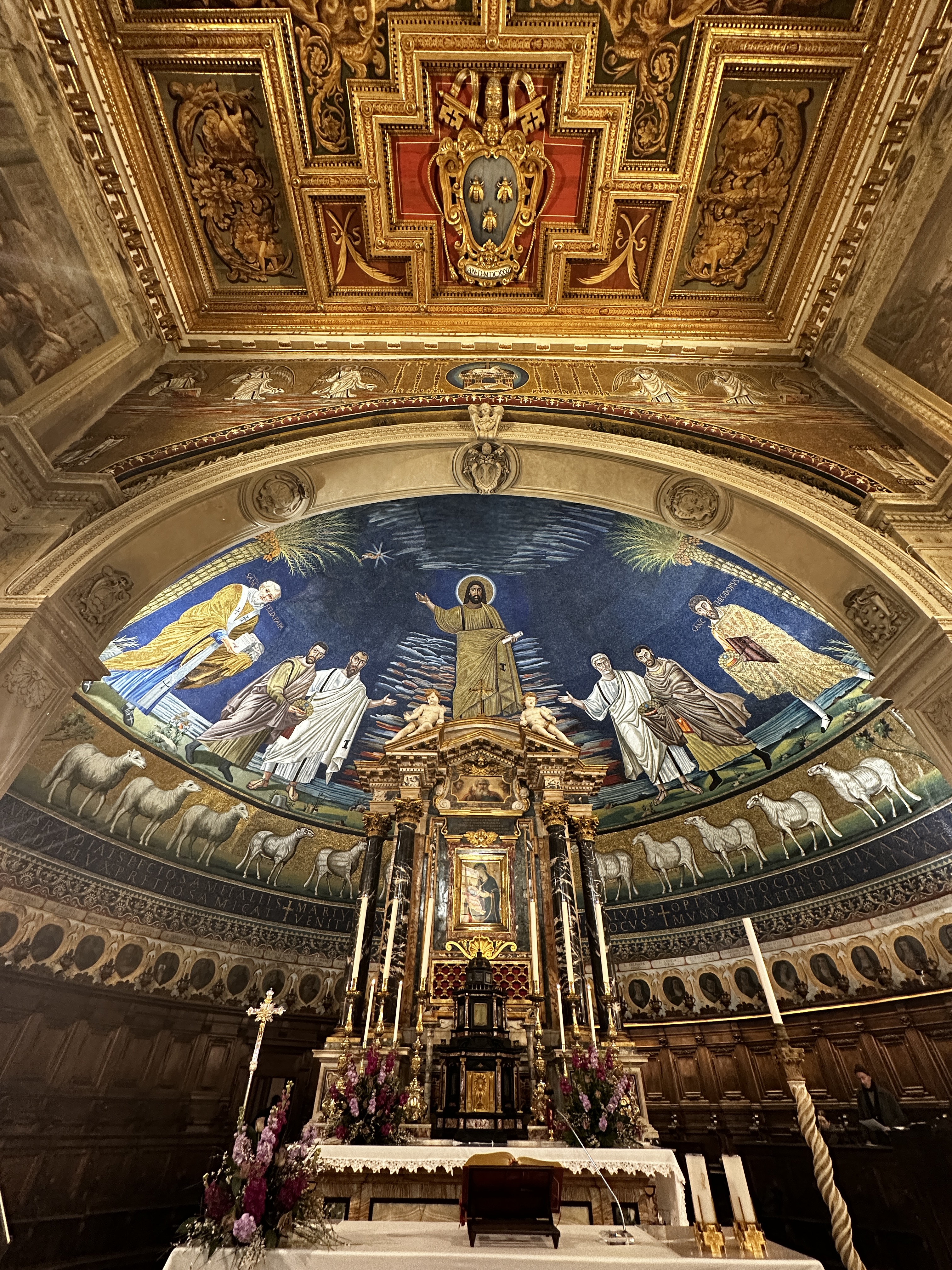
As we step inside, the ethereal beauty of the Mosaic captures our attention. The central figure of Christ, depicted as the Cosmic King, draws us into the paradoxical nature of Christianity. But the first sight we see is a fresco: the King of the Universe nailed to the cross, embracing the profound irony that defines the Christian proclamation – a crucified Criminal who pours out love.
In this Lenten season, as we reach the halfway point, we are reminded of Christ as our divine physician. The Basilica serves as a poignant reminder that our weaknesses, sins, and failings were crucified with Christ on the cross. It is an invitation to throw everything at the foot of the cross, allowing the Divine Physician to heal us in His infinite love.
Quoting the station Church Mass collect dedicated to Saints Cosmos and Damien, we hear:
May the blessed feast of Your saints, Cosmas and Damian, glorify You, O Lord; for on this day in Your marvelous providence, You gave them glory everlasting, and gave us their help. Through Jesus Christ, …
Moving deeper into the Basilica, the sixth-century Mosaic unveils a breathtaking portrayal of Christ as the icon of the invisible God. The symbolism in the Mosaic, with Christ’s wounds and the Agnus Dei, underscores the transformative power of the divine physician. The twelve sheep, representing the apostles, symbolize the procession towards the Lamb of God, standing on a rock from which flow the four rivers of paradise.
Comparing this Mosaic to other art within the Basilica, we witness the unique transcendental nature of Byzantine art: the first flowering of Byzantine art in Rome, illustrating the focus on the Divine and the intangible.
And so we see the true purpose of Christian art – not as museum pieces but as instruments for communion with God.
The journey through the Basilica of Saints Cosmos and Damien invites us to embrace divine healing. As we reach the halfway point of Lent, let us reflect, confess, and surrender ourselves at the foot of the cross. The Basilica stands as a testament to the enduring power of faith and the transformative love of the Divine Physician. Watch the accompanying YouTube video to immerse yourself in the sacred beauty of this Roman Station Church and to deepen your connection with the divine healing offered through the Paschal Mysteries.
 Crux Stationalis