For the 2025 Season of Lent, I will publish a daily blogpost for each Roman Station Church and therein I will include my video for the Station Church. The easiest way to stay up-to-date is to subscribe here to receive the post in your email inbox. The calendar of churches is below along with the times for each liturgy celebrated by the diocesan community in union with the Pontifical Academy of the Roman Martyrs. Subscribe here with your email to follow along this Lent with Crux Stationalis.
Throughout the liturgical season of Lent, pilgrims and Romans visit the most ancient churches of Rome in what is the oldest pilgrimage in Rome. The tradition expanded beyond Lent to other days of the liturgical year. The origins in Lent, however, come about from the desire of Romans to honor their ancestors in the faith, the early Christian martyrs of Rome.
Therefore, each day of Lent, we travel to a different tomb of a martyr honoring those who offered their lives in union with the sacrifice of Christ — which we will celebrate in the final days of Lent during the Holy Triduum as we await the resurrection of Christ on Easter morning.

What is a Station?
The word “station” comes from the Latin statio, meaning “standing”. In the context here, it originally referred to days of penance when the custom was for the faithful to refrain from (“stay from”) eating from sunset until three-quarters of the way through daylight on the next day (the “ninth hour,” in the ancient Roman way of telling time: “none”).
On these days, the tradition grew up that the Holy Father the Pope would visit a church in each part of the city and celebrate Mass with the congregation, in order to strengthen the sense of community within the Church at Rome. The Easter celebrations were a sort of overflow of this tradition, as obviously penance at Easter is inappropriate.
A statio was not the same as a ieunium or “fast,” which was until sunset or after Vespers. Most of the station days occur during Lent, however, which was traditionally marked by a daily ieunium anyway in the early Church. (In the Roman rite this never included Sundays in Lent. For this reason the Roman Lent starts on Ash Wednesday, so as to give a full forty days of penitence before Easter Day. (This is not done in the Eastern churches, because they count Sundays as part of Lent).
The Liturgy of the Station
In addition to Mass, the traditional station liturgy consists of an initial procession, the Litany of Saints, and a veneration of relics.
Originally the congregation gathered at an ecclesia collecta (“collect church”) nearby, where the procession was “collected” or assembled. This would then process through the streets for a short distance, to the actual station church. There was no collect church for Sunday stations.
These collect churches are no longer used, and some of the ancient ones have even been destroyed, but they are nevertheless listed below (from “The Sacramentary” by Bl. Ildephonso Schuster).
The length of the procession was probably dictated in part by the old custom of going barefoot as a penitential exercise during it. This was prescribed for Jews on Yom Kippur in Christ’s time, but among Latin Christians it has never been more than a voluntary devotion.
Alternative churches
On some days, the list has more than one station church. The original reason was simply that the crowds would have been too large to handle if only one church was used, so an alternative was also designated. In such cases, the most important (i.e. the original traditional station) is listed first, but the indulgences can still be gained by attending the “alternative church”. Some of these alternatives listed are no longer regularly used.
In a few cases the original station has been destroyed (for example, when the station at San Trifone was transferred to Sant’Agostino when the old church was demolished for the latter’s convent).
Also, in the 1930’s, two churches were raised to stational status by the Pope as “alternatives,” by reason of their importance.
Nowadays
Each year since the 1960’s, the Pontifical North American College (the American seminary in Rome) has celebrated a Stational Mass in English at all the original Station Churches (Monday thru Saturday). Nowadays, Masses begin promptly at 7:00 a.m., and all are welcome to attend. More information can be found at the NAC’s Station Church website.
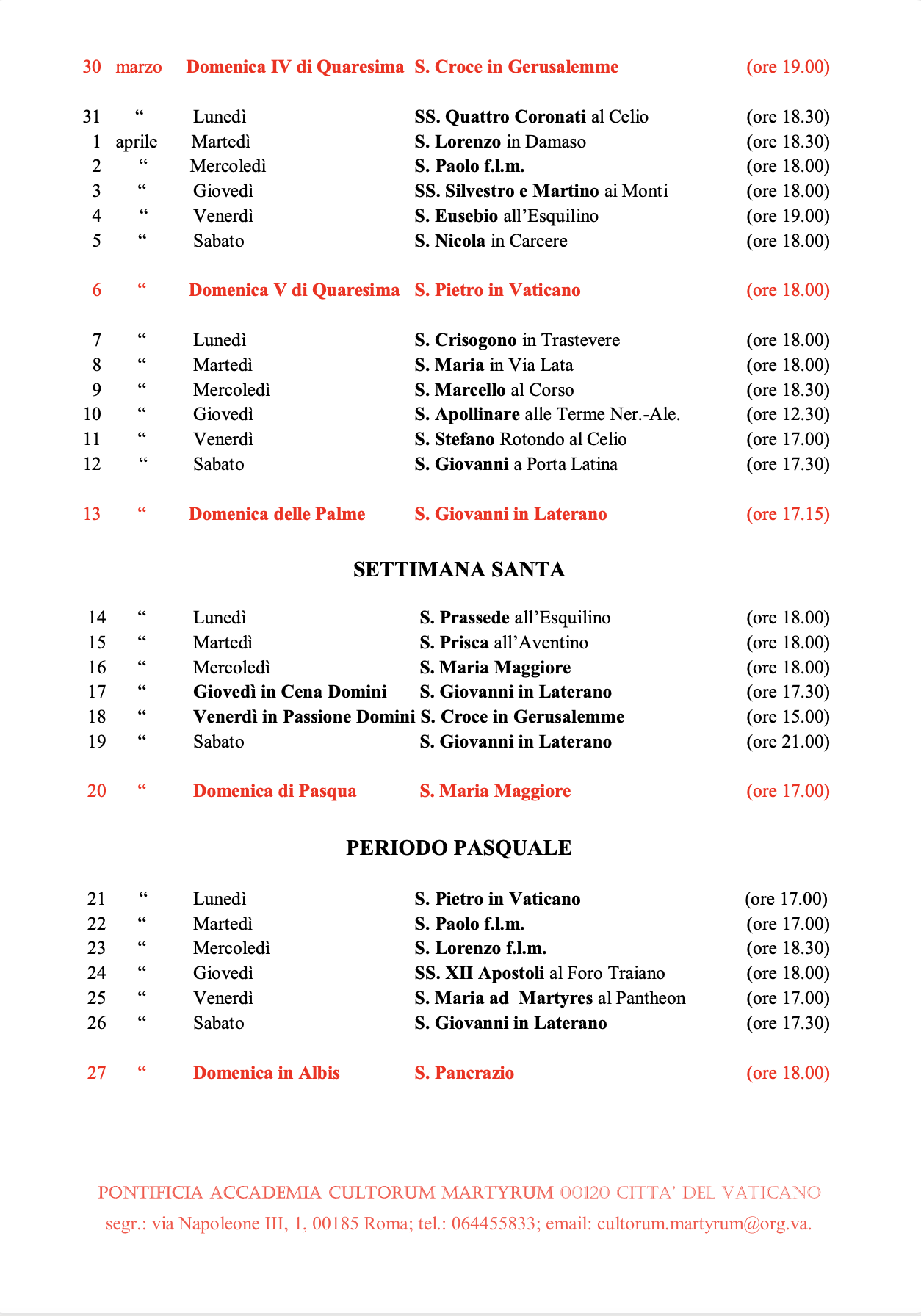
The scheduled times for each church change from one year to the next. I provide the times for 2025 below.
Because of restoration works and other practical problems, stations are sometimes changed. The list below is the traditional list, and the only way to be absolutely certain if it’s correct in a given year is to check the schedules when you’re there. Changes may occur at quite short notice.
Calendar of Station Churches
Below you can find the calendar of Churches and my Crux Stationalis video visiting each Roman Station Church.
Septuagesima Stations
Septuagesima Sunday
Papal Minor Basilica of St. Lawrence Outside the Walls [San Lorenzo fuori le mura]. No station is celebrated nowadays. Watch my video by clicking here.
Sexagesima Sunday
Papal Major Basilica of St. Paul’s Outside the Walls [San Paolo fuori le mura]. No station is celebrated nowadays. Watch my video by clicking here.
Quinquagesima Sunday
Papal Major Basilica of St. Peter’s [Basilica di San Pietro]. No station is celebrated nowadays. Watch my video by clicking here.
Lenten Station Churches
Ash Wednesday
The Collect Church is Sant’Anastasia. The Station for Ash Wednesday is Santa Sabina (16:30 Station Mass).
Thursday
The Collect Church is San Nicola in Carcere. The Station is San Giorgio in Velabro (17:00 Station Mass).
Friday
The Collect Church is Sanctae Luciae in Septizonio (demolished). This church stood under the slope of the Palatine, just north of the junction between Via di San Gregorio and Via dei Cerci. It was titular, but fell into ruins and vanished at the end of the 16th century. Also known as Septisolio in the sources. The Station is Santi Giovanni e Paolo al Celia (17:30 Station Mass in the case romane which sit below the basilica).
Saturday
The Collect Church is San Lorenzo in Lucina. The Station is Sant’Agostino (replaced San Trifone when that was demolished) (18:30 Station Mass).
First Sunday and following week
First Sunday
The Station is San Giovanni in Laterano (Papal Major Basilica of St. John Lateran, the Cathedral of Rome). (17:15 Station Mass).
Monday
The Collect Church is Santi Cosma e Damiano. The Station is San Pietro in Vincoli (17:00 Station Mass).
Tuesday
The Collect Church is San Nicola in Carcere. The Station is Sant’Anastasia (17:00 Station Mass).
Wednesday
The Collect Church is San Pietro in Vincoli. The Station is Santa Maria Maggiore (Papal Major Basilica of St. Mary Major). (18:00 Station Mass).
Thursday
The Collect Church is Sant’Agata de’ Goti. The Station is San Lorenzo in Panisperna (17:00 Station Mass).
To be continued….STAY TUNED for updates to this calendar. Don’t forget to subscibe via email to be alerted and follow along to every Roman Station Church.
 Crux Stationalis
3 thoughts on “Discover Rome’s Ancient Roman Station Churches: LENT 2025 CALENDAR”