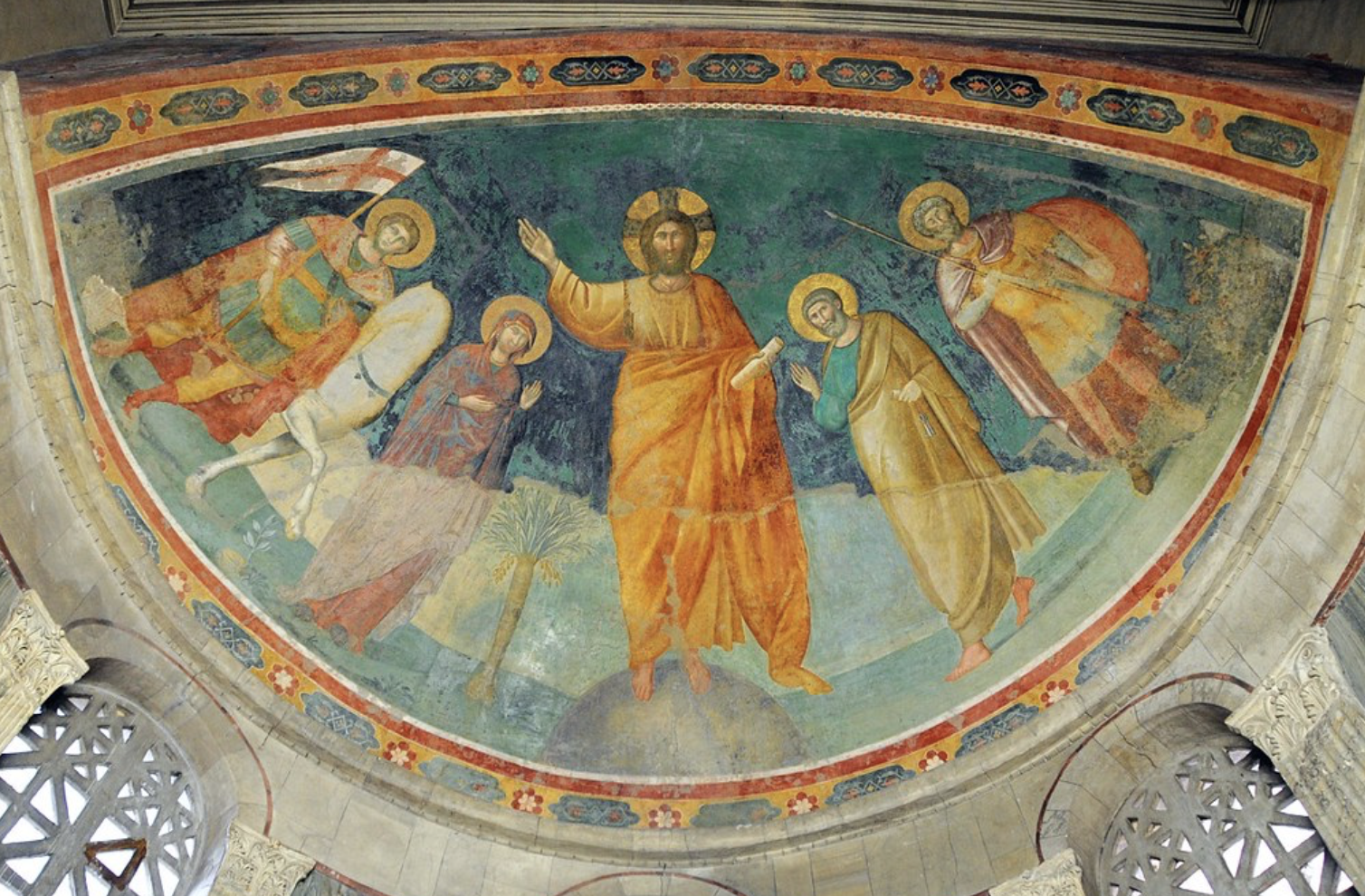
Thursday after Ash Wednesday: San Giorgio al Velabro
Tucked away in a quiet corner of Rome, near the ancient Forum Boarium, San Giorgio in Velabro stands as a silent witness to both the city’s legendary past and the Church’s enduring Lenten pilgrimage. Though often overlooked by visitors drawn to Rome’s grand basilicas, this humble yet historic church holds a special place in the Roman Station Church pilgrim itinerary presented by Crux Stationalis, serving as the first Thursday’s Lenten station church.
A Church at the Heart of Rome’s Legendary Beginnings
The Velabrum—the lowland between the Palatine and Capitoline Hills—was once a marshy area where the Tiber frequently overflowed. According to tradition, it was here that the she-wolf discovered and nursed Romulus and Remus, Rome’s legendary founders. Later, this district became a hub of early commerce, a fitting place for one of the city’s oldest Christian communities to take root.
The church itself dates back to at least the 7th century, though some scholars believe a house-church or oratory may have existed here even earlier. It was dedicated to St. George, the warrior-martyr venerated in both the East and the West, reinforcing the ancient Christian ties between Rome and Byzantium.
Architectural Continuity and Change
San Giorgio in Velabro remains one of the best examples of Rome’s early Christian architectural heritage. Unlike later Baroque churches that overwhelm with ornamentation, its simple, columned nave evokes the ascetic purity of the early Church. The columns themselves, taken from various Roman temples, reflect the city’s transformation from a pagan capital to the heart of Christendom.
The 13th-century portico, attributed to Stefano Stella, is a later medieval addition that enhances the church’s timeless character. The bell tower, added around the same time, echoes the Romanesque style seen in other churches of the era.
In the 1920s, architect Antonio Muñoz led a significant restoration, stripping away Baroque additions to restore the church’s medieval simplicity. The floor was lowered to its original level, ancient windows were reopened, and remnants of a schola cantorum—likely from Pope Gregory IV’s time—were uncovered, allowing modern pilgrims to step into a sacred space much as it was in the early centuries of Christianity.
A Church Scarred Yet Resilient
On the night of July 27, 1993, San Giorgio in Velabro was shaken by a terrorist bombing that nearly destroyed its medieval portico and caused a massive breach in its wall. The attack was widely believed to be linked to the Mafia’s tensions with the Vatican during the pontificate of John Paul II. The extensive damage required years of restoration, but the church—like the faith it represents—emerged renewed, bearing yet another layer of history upon its ancient stones.
The Lenten Station Church for the First Thursday of Lent
San Giorgio in Velabro is one of the 40 station churches of Rome, a tradition dating back to Pope St. Gregory the Great in the 6th century. Each year, on the first Thursday of Lent, the faithful gather here as part of the city’s great penitential pilgrimage.
As the Roman Station Church pilgrim itinerary with Crux Stationalis unfolds, this church reminds the pilgrim of the fortitude of St. George, the resilience of the early Christian community, and the unwavering witness of the Church throughout the ages. The modest yet ancient sanctuary, standing in the shadow of Rome’s pagan past, invites each visitor to take up their own spiritual combat, following in the footsteps of the saints who have gone before.
For those walking the Lenten road, San Giorgio in Velabro is not just a historical monument but a living signpost on the pilgrimage toward Easter—a quiet yet powerful reminder that the faith endures, even through fire and storm.
Come and visit the Church with Crux Stationalis in my YouTube video here:
If you appreciate our work you can become a Patron at our Patreon. Or, please consider a one time gift offering via PayPal.
 Crux Stationalis