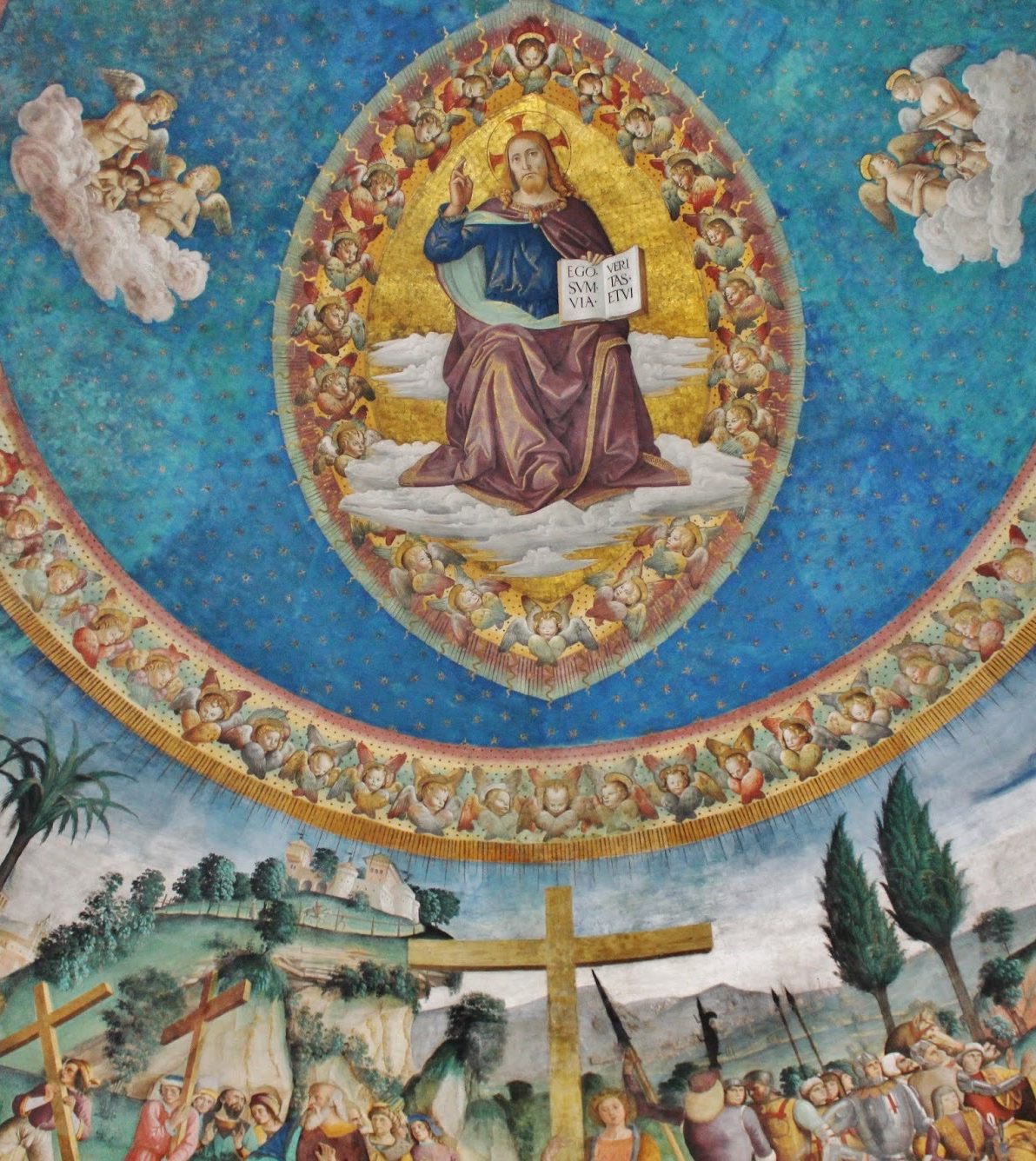
As we continue our Lenten pilgrimage through the station churches of Rome, we arrive at Santa Croce in Gerusalemme, the Basilica of the Holy Cross in Jerusalem. This magnificent church, one of the Seven Pilgrimage Churches of Rome, is particularly fitting for Laetare Sunday, the midpoint of Lent, when the Church pauses to rejoice before pressing forward to the Passion and Resurrection of Christ.
SPECIAL NOTE: Check out this beautiful notebook inspired by the fresco from today’s Station Church. You can purchase it: HERE.
Here is our Podcast for Santa Croce in Gerusalemme:
The Meaning of Laetare Sunday
Laetare Sunday, the fourth Sunday of Lent, takes its name from the first words of the Introit at Mass: Laetare, Jerusalem—“Rejoice, O Jerusalem.” This day, often called “Refreshment Sunday,” is a moment of spiritual reprieve within the penitential season of Lent. The Church lightens the somber mood by permitting the use of rose-colored vestments, signaling the nearness of Easter and the joy that awaits the faithful who persevere in their Lenten discipline.
The theme of the heavenly Jerusalem permeates the day’s liturgy. As Durandus explains, this Sunday “treats of the heavenly Jerusalem, and because we come into that land on the day on which the sons of Israel came into the Promised Land … therefore Exodus is now read.” The Exodus reading at Matins (Exodus 3:1-15) recounts God’s promise to deliver His people from Egypt, foreshadowing Christ’s victory over sin and death. Just as the Israelites journeyed from slavery to freedom, we too are journeying toward the heavenly Jerusalem, our true homeland.
The Station Church: Santa Croce in Gerusalemme
Santa Croce in Gerusalemme is an ideal place to contemplate this theme. The basilica was built to house the relics of the True Cross brought to Rome by St. Helena, the mother of Emperor Constantine. With its relics of the Passion—fragments of the True Cross, the nails, and thorns from Christ’s Crown—this church reminds us that our path to the heavenly Jerusalem is inseparable from the Cross.
Laetare Sunday, though a day of rejoicing, is not a call to abandon penance but rather a reminder that joy and suffering are intertwined. The Holy Cross, the instrument of suffering, is also the sign of our salvation. It is in this paradox that we find the essence of Christian hope.
The Music of the Liturgy: Tones of Rejoicing and Expectation
The music of Laetare Sunday reflects the balance between suffering and hope. The Introit, Laetare, Jerusalem, is sung in the fifth tone, a mode that expresses both uplifted joy and longing. Durandus tells us that this is because of “the five thousand men whom He refreshed” when Christ fed the multitude—a sign of the heavenly refreshment awaiting us. The Gradual, Laetatus sum, follows in the seventh tone, symbolizing the seventh age of the world, the eternal Sabbath when the saints will finally rest in the heavenly Jerusalem.
Yet, even in this moment of joy, the Tract reminds us of the trials of the Christian life: Qui confidunt in Domino sicut mons Sion—“They who trust in the Lord are like Mount Sion; he shall not be moved forever.” Durandus explains that because we are still in the age of labor, the Tract follows the Gradual, urging us to persevere.
The Readings: The Promise of Freedom
The Epistle (Galatians 4:22-31) presents the allegory of Sarah and Hagar, contrasting the old covenant of slavery with the new covenant of freedom in Christ. “That Jerusalem which is above is free, which is our mother,” St. Paul declares. This passage encapsulates the theme of Laetare Sunday—liberation from bondage, whether from sin, suffering, or the trials of this world, and the promise of eternal joy.
The Gospel (John 6:1-15) recounts the feeding of the five thousand, a miracle that prefigures the Eucharist, the true bread from heaven. Just as Christ nourished the crowd in the wilderness, He continues to sustain us on our pilgrimage toward the eternal feast of the Lamb.
Conclusion: Rejoicing in the Cross
Standing in Santa Croce in Gerusalemme, surrounded by relics of Christ’s Passion, we are reminded that our joy is not separate from the Cross but flows from it. Laetare Sunday is a foretaste of Easter, a glimpse of the joy that awaits those who remain faithful. The Holy Cross teaches us that suffering is not the end of the story—resurrection is.
As we continue through Lent, may this Sunday’s joy strengthen us to carry our crosses with renewed hope, knowing that beyond Good Friday lies Easter morning, and beyond this life, the eternal joy of the heavenly Jerusalem.
Laetare, Jerusalem! Rejoice, O Jerusalem!
To stay up-to-date with all our content from Rome and beyond make sure you are subscribed here:
If you need a helpful book of meditations for this Season of Lent, check out my publication of meditations on the Passion of Jesus written for young Passionist novices.
31 Days of Meditation on the Passion of Jesus: BUY NOW
If you appreciate our work you can become a Patron at our Patreon. Or, please consider a one time gift offering via PayPal.
See you tomorrow at Santi Quattro Coronati! Don’t forget to subscribe above with your email to receive our newest content straight to your email!
 Crux Stationalis
Jacob good morning. a friend of mine, Fr Peter Idler, gave me your name and links, suggesting that I contact you as I am making a trip to Rome in October. He suggested that I reach out and ask you if you do any private or individual tours, so I’m asking- do you? pls let me know
Thank you
Richard
LikeLike