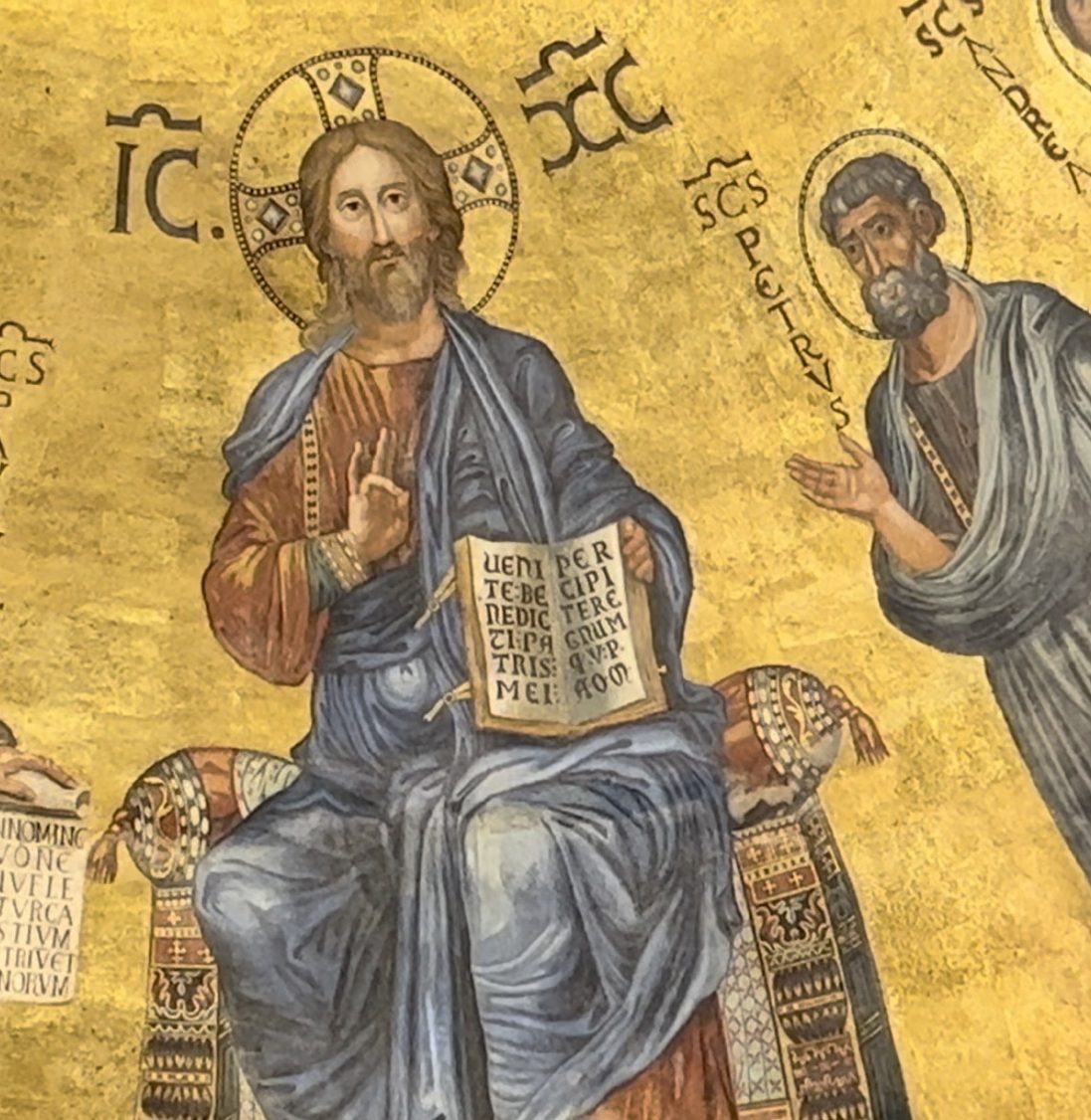
Station Church for Wednesday of the Fourth Week of Lent: San Paolo fuori le Mura, or St. Paul Outside the Walls, is one of the four major papal basilicas of Rome and the second-largest church in the city, after St. Peter’s Basilica. Built over the tomb of St. Paul, this grand and historic church has been a place of pilgrimage for nearly two millennia. Its origins date back to the time of Emperor Constantine, and its history is filled with periods of expansion, destruction, and restoration.
Podcast for St. Paul’s
The Origins of the Basilica and Constantine’s Construction
Following the Edict of Milan in 313 AD, Emperor Constantine the Great initiated the construction of churches over the tombs of the Apostles Peter and Paul. While St. Peter’s Basilica was erected over the Apostle’s burial site in Vatican Hill, a similar effort was made to honor St. Paul at the location of his tomb along the Via Ostiense. Constantine’s original church, completed around 324 AD, was relatively modest, featuring a single nave and a small apse over the Apostle’s grave.
The site of the basilica was already venerated by early Christians. It was believed that after St. Paul’s martyrdom—traditionally dated to 67 AD under Emperor Nero—his followers buried him along the Via Ostiense. By the 2nd century, a memorial shrine (cella memoriae) had been erected over his tomb, as attested by inscriptions from Pope Anicetus’ pontificate (155–166 AD) and later confirmed by Pope Damasus I (366–384 AD).
Expansion Under Theodosius I and the 5th Century Basilica
By the late 4th century, Constantine’s structure was deemed too small for the growing devotion to St. Paul. Under the patronage of Emperor Theodosius I, and later Emperors Valentinian II, Arcadius, and Honorius, the basilica was completely rebuilt and expanded into a magnificent five-aisled structure. Completed in 390 AD, this new basilica featured 80 columns, a grand nave, and an enormous triumphal arch, making it the largest church in Rome until the rebuilding of St. Peter’s in the Renaissance period.
This expansion solidified the basilica’s status as a major Christian pilgrimage site. Pope Leo the Great (440–461) further adorned it, commissioning stunning mosaics and enriching the interior with sacred relics.
The Medieval and Renaissance Periods: Devotion and Decline
Throughout the Middle Ages, San Paolo fuori le Mura continued to be a center of Christian worship. The monastery attached to the basilica, founded in the 6th century, became a prominent monastic institution under the Benedictines. However, the basilica also suffered from various attacks and neglect. During the 9th century, Pope John VIII (872–882) had to fortify it against Saracen raids, building defensive walls around the complex.
The basilica saw further renovations and embellishments in the Renaissance. Pope Martin V (1417–1431) restored parts of the decaying structure, and later Popes such as Gregory XIII (1572–1585) commissioned new works of art. However, despite these efforts, the basilica remained largely in its early medieval state.
The Fire of 1823 and the Rebuilding of the Basilica
The greatest disaster in the basilica’s history struck on July 15, 1823, when a massive fire broke out, destroying much of the original 4th-century structure. The disaster was caused accidentally during repair work on the roof. Almost all of the basilica’s ancient mosaics, artworks, and structural elements were lost.
Following the fire, Pope Leo XII (1823–1829) initiated an ambitious reconstruction project, determined to restore the basilica to its former grandeur. Contributions poured in from across the Christian world, including donations from Tsar Nicholas I of Russia, King Louis XVIII of France, and Emperor Francis I of Austria. The rebuilt basilica, consecrated by Pope Pius IX in 1854, faithfully preserved the layout and spirit of the original, incorporating salvaged elements wherever possible.
Architectural Features and Sacred Relics
The present-day San Paolo fuori le Mura retains its early Christian basilican layout, with a long nave, towering columns, and semicircular apse. Notable features include:
- The Triumphal Arch Mosaics – Preserved from the 5th century, depicting Christ with Saints Peter and Paul.
- The Cloister – A magnificent medieval addition by the Vassalletto family (13th century), showcasing exquisite Cosmatesque decorations.
- The Papal Portraits – A unique series of medallions depicting all popes from St. Peter to the present.
- The High Altar – Built over St. Paul’s tomb, featuring a gilded 13th-century ciborium designed by Arnolfo di Cambio.
- The Chains of St. Paul – Housed in the basilica’s reliquary, these chains are believed to have bound the Apostle during his imprisonment in Rome.
Modern Devotion and Significance
Today, San Paolo fuori le Mura remains a major pilgrimage destination, drawing visitors from around the world to venerate the Apostle Paul. The basilica continues to serve as an important center of Christian unity, hosting ecumenical gatherings, particularly during the annual Week of Prayer for Christian Unity.
Through centuries of triumph, devastation, and renewal, San Paolo fuori le Mura stands as a monument to faith and perseverance, a sacred place where pilgrims encounter the legacy of St. Paul’s mission, martyrdom, and eternal witness to Christ.
Enjoy our Video Tour
If you need a helpful book of meditations for this Season of Lent, check out my publication of meditations on the Passion of Jesus written for young Passionist novices.
31 Days of Meditation on the Passion of Jesus: BUY NOW
If you appreciate our work you can become a Patron at our Patreon. Or, please consider a one time gift offering via PayPal.
See you tomorrow at Sts. Sylvester and Martin in Monti! Don’t forget to subscribe above with your email to receive our newest content straight to your email!
 Crux Stationalis