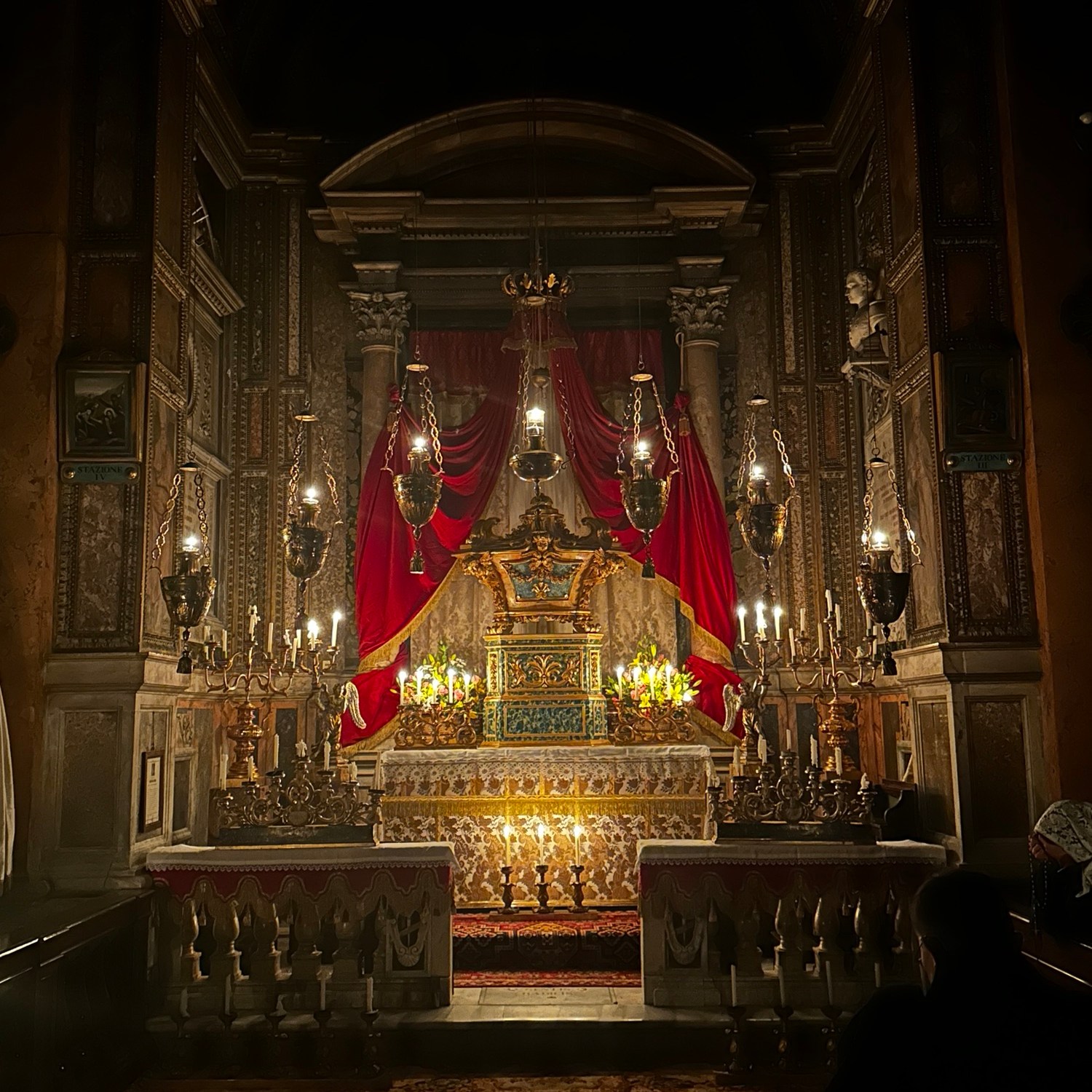
Good Friday’s Tenebrae:
Holy Saturday Tenebrae
As you can imagine, these days in Rome are quite busy. I haven’t been able to provide new podcasts for you this Holy Week.
Nonetheless, I’ve been praying for you.
Here are the video tours we have at Crux for Holy Week. I hope they provide some spiritual fruit for you during these days:
And the two martyrs for this week:
“How Lonely Sits the City”: A Meditation on Tenebrae and the Lamentations of Jeremiah
In the darkness of Holy Week, the Church offers one of her most poignant liturgies: Tenebrae. The name means “shadows,” and the rite lives up to it—a slow extinguishing of light, a descent into sorrow, silence, and the mystery of abandonment. At its heart are the Lamentations of Jeremiah, chanted in mournful tones that fill the candlelit church like the cry of a prophet from deep within the ruins.
The Book of Lamentations was written in the aftermath of the destruction of Jerusalem in 586 BC. The holy city has fallen. The Temple lies in ashes. The people are scattered or enslaved. Jeremiah, sometimes called the “weeping prophet,” gives voice to this devastation in poetry that is both raw and ordered—structured into acrostics, as if to impose form on the formlessness of grief.
During Tenebrae, the Church takes up Jeremiah’s laments and sees in them the mystery of Christ’s Passion. “Quomodo sedet sola civitas plena populo”—“How lonely sits the city, once full of people.” These are not just historical reflections on Jerusalem. They are the sorrow of the Church, the Mother of Sorrows, as she beholds the betrayal and crucifixion of her Lord. She watches, powerless, as the crowds turn on Him, the Temple of His Body is broken, and the world descends into night.
The Lamentations are sung with a haunting beauty, introduced by the Hebrew letters—Aleph, Beth, Gimel—drawn out in long, mournful tones. This ancient chant reminds us that the grief of Jerusalem is not forgotten; it is remembered, renewed, and fulfilled in Christ’s suffering. The fall of the holy city foreshadows the abandonment of the Son of God, left alone in Gethsemane, condemned, and crucified outside the walls.
But even in this sorrow, there is a strange hope. Jeremiah weeps for a city in ruins, yet he never despairs. His tears are offered as prayer. “The steadfast love of the Lord never ceases; His mercies never come to an end.” In Tenebrae, that faint hope is symbolized by the single candle that remains lit, hidden behind the altar. Christ, the Light of the World, is never fully extinguished, even in death. He descends into our darkest places, but He is not overcome.
The Lamentations teach us how to mourn. They give us permission to sit with loss, to name sorrow, to lament the brokenness in ourselves and the world. But they also teach us how to mourn with faith—trusting that God’s mercy is deeper than the ruins, and that out of desolation, redemption can rise.
Tenebrae does not resolve our grief—it sanctifies it. And in the chant of Jeremiah, the Church learns to sing even as she weeps, waiting for the dawn.
If you need a helpful book of meditations for this Season of Lent, check out my publication of meditations on the Passion of Jesus written for young Passionist novices.
31 Days of Meditation on the Passion of Jesus: BUY NOW
If you appreciate our work you can become a Patron at our Patreon. Or, please consider a one time gift offering via PayPal.
A blessed Holy Triduum to you all! Subscibe to stay up-to-date with Crux Stationalis content!
 Crux Stationalis