High on the Gargano Peninsula in southern Italy rises one of Christianity’s most ancient and revered sanctuaries: the Shrine of St. Michael the Archangel at Monte Sant’Angelo. Its origins trace back to the late 5th century, when the Archangel himself is said to have appeared in a series of visions that gave the site its unique status as the only church directly consecrated by heaven.
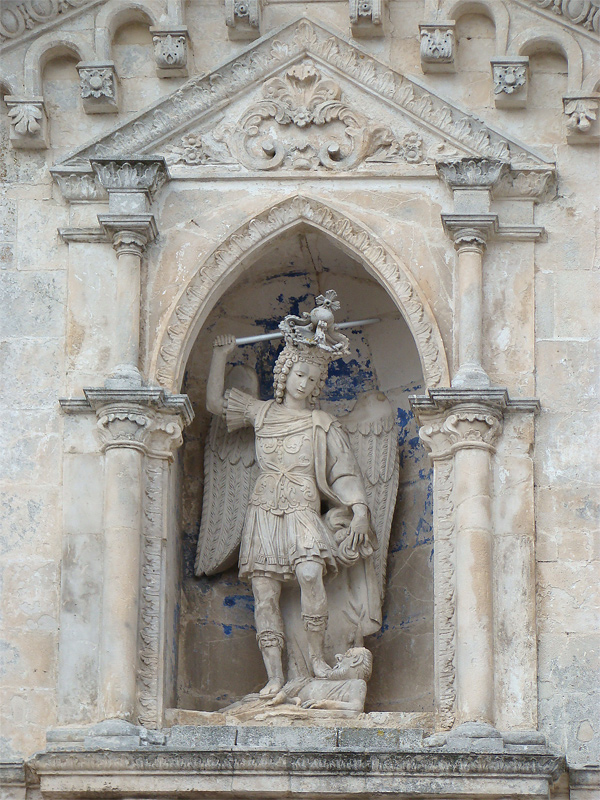
According to tradition, the first apparition took place around 490 A.D. when a wealthy landowner lost a prized bull on the rocky slopes of the Gargano. After days of searching, he found it kneeling inside a cave. Angered, he shot an arrow at the animal, but the arrow miraculously turned back upon the archer. Troubled, the local bishop prayed and fasted, and St. Michael appeared, declaring the cave to be under his protection. He announced that it was a place where sins would be forgiven and God honored.
Subsequent apparitions confirmed the site’s sanctity, especially in 493 A.D., when the archangel appeared again to the bishop of Siponto, urging him to dedicate the cave to Christian worship. When the bishop hesitated, St. Michael declared that no human hand was needed—he himself had already consecrated the shrine. Thus, unlike any other sanctuary, the grotto at Monte Sant’Angelo is believed to have been dedicated by heaven itself.
Since then, the Sanctuary of St. Michael has become a major pilgrimage destination, drawing popes, saints, and crusaders who sought the archangel’s protection. A popular pilgrimage site on the way to Jerusalem; pilgrims have travelled from as far as Ireland to visit the “Celestial Basilica”.
Among the pilgrims who visited the Saint Michael Archangel Sanctuary were many popes (Gelasius I, Leo IX, Urban II, Alexander III, Gregory X, Celestine V, John XXIII as Cardinal, John Paul II), saints (Bridget of Sweden, Bernard of Clairvaux, Thomas Aquinas), emperors, kings, and princes (Louis II of Italy, Otto III, Henry II, Matilda of Tuscany, Charles I of Naples, Ferdinand II of Aragon).
Francis of Assisi also visited the Sanctuary, but, feeling unworthy to enter the grotto, stopped in prayer and meditation at the entrance, kissed a stone, and carved on it the sign of the cross in the form “T” (tau).
The grotto, with its rough stone walls and centuries-old inscriptions, retains an atmosphere of awe and mystery, reminding pilgrims of the powerful message entrusted to this mountain: that St. Michael, the prince of the heavenly host, continues to defend God’s people and intercede for the faithful.
 Crux Stationalis