Each year on Jan. 21, the Church marks the feast of St. Agnes of Rome with a ritual that intertwines martyrdom, papal authority, and centuries of living tradition: the blessing of lambs whose wool will later be woven into the pallia worn by new metropolitan archbishops.
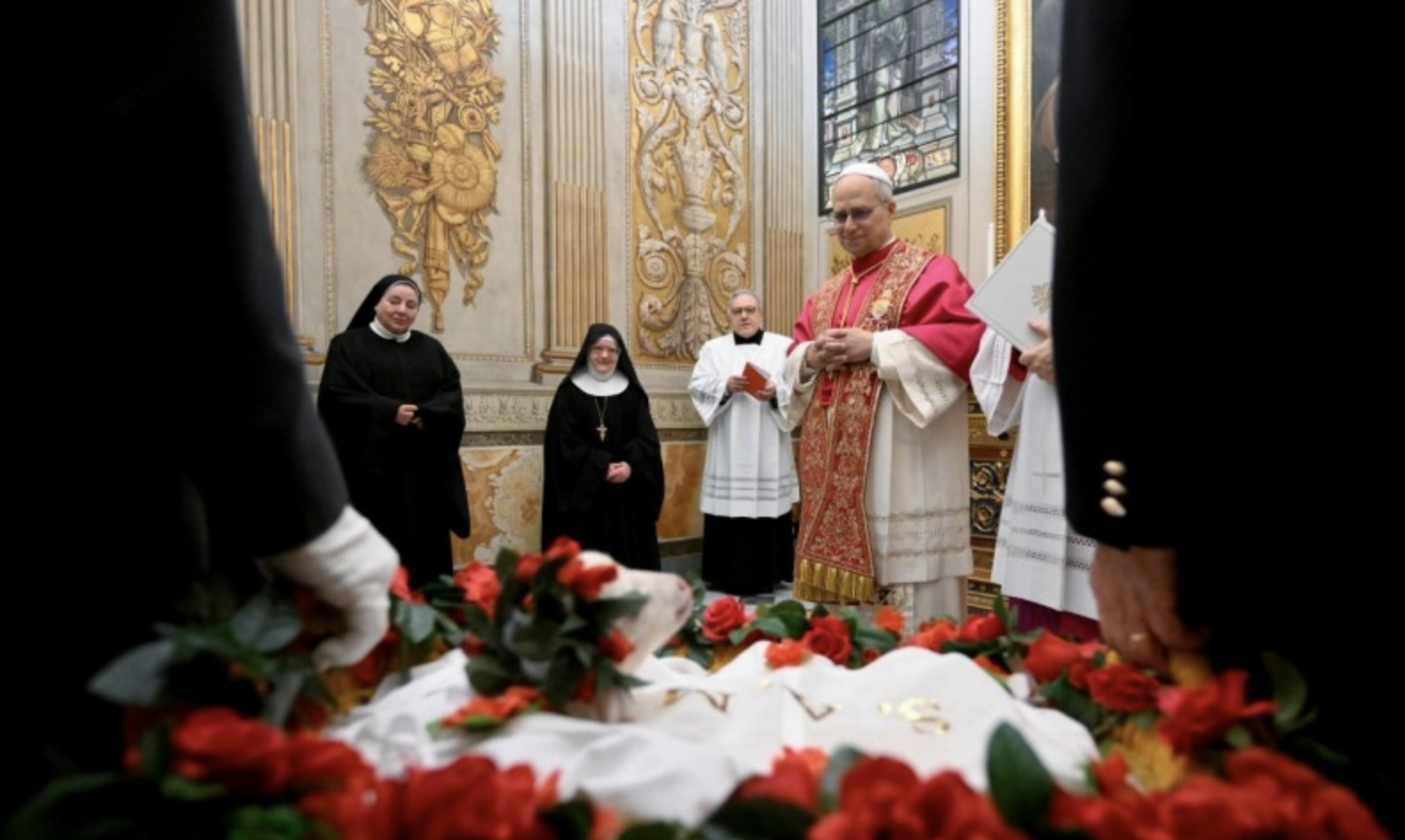
The ceremony takes place at the Basilica of St. Agnes Outside the Walls, built over the tomb of the young Roman martyr who was killed—tradition holds—at the beginning of the fourth century. The lambs blessed on her feast day will eventually provide the wool for the pallium, a liturgical vestment symbolizing both episcopal jurisdiction and the bond between the Pope and the metropolitan archbishops of the world.
Agnes, Lamb and Martyr
The symbolism begins with Agnes herself. Her name evokes both the Greek haghnòs, meaning “chaste” or “pure,” and the Latin agnus, “lamb.” That linguistic convergence, Christians have long noted, foreshadows her death: Agnes was executed by a sword thrust to the throat, in the same manner used to slaughter lambs.
In Christian iconography she is frequently depicted alongside a lamb, emblem of innocence and sacrifice, and holding a palm branch, the traditional sign of martyrdom. Agnes is also venerated as a saint of the young, remembered for her unwavering profession of faith and her declaration that Christ alone was her spouse.
Her feast day commemorates not only her death but also a tradition already attested in late antiquity. According to research cited by Father Franco Bergamin, abbot general of the Canons Regular of the Lateran, references from the fourth century describe the presence of a lamb at Agnes’s tomb on her feast day as a sign identifying the resting place of the saint. By the sixth century, sources already speak explicitly of the blessing of lambs at her tomb—a practice that has endured to the present.
From Lambs to Pallia
The lambs blessed on Jan. 21 provide the wool used to make the pallia, narrow white woolen bands worn over the shoulders by metropolitan archbishops. About five centimeters wide and curved to rest atop the chasuble, the pallium is decorated with six black silk crosses—one on each end and four along the curve—and fastened with jeweled pins front and back.
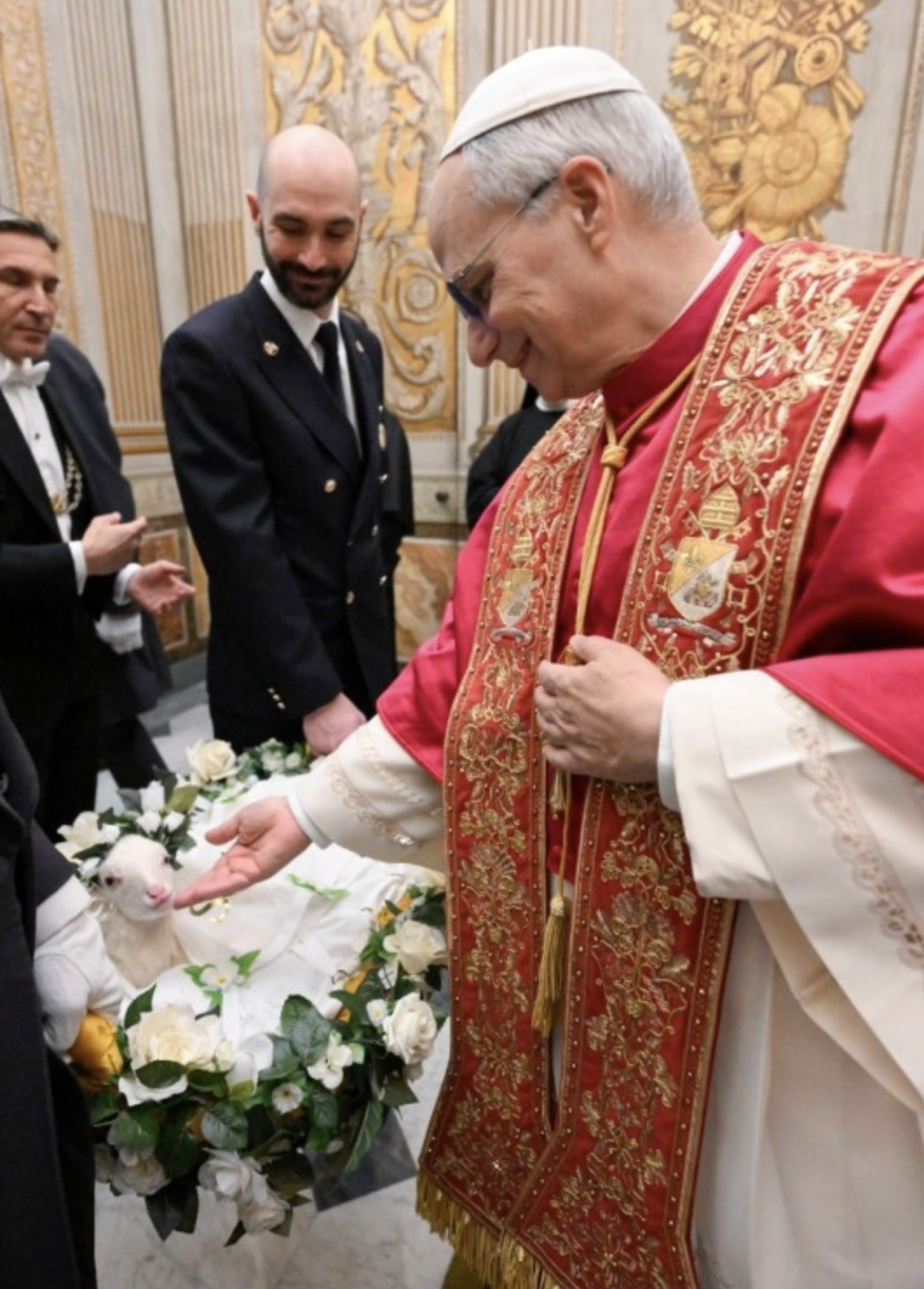
The pallium is both a sign of honor and a juridical symbol, expressing the special communion between the Pope and those archbishops who preside over ecclesiastical provinces. The pallia are solemnly blessed by the Pope each year on June 29, the Solemnity of Saints Peter and Paul, and either imposed by the Pope or later imposed on the archbishops in their own sees by the apostolic nuncio.
Historically, the lambs were procured by the canons of St. Agnes, with the Chapter of St. John Lateran providing the animals in gratitude for the canons’ service at the Lateran Basilica during major feasts. In earlier centuries, popes themselves often blessed the lambs before they were entrusted to the Benedictine nuns of St. Cecilia in Trastevere.
Care of the Lambs
Today, the lambs are donated to the Chapter of St. John Lateran by the Trappist monks of the Abbey of the Three Fountains in Rome. Until about twenty years ago, the monks raised the lambs themselves, but urban development has since made that impossible.
“We no longer raise the lambs,” said Father Emanuele Jablczynski, prior of the abbey, in an interview with Vatican News. “We purchase them directly from shepherds and then entrust them to the Sisters of the Holy Family of Nazareth.”
Those sisters prepare the lambs for the feast, washing and tending them and dressing them in symbolic garments: one lamb wears red, recalling Agnes’s martyrdom; the other wears white, signifying her virginity. Matching flower crowns are placed on their heads, and small bows adorn their ears. Each lamb is then placed in a basket and carried to the Basilica of St. Agnes.
During Mass celebrated by the abbot general of the Canons Regular of the Lateran, the lambs are placed on the altar above the relics of Agnes and of St. Emerentiana, her foster sister. Emerentiana, a catechumen preparing for baptism, was killed two days after Agnes when she was found praying at the martyr’s tomb and was stoned outside the church.
From Wool to Vestment
After the feast, the lambs are brought to the Benedictine monastery of St. Cecilia in Trastevere, where they are welcomed with the chant Isti sunt agni novelli (“These are the newly born lambs”). The nuns care for them attentively, even bottle-feeding them when necessary.
The monastery provides a dedicated space for the animals, complete with shelter, straw bedding, heat, water, and an enclosure where they can move freely. Shearing takes place in the spring, but work on the pallia begins immediately, as the process takes several months.
Transforming the wool from fleece to finished vestment involves washing, carding, combing, spinning, and finally weaving—still done entirely by hand by the nuns. The monastery uses a specialized loom designed specifically for the dimensions of the pallium; some of its wooden looms date back to the seventeenth century, while others were built in Prato in the last century.
Once the weaving is complete, black silk crosses are sewn onto the pallia. They are then delivered on June 24, the Solemnity of the Nativity of St. John the Baptist, to the Office for the Liturgical Celebrations of the Pope. The date recalls John the Baptist’s role as the one who pointed to Christ as the Lamb of God.
The wool from the two lambs blessed on St. Agnes’s feast is traditionally used for the Pope’s own pallium, with additional wool employed for the others. For the nuns, it is work carried out not simply as craftsmanship but as an act of devotion—marked by patience, care, and fidelity to the Church and to the Pope.
 Crux Stationalis