The Station of Lent’s First Day
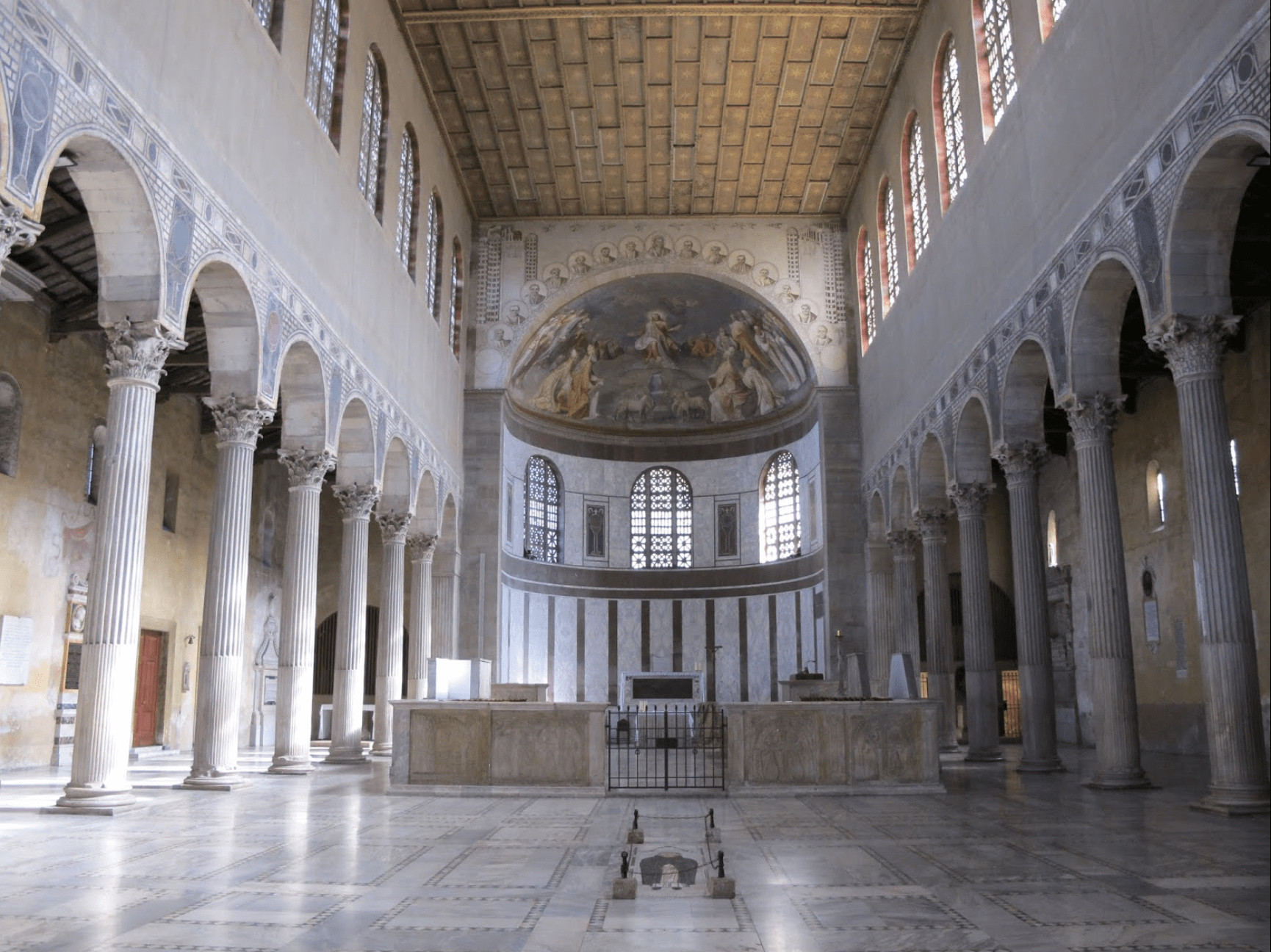
On Ash Wednesday, the Roman Church gathers at the Basilica of Santa Sabina all’Aventino, the first station church of Lent. Perched high on the Aventine Hill overlooking the Tiber, Santa Sabina marks the formal beginning of Rome’s Lenten pilgrimage. The ancient station tradition situates the Bishop of Rome at this basilica to inaugurate the penitential season, traditionally following a procession from nearby Sant’Anselmo. The ascent of the Aventine is not incidental; the geography reinforces the liturgical threshold. Lent begins uphill.
Today’s Video Tour of Santa Sabina
Fifth-Century Foundations
Santa Sabina was constructed between 422 and 432 AD by a priest named Peter of Illyria. It was established as a titulus under Pope Celestine I in 423. The church stands on what had been aristocratic Roman residences. Its dedication recalls Saint Sabina, traditionally identified as a Roman matron martyred under Hadrian. While the historical details of her life are sparse, the dedication is ancient and stable in the Roman liturgical record.
A Basilica Preserved in Form
Architecturally, Santa Sabina is one of the best-preserved examples of a fifth-century Christian basilica in Rome. The structure retains its original longitudinal plan: a wide nave, two side aisles, and a semicircular apse. Twenty-four Proconnesian marble columns with Corinthian capitals divide the nave from the aisles. These columns are spolia, reused from earlier Roman buildings, consistent with late antique construction practice. The nave clerestory windows, restored in the twentieth century to approximate their early form, flood the interior with direct light. The effect is austere and structural rather than decorative.
The Cypress Doors and Early Christian Iconography
The basilica’s most significant artistic survival is its wooden entrance doors, carved from cypress between 430 and 432. Originally composed of twenty-eight panels, eighteen remain. The reliefs depict scenes from both Old and New Testaments. Among them is one of the earliest surviving public representations of the Crucifixion of Christ with the two thieves. The figures are rendered without later iconographic elaboration. The panels constitute a primary witness to early Christian narrative art and theological emphasis in the decades after Constantine.
Medieval Adaptation and Dominican Custody
In the medieval period, Santa Sabina underwent fortification during times of instability. Its essential basilican form, however, was not fundamentally altered. In 1218–1222, Pope Honorius III granted the complex to the newly founded Order of Preachers. The adjacent convent became the Dominican headquarters. St. Dominic resided there until his death in 1221. The basilica remains the seat of the Dominican General Curia. Subsequent figures associated with the site include St. Thomas Aquinas and Pope Pius V, both Dominicans.
The Liturgical Point of Departure
As the Ash Wednesday station, Santa Sabina functions as the liturgical point of departure for Lent in Rome. The Pope’s presence there situates the season within the city’s ancient ecclesial geography. The church’s fifth-century fabric, Dominican custodianship, and continuity of worship make it both an archaeological constant and a living liturgical site. On the Aventine, Lent does not begin symbolically. It begins concretely — at a specific altar, in a basilica built before the fall of the Western Empire, under carved doors that have witnessed sixteen centuries of penitential procession.
Receive these articles daily in your inbox by subscribing here:
And please share this article with your family and friends — every share helps our fellow Catholic brothers and sisters discover Rome’s most ancient treasures, and hopefully brings edification through the liturgical season of Lent.
The full Lenten itinerary can be found here at the sticky post with links to every video tour of the Roman Station Churches available at Crux Stationalis.
 Crux Stationalis