The First Thursday Station of Lent
San Giorgio in Velabro is the Roman station church for the Thursday after Ash Wednesday, one of the earliest steps in the city’s traditional Lenten itinerary. The station system assigns specific churches to each day of Lent, rooting the season not in abstract devotion but in the topography of Rome itself. On this day, the Church gathers in the Velabrum, a low-lying zone at the edge of the ancient civic center, where early Christian worship developed in close proximity to Rome’s oldest commercial and political spaces.
Today’s Video Tour of San Giorgio in Velabro
The Velabrum: Where Rome Flooded and Traded
The church stands in the area historically known as the Velabrum, a marshy basin formed by the Tiber’s flooding, between the Palatine Hill and the Capitoline slope. In antiquity this district was tied to the Forum Boarium, Rome’s cattle market and one of the city’s earliest hubs of trade. San Giorgio’s location places it in a zone where pagan Rome was intensely present: near monumental arches, temples, and the old routes of civic procession. The Christian station liturgy here is a deliberate act of sanctifying geography.
Foundation and Early Medieval Rome
The church is traditionally connected to the late seventh century. Its foundation is associated with Pope Leo II (682–683), placing it in the period when Rome’s liturgy and church-building were increasingly shaped by Greek-speaking clergy and Eastern Christian influence. This context matters because the church’s dedication is to Saint George, one of the most widely venerated military martyrs of the Christian East. The cult of George took root strongly in Rome during these centuries, and the church became a focal point for that devotion.
The dedication also included Saint Sebastian, another martyr deeply embedded in Roman Christian memory. Over time, however, the identity of the church consolidated around Saint George, and the basilica became one of the principal Roman sites associated with his veneration.
Relics and the Cult of Saint George
San Giorgio in Velabro is tied to the strengthening of Saint George’s cult in Rome through the translation of relics in the eighth century. Pope Zacharias (741–752) is associated with bringing relics of Saint George to the church. In the Roman imagination, the presence of relics was not decorative; it established a church as a real locus of intercession and a concrete anchor for the liturgical calendar. The station assignment of this church in early Lent reflects that status.
Architecture: A Church Built Into Ancient Rome
San Giorgio in Velabro is architecturally irregular. Its plan is not a clean rectangle but a slightly trapezoidal shape, the result of building constraints and successive reconstructions. The church is physically embedded into ancient Rome: the Arcus Argentariorum, a third-century monument, stands directly beside and is visually integrated with the church’s entrance zone. This is not a modern juxtaposition; it is medieval Rome’s normal condition—Christian worship set into the bones of the imperial city.
The building’s most significant early medieval rebuilding is linked to Pope Gregory IV (827–844), under whom major restorations and structural elements were introduced. The church’s medieval character was further shaped by later Romanesque work, including its distinctive multi-story brick bell tower, a hallmark of twelfth-century Rome.
Interior Features and Later Restorations
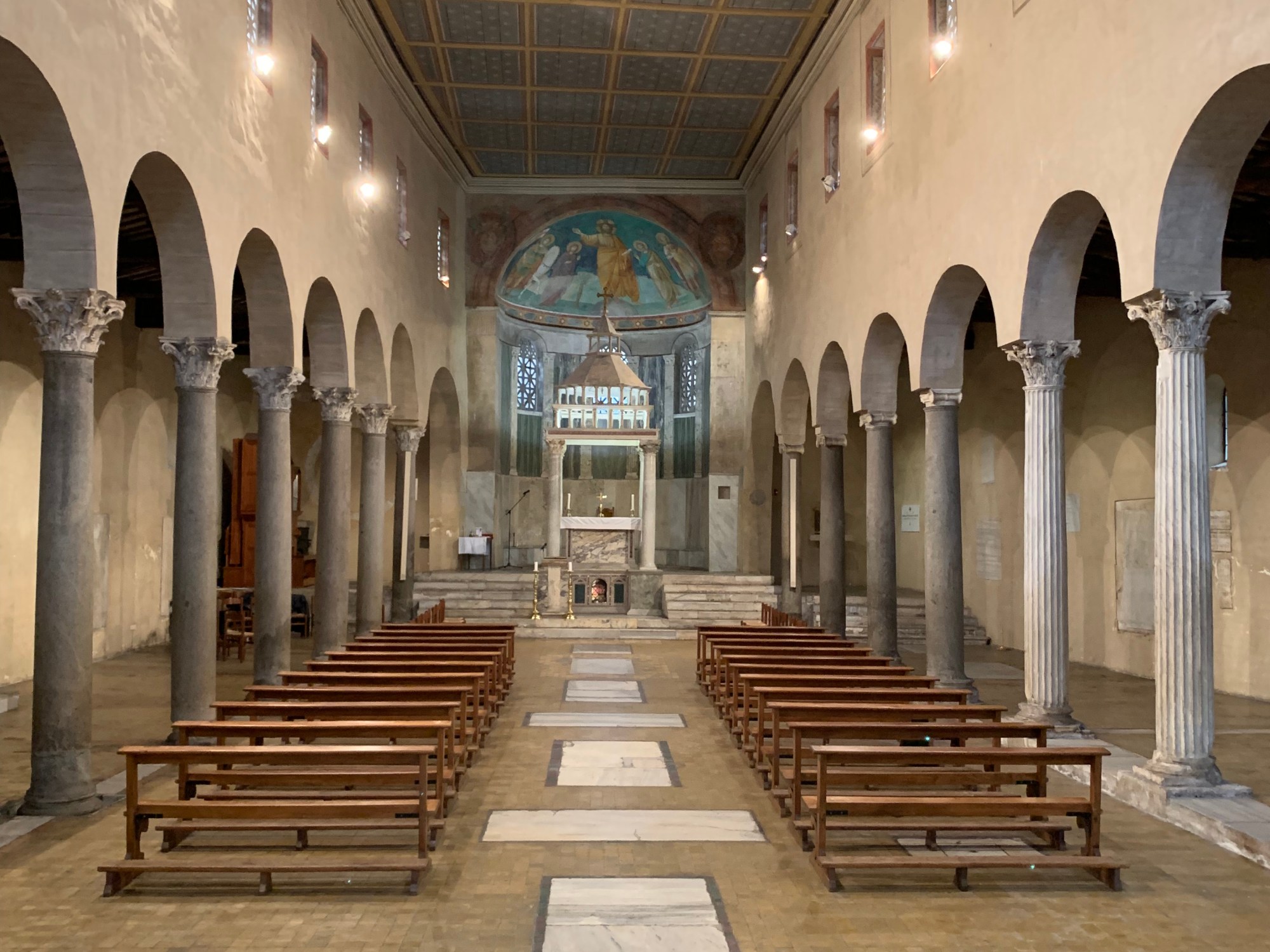
Inside, San Giorgio preserves the essential basilican arrangement: nave and aisles divided by reused columns. The apse was historically decorated with medieval fresco work, including a prominent Christological composition with saints. In the twentieth century, major restoration campaigns sought to strip back later additions and recover the medieval form, reopening windows and resetting floor levels closer to their earlier state. During this work, evidence of an early schola cantorum—the enclosed choir space used for chant—was identified, with surviving fragments retained in the church.
1993: Bombing and Repair
San Giorgio in Velabro also carries modern scars. In 1993, a bomb exploded near the church, damaging the portico and façade zone. Restoration followed, but the event remains part of the church’s lived history: an early medieval station church that has not simply survived time, but has been struck by it.
The Station Meaning
As the station church for the Thursday after Ash Wednesday, San Giorgio in Velabro is a precise Roman choice: early medieval in foundation, Eastern in dedication, and physically lodged in the infrastructure of pagan Rome. Historically, it belongs to the moment when the city’s liturgy was being stabilized into the daily discipline of the stational cycle, and when Rome’s devotion was expanding to include the great martyrs of the wider Christian world. Theologically, the station here insists that Lent begins not with private resolve but with the Church assembled — ekklesia — in a specific place, around a specific altar, under the sign of martyrs whose witness is older than the city’s Christian monuments. In the Velabrum, where Rome once traded, flooded, and processed in honor of its gods, the Lenten liturgy asserts a different order of history: the Cross planted in the civic center, the saints set as Rome’s true guardians, and the work of conversion undertaken not as an individual project but as the common labor of a people being gathered into unity.
Receive these articles daily in your inbox by subscribing here:
And please share this article with your family and friends — every share helps our fellow Catholic brothers and sisters discover Rome’s most ancient treasures, and hopefully brings edification through the liturgical season of Lent.
The full Lenten itinerary can be found here at the sticky post with links to every video tour of the Roman Station Churches available at Crux Stationalis.
 Crux Stationalis