The First Saturday Station of Lent
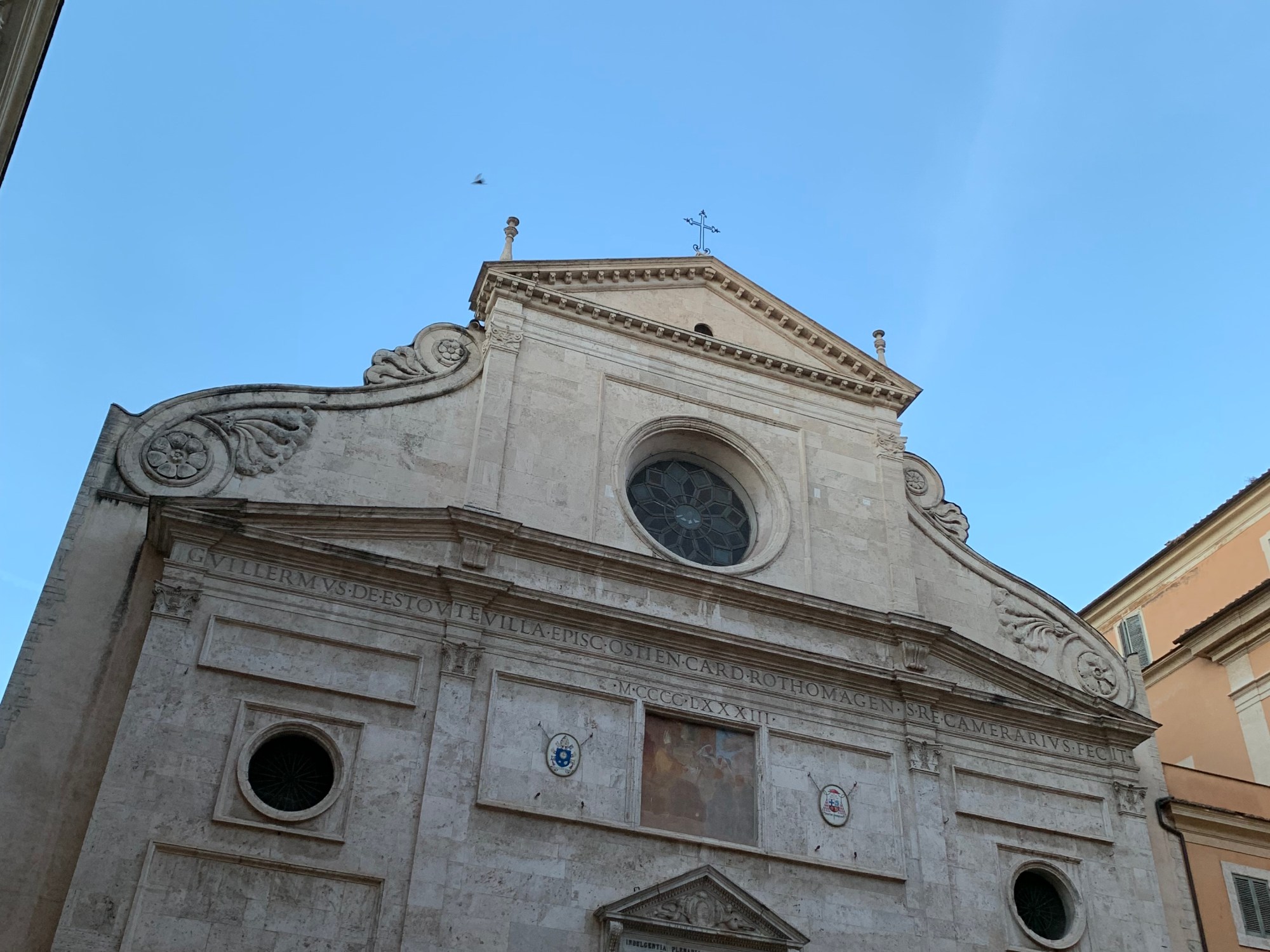
For the Saturday after Ash Wednesday, the Roman station tradition brings the Church to Sant’Agostino in Campo Marzio, in the heart of the historic Campus Martius. The station assigned to this day was once San Trifone in Posterula; when that church disappeared, the title and Lenten assignment passed to Sant’Agostino. The transfer preserved the continuity of the stational map while anchoring the day in one of Rome’s principal Augustinian churches.
Today’s Video Tour of Sant’Agostino
An Augustinian Foundation
Sant’Agostino is not simply dedicated to Saint Augustine — it is an Augustinian church, long entrusted to the Order of Saint Augustine (O.S.A.). The Augustinians established their presence here in 1286, when land was donated for a convent. Shortly thereafter, they were granted use of the nearby church of San Trifone. As the community grew, a larger and more fitting church became necessary.
The Augustinian identity of Sant’Agostino takes on particular contemporary resonance with the election of Pope Leo XIV, the first Augustinian Pope. The church dedicated to Augustine, served by his Order, now stands within the living memory of a pontificate shaped by Augustinian formation — a fact that gives added weight to its place in the Roman Lenten itinerary.
Construction and Renaissance Rebuilding
The present basilica owes its form to late 15th-century reconstruction. Pope Boniface VIII initiated plans for a new church in 1296, but the decisive rebuilding occurred under Pope Sixtus IV. Between 1479 and 1483, architects Giacomo di Pietrasanta and Sebastiano Fiorentino, financed largely by Cardinal Guillaume d’Estouteville, completed the structure that stands today.
Sant’Agostino became one of the earliest Renaissance churches in Rome. Its travertine façade was built using stone taken from the Colosseum, a common Renaissance practice that physically incorporated imperial ruins into Christian architecture. The façade presents balanced classical lines, later adjusted with Baroque modifications.
Architectural Structure
The church follows a three-nave Latin cross plan, with a transept and deep side chapels. The spatial arrangement reflects early Renaissance order and clarity rather than medieval layering. In the 18th century, Luigi Vanvitelli made structural modifications to the convent and dome area, contributing to the church’s present appearance.
The basilica also holds the tomb of Saint Monica, mother of Saint Augustine. Her relics were translated here in 1424, establishing Sant’Agostino as a site of pilgrimage linked directly to Augustine’s own life and conversion narrative.
Artistic Patrimony
Sant’Agostino is known for significant Renaissance and Baroque artworks. It houses Caravaggio’s Madonna of the Pilgrims (Madonna di Loreto) in the Cavalletti Chapel — a work that depicts the Virgin appearing to humble pilgrims in contemporary dress. On a pillar of the left nave is Raphael’s Prophet Isaiah (1512). The high altar, redesigned by Gian Lorenzo Bernini in 1627, preserves a revered Byzantine Madonna and Child, traditionally associated with Santa Sofia in Constantinople.
Multiple side chapels contain works by major Roman artists of the 16th and 17th centuries, embedding the church firmly within Rome’s artistic development.
The Station Significance
As the station church for the Saturday after Ash Wednesday, Sant’Agostino situates the early days of Lent within an Augustinian framework: conversion, grace, and the restless heart seeking God. Historically, it preserves the continuity of a displaced station. Architecturally, it marks Rome’s turn toward Renaissance clarity. Ecclesially, it stands as the mother church of an Order that now counts the reigning Pope among its sons.
In the Campus Martius — amid dense Renaissance streets — Lent pauses at the altar of an Augustinian basilica, under the name of the Doctor of Grace, in a church that now carries renewed significance in the age of Pope Leo XIV.
Receive these articles daily in your inbox by subscribing here:
And please share this article with your family and friends — every share helps our fellow Catholic brothers and sisters discover Rome’s most ancient treasures, and hopefully brings edification through the liturgical season of Lent.
The full Lenten itinerary can be found here at the sticky post with links to every video tour of the Roman Station Churches available at Crux Stationalis.
I propose two works for your Lenten meditations and beyond Lent to concentrate your prayer on the Passion of Christ and his Love for you in His Passion: 31 Days of Meditations on the Passion written by a Passionist Father and Flowers of the Passion by St. Paul of the Cross.
 Crux Stationalis