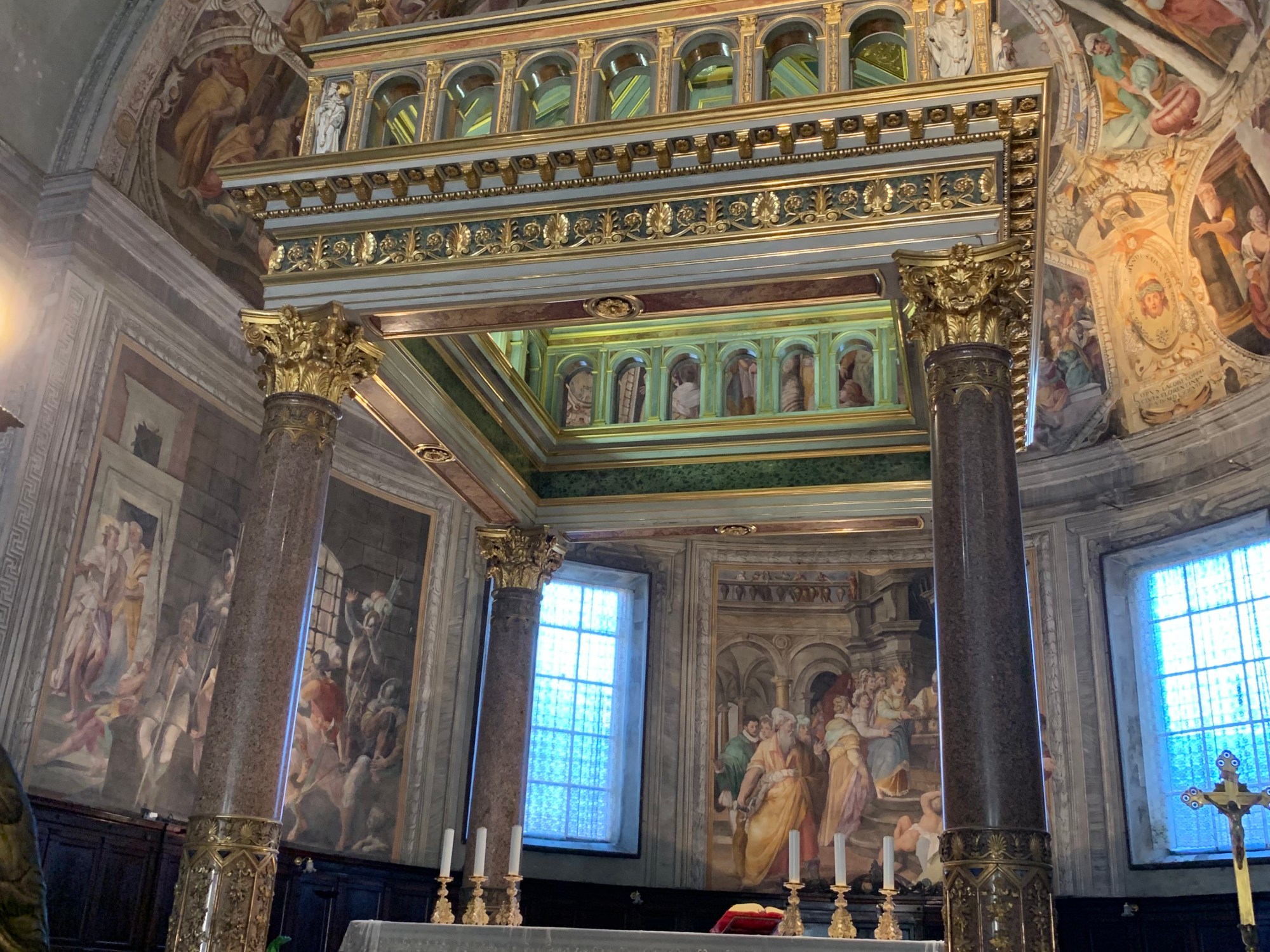
Lenten Station in Rome
On the Monday of the First Week of Lent, the Roman stational tradition directs the faithful to San Pietro in Vincoli — the Basilica of Saint Peter in Chains. This assignment places one of Rome’s most historic churches at the center of early Lenten observance, continuing the city’s ancient liturgical rhythm that began on Ash Wednesday and moves through the first week of the penitential season.
Video Tour of San Pietro in Vincoli
Location and Identity
San Pietro in Vincoli stands on Via Cavour in rione Monti, near the northern slope of the Esquiline Hill. It is a major basilica, a parish church, and a titular church in the College of Cardinals. The dedication honors Saint Peter and his chains, drawing immediate attention to liberation and authority — central motifs in the Church’s theology and Roman identity.
The Chains of Saint Peter
The basilica’s primary claim to fame is its relic of the chains that bound Saint Peter during his imprisonment in Jerusalem. Two separate chains are preserved: one attributed to that Jerusalem imprisonment and the other to Peter’s captivity in Rome. According to early Christian tradition, Pope Leo I (440–461) discovered the Roman chain and later brought the Jerusalem chain to Rome, uniting the two. These combined relics have made the church a focus of pilgrimage for centuries.
The image and meaning of the chains — vincoli — underscore the Lenten themes of captivity and freedom, sin and redemption. The believer entering the church on this Monday of Lent is confronted, without ambiguity, with the historical memory of Peter bound and then freed — a story that echoes the Paschal narrative.
Foundation and Early History
The basilica was originally founded in the 5th century under Pope Leo I, making it one of the earliest Christian foundations in the northern portion of Rome’s ancient core. The church stood near the ancient Clivus Suburanus — a principal thoroughfare of late antique Rome — and was part of a broader program of basilicas built during Leo’s pontificate.
Over the centuries, San Pietro in Vincoli has undergone multiple renovations and expansions, but its core identity has endured: a place fixed in memory, tied to the apostolic witness of Peter and the lived tradition of the Roman Church.
Michelangelo’s Moses and Artistic Patrimony
San Pietro in Vincoli houses one of the most iconic works of Renaissance sculpture: Michelangelo’s Moses, completed circa 1513–1515. The statue is part of the tomb commissioned for Pope Julius II. Michelangelo’s Moses — seated, muscular, and compelling — has become one of the defining sculptural images of the high Renaissance. It stands in the church’s Julius II tomb ensemble, accompanied by figures depicting the prophets and allegorical figures.
The presence of Michelangelo’s work draws scholars, pilgrims, and visitors alike, but within the station tradition the focus remains oriented toward the liturgical function of the basilica and its place in the life of the Church.
Architecture and Spatial Arrangement
The basilica follows a basilican plan with a high central nave flanked by side aisles. The interior maintains a sense of early Christian spatial logic, even as later Baroque and Renaissance elements — altars, chapels, and decorative programs — were added through subsequent centuries.
Several chapels along the side aisles contain significant artworks and devotional foci, but the central axis of the church remains oriented toward the high altar, directly over the location of the relics of Peter’s chains.
Titular Church and Parish Life
San Pietro in Vincoli has long been a cardinalatial title church, assigned to cardinal-priests whose role in the Roman Church’s governance reflects the church’s historical and liturgical prominence. As a parish, it also serves the faithful of the surrounding neighborhood, integrating everyday Christian life with the station’s Lenten role.
The Station Significance
On the Monday of the First Week of Lent, San Pietro in Vincoli stands as a locus of memory, pilgrimage, and theological focus. The chains of Peter — relics of bondage and liberation — confront the Lenten pilgrim with the concrete reality of sin, captivity, and the hope of freedom in Christ. In Rome’s stational sequence, this basilica continues the ancient practice of ordering the season of conversion around specific places, anchored in scripture, tradition, and the lived history of the Church.
Receive these articles daily in your inbox by subscribing here:
And please share this article with your family and friends — every share helps our fellow Catholic brothers and sisters discover Rome’s most ancient treasures, and hopefully brings edification through the liturgical season of Lent.
The full Lenten itinerary can be found here at the sticky post with links to every video tour of the Roman Station Churches available at Crux Stationalis.
I propose two works for your Lenten meditations and beyond Lent to concentrate your prayer on the Passion of Christ and his Love for you in His Passion: 31 Days of Meditations on the Passion written by a Passionist Father and Flowers of the Passion by St. Paul of the Cross.
 Crux Stationalis