The Lenten Station in Rome
On the Wednesday of the First Week of Lent, the ancient Roman stational tradition brings the faithful to Santa Maria Maggiore, the principal Marian basilica of Rome. As one of the city’s major papal basilicas, this church functions not only as a liturgical station in the penitential season but also as a central locus of Marian devotion in the life of the Church.
Video Tour of Santa Maria Maggiore
Status and Dedication
Santa Maria Maggiore — literally “Saint Mary the Greater” — is one of the four major papal basilicas in Rome, as well as the largest Catholic church in the city dedicated to the Blessed Virgin Mary. It is also known by alternate titles that reflect its traditions: Santa Maria della Neve (“Our Lady of the Snows”) from its foundation legend, and Santa Maria ad Praesepe (“of the Manger”) because of its relic of the Nativity. The basilica serves as a titular church, a major parish, and a site of continuous Roman worship and pilgrimage.
Early Christian Origins
The origins of Santa Maria Maggiore date to the 5th century, built soon after the Council of Ephesus affirmed Mary as Theotokos, Mother of God. Tradition holds that the basilica was founded following a miraculous snowfall on the Esquiline Hill in midsummer — August 5 — which marked the outline for the church’s plan. The present core structure was consecrated under Pope Sixtus III (432–440). These origins make Santa Maria Maggiore one of the earliest major Christian churches dedicated to Mary in the Western world.
Architectural Evolution
Santa Maria Maggiore’s architecture reflects more than fifteen centuries of building history. The Romanesque bell tower, standing at about 75 meters, is the tallest in Rome and dates to the 14th century. The basilica’s façade in its current form was completed in the mid-18th century by Ferdinando Fuga. Inside, massive marble columns — spolia from ancient Roman structures — separate the wide central nave from its side aisles. The basilica’s plan remains a classic early Christian basilica: a tall central nave with clerestory lighting and a semicircular apse at the east.
Mosaics and Artistic Patrimony
Santa Maria Maggiore preserves extraordinary mosaics from the 5th century along the nave and triumphal arch, among the oldest cycles of Christian mosaic in Rome. These depict scenes from the Old Testament and from the life of Christ. A later series of mosaics in the apse, commissioned by Pope Nicholas IV (1288–1292) and executed by Jacopo Torriti, illustrate Marian themes — including the Coronation of the Virgin — and mark one of the earliest extant iconographic programs dedicated to Mary in Western art.
Relics and Devotional Focus
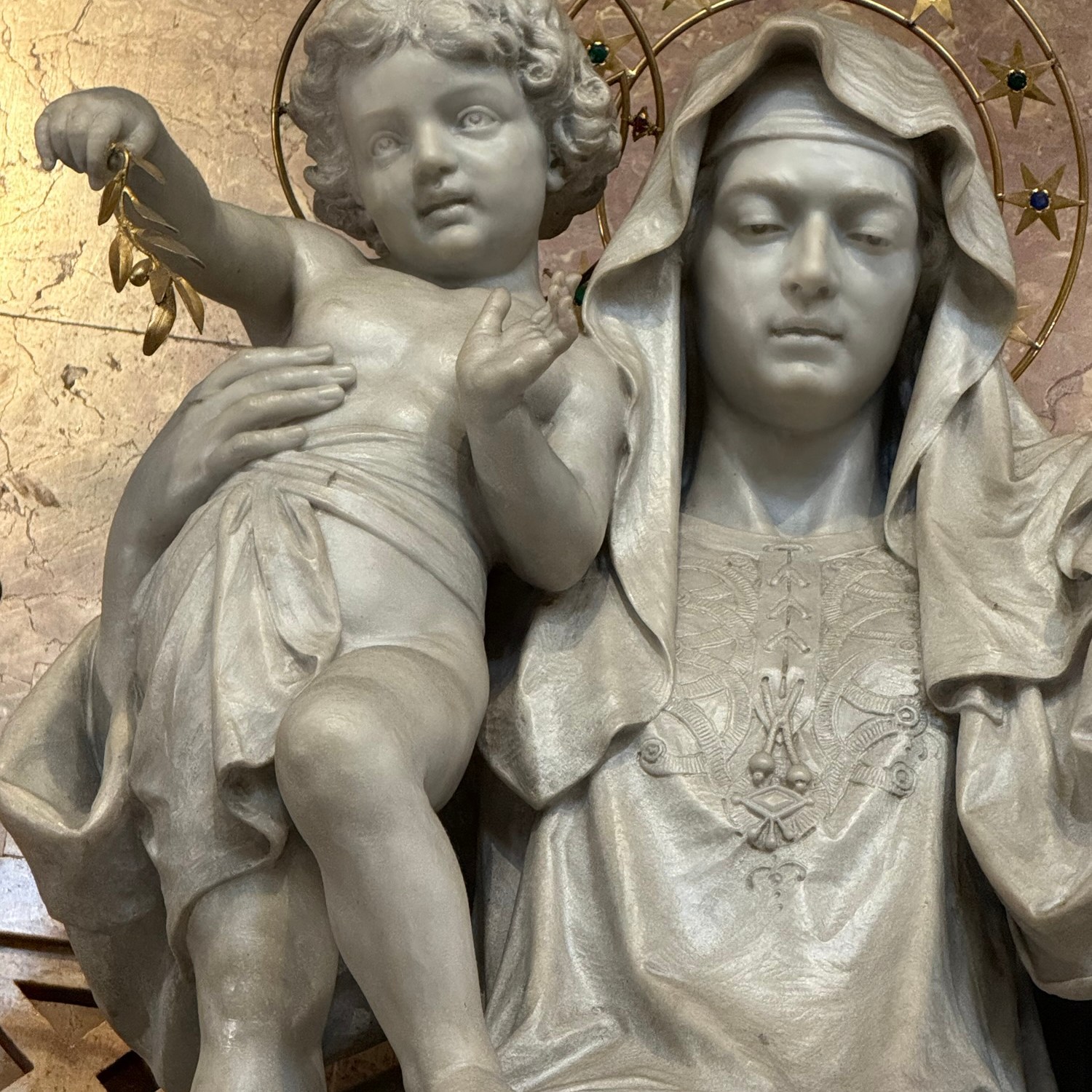
Beneath the high altar is the relic of the Holy Crib, believed to contain portions of the manger in which Jesus was laid at Bethlehem. This relic gives Santa Maria Maggiore the title Santa Maria ad Praesepe and underscores the basilica’s connection to the mystery of the Incarnation. The basilica also houses the Salus Populi Romani, a venerated icon of the Virgin Mary regarded as a protector of the Roman people. Both relic and icon have been focal points of papal devotion and public prayer.
Papal and Ecclesial Role
As a papal basilica, Santa Maria Maggiore plays a role in the liturgical life of the universal Church. Popes preside there on principal Marian feast days and it has long been a center of Roman Catholic worship and pilgrimage. The basilica also contains tombs of several popes and stands today as a major site of ecclesial memory and devotion.
The Station Significance
On the Wednesday of the First Week of Lent, Santa Maria Maggiore anchors the Church’s penitential journey at the threshold of the season’s midpoint. The station here places the Lenten pilgrimage in the light of Marian faith: from the Incarnation, preserved and venerated in relic and icon, to the ongoing call to conversion and deeper union with Christ. In Rome’s ritual map, this basilica remains a concrete locus where history, devotion, and the Lenten call to repentance converge.
Receive these articles daily in your inbox by subscribing here:
And please share this article with your family and friends — every share helps our fellow Catholic brothers and sisters discover Rome’s most ancient treasures, and hopefully brings edification through the liturgical season of Lent.
The full Lenten itinerary can be found here at the sticky post with links to every video tour of the Roman Station Churches available at Crux Stationalis.
I propose two works for your Lenten meditations and beyond Lent to concentrate your prayer on the Passion of Christ and his Love for you in His Passion: 31 Days of Meditations on the Passion written by a Passionist Father and Flowers of the Passion by St. Paul of the Cross.
 Crux Stationalis