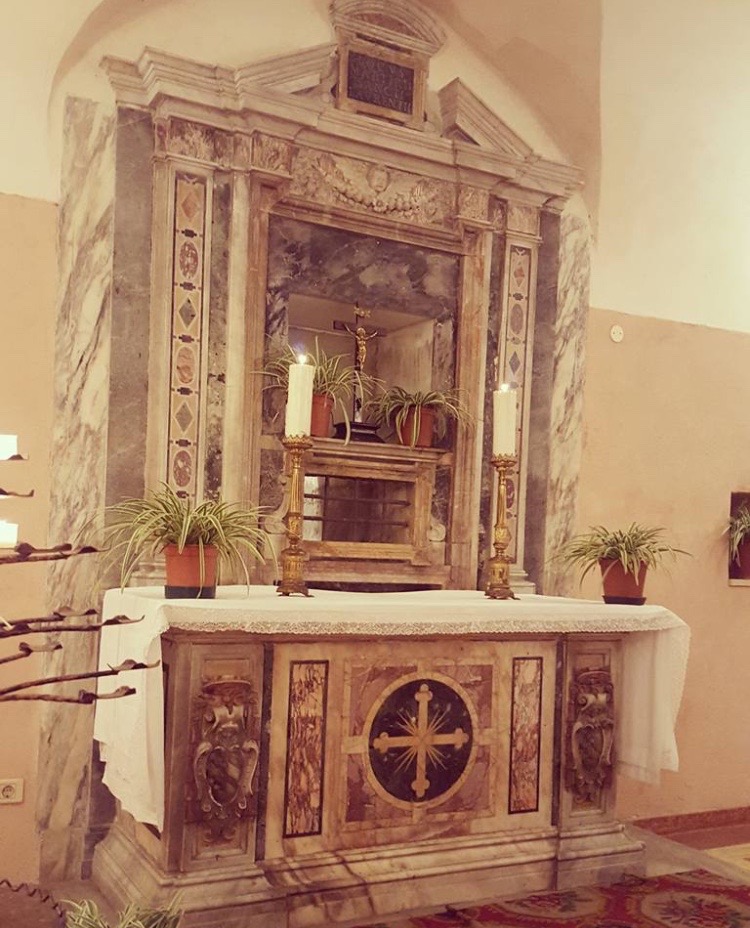
The Lenten Station
On the Thursday of the First Week of Lent, the Roman Church’s ancient stational tradition brings the faithful to San Lorenzo in Panisperna. This station is rooted in Rome’s early practice of assigning specific basilicas and titular churches to particular days of Lent, connecting the city’s geography with the rhythm of penitential worship.
Video Tour of San Lorenzo in Panisperna
Dedication and Location
San Lorenzo in Panisperna is a Roman Catholic church located at Via Panisperna 90 in the rione Monti of central Rome. It is dedicated to Saint Lawrence, the 3rd-century Roman deacon and martyr who remains one of the city’s most venerated saints. The church holds the status of titular church and stational church, and today it continues to serve as an active parish with regular liturgical celebrations.
Historical Origins
The site’s Christian significance predates the current structure. Tradition holds that the original church here was constructed on or near the spot of Saint Lawrence’s martyrdom, which occurred in 258 AD during the persecutions under Emperor Valerian. While documentary evidence of a church on the site appears only in the medieval period, the location’s long association with Lawrence’s death and veneration made it a fitting place for worship and pilgrimage.
In early medieval catalogues the church was known as San Lorenzo in Formoso, and it remained among the churches visited in Rome’s ancient station liturgy on the Thursday after the first Sunday of Lent.
Rebuilding and Architectural Development
The present church owes its core design to a 16th-century rebuilding ordered by Pope Gregory XIII and executed by architect Carlo Rainaldi in 1575–1576. It was during this period that the name “in Panisperna” became fixed, replacing its earlier designation. The façade constructed at that time still survives and gives the church its recognizable street presence.
Subsequent architectural additions include a 17th-century outer portico, which was restored and decorated in the late 19th century with images of Saint Lawrence and Saint Francis of Assisi. In 1893–1894, Pope Leo XIII — himself once ordained bishop in this church — added a steep flight of steps leading to a tree-lined courtyard in front of the basilica.
Interior and Artistic Patrimony
San Lorenzo in Panisperna’s interior is organized as a single nave with three chapels on each side. The high altar features a significant late 16th-century fresco depicting the Martyrdom of Saint Lawrence, painted by Pasquale Cati, a pupil of Michelangelo. A 14th-century crucifix stands near the altar, anchoring the church’s devotional focus on the passion and witness of the martyr.
Side chapels contain a range of later artworks: on the south side are a painting of Saint Clare of Assisi and the tomb of Saints Crispin and Crispinianus, with works by Antonio Nessi and Giovanni Francesco Romano; on the north side are depictions of the Stigmata of Saint Francis and the Chapel of Saint Bridget of Sweden, where the saint once prayed and begged for the poor before her body was translated back to Sweden. A martyr named Victoria is now interred beneath the altar of the Bridget chapel.
Under the church’s porch is a small chapel housing the forno or oven believed to have contained the gridiron on which Lawrence was martyred — a tangible connection to the site’s foundational witness.
Titular Status and Ecclesial Role
San Lorenzo in Panisperna has been a cardinalatial title since 1517, and its current titular cardinal-priest is Cardinal Michael Michai Kitbunchu. The church’s role in the Roman station liturgy reaffirms its continued liturgical importance, especially during Lent when the faithful are called into a daily pattern of pilgrimage and prayer tied to Rome’s early Christian heritage.
The Station Significance
As the stational church for the Thursday of the First Week of Lent, San Lorenzo in Panisperna anchors the Church’s journey in a location inseparable from the testimony of a martyr. Its historical origins, architectural evolution, artistic treasures, and concrete link to the story of Saint Lawrence make it a definitive locus for reflection on sacrifice, charity, and the cost of discipleship during the penitential season.
Receive these articles daily in your inbox by subscribing here:
And please share this article with your family and friends — every share helps our fellow Catholic brothers and sisters discover Rome’s most ancient treasures, and hopefully brings edification through the liturgical season of Lent.
The full Lenten itinerary can be found here at the sticky post with links to every video tour of the Roman Station Churches available at Crux Stationalis.
I propose two works for your Lenten meditations and beyond Lent to concentrate your prayer on the Passion of Christ and his Love for you in His Passion: 31 Days of Meditations on the Passion written by a Passionist Father and Flowers of the Passion by St. Paul of the Cross.
 Crux Stationalis