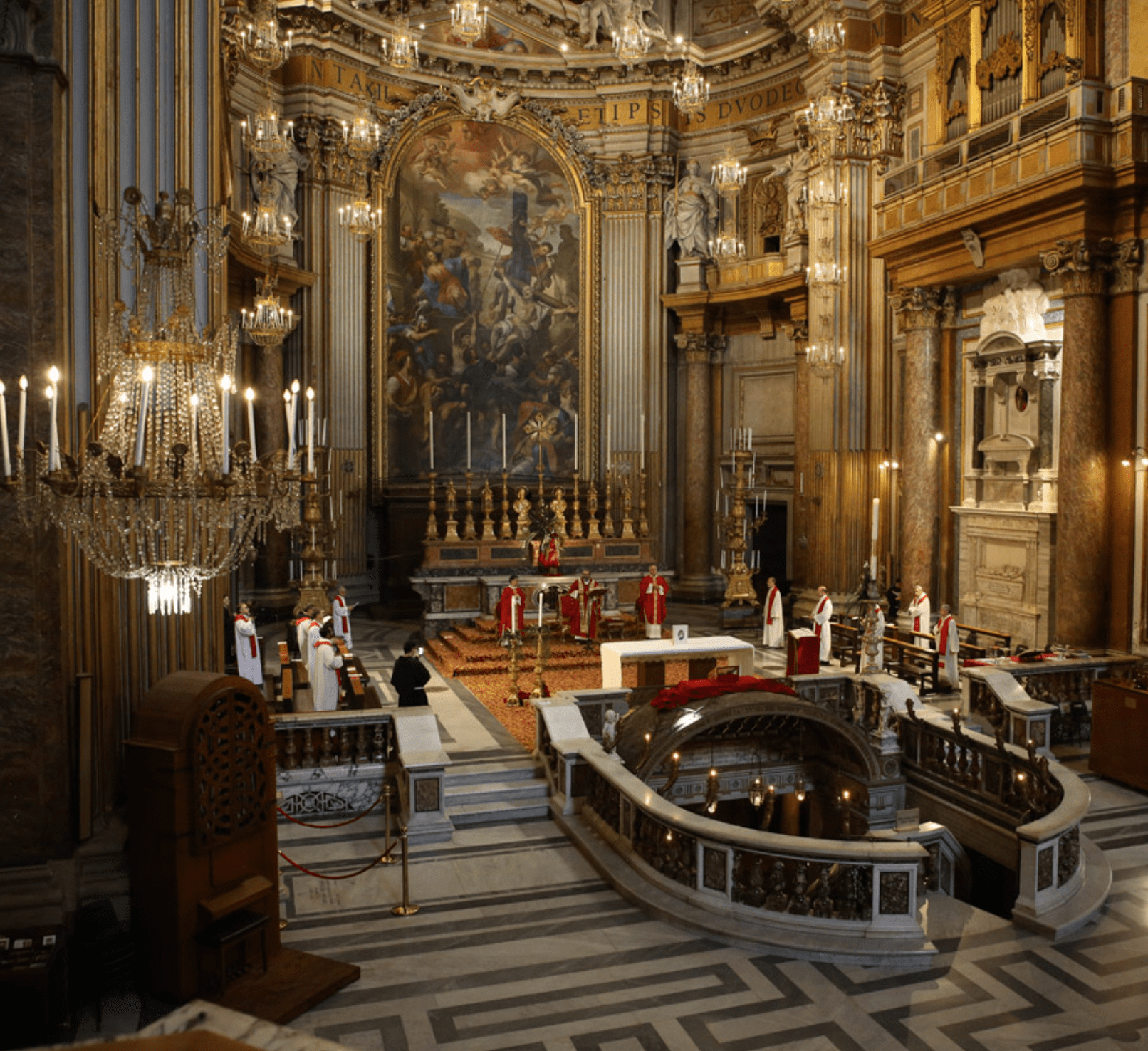
The Lenten Station and the Ember Tradition
On the Friday of the First Week of Lent, the Roman stational tradition brings the faithful to Santi Apostoli — the Basilica of the Holy Apostles. This day also coincides with the traditional Lenten Ember Days (Quattuor Tempora), the quarterly days of fasting and prayer observed in the Roman Rite to sanctify the seasons and invoke God’s blessing upon the Church’s ministers and the fruits of the earth. The convergence is deliberate: penitence, apostolic witness, and prayer for the Church’s life meet in a basilica dedicated to the Twelve.
Video Tour of Santi Apostoli
Dedication and Location
Santi Apostoli stands on Via della Pilotta in the rione Trevi, near Piazza Venezia and the Quirinal slope. It is dedicated collectively to the Twelve Apostles, emphasizing the unity of the apostolic college rather than a single patron. The church functions as a minor basilica, parish, and titular church, maintaining both local pastoral activity and a defined place in Rome’s ecclesial structure.
Early Foundation
The first church on this site dates to the 6th century, founded under Pope Pelagius I (556–561). This period followed the Gothic Wars, when Rome’s urban fabric was still recovering from devastation. Establishing a church dedicated to the Apostles in this context reinforced continuity with the foundational witnesses of the faith during a time of political instability.
The basilica appears in early medieval records and liturgical lists, confirming its importance among Rome’s established worship sites.
Carolingian and Medieval Development
In the 8th century, during the pontificate of Pope Hadrian I (772–795), the church underwent significant restoration. This period of Carolingian influence strengthened ties between Rome and the Frankish world, and rebuilding projects reinforced Rome’s identity as the apostolic center of Western Christendom.
Throughout the medieval period, Santi Apostoli remained active as a titular church and liturgical center. Its dedication to the Apostles made it a natural focal point for themes of mission, preaching, and ecclesial continuity.
Renaissance Reconstruction
The present structure largely reflects a 16th-century rebuilding initiated under Pope Julius II. The project is attributed to Giuliano da Sangallo, with later involvement by Michelangelo, who contributed refinements to the architectural proportions and interior articulation.
The façade visible today was constructed between 1668 and 1675, designed by Carlo Rainaldi under Pope Clement IX. It presents a restrained Baroque elevation with Corinthian pilasters and a central pediment, bearing the inscription honoring the Apostles.
Interior and Artistic Program
The interior follows a basilican plan with a wide central nave and side aisles. Multiple chapels are dedicated to individual apostles, reinforcing the collective titular theme. Marble revetments, sculptural tombs, and Baroque altarpieces contribute to the visual coherence of the space without obscuring its liturgical orientation.
The high altar anchors the basilica’s devotional life and serves as the focal point during the Lenten station. Tombs of cardinals and significant ecclesiastical patrons reflect centuries of Roman clerical association with the church.
Ember Day Context
The Friday of the First Week of Lent traditionally forms part of the Spring Ember Days, observed as days of fasting and prayer. Historically, Ember Days were also associated with priestly ordinations, linking them directly to apostolic succession. Holding this Ember station at Santi Apostoli underscores that connection: the Church fasts and prays under the patronage of the Apostles, asking for fidelity in ministry and fruitfulness in mission.
The Station Significance
As the station church for this Ember Friday, Santi Apostoli situates early Lent within apostolic continuity. The Apostles represent the Church’s foundation; the Ember fast emphasizes purification and renewal. In Rome’s stational map, this basilica unites penance, prayer for the Church’s ministers, and remembrance of the apostolic mission — concrete, historical, and liturgically fixed in place.
Receive these articles daily in your inbox by subscribing here:
And please share this article with your family and friends — every share helps our fellow Catholic brothers and sisters discover Rome’s most ancient treasures, and hopefully brings edification through the liturgical season of Lent.
The full Lenten itinerary can be found here at the sticky post with links to every video tour of the Roman Station Churches available at Crux Stationalis.
I propose two works for your Lenten meditations and beyond Lent to concentrate your prayer on the Passion of Christ and his Love for you in His Passion: 31 Days of Meditations on the Passion written by a Passionist Father and Flowers of the Passion by St. Paul of the Cross.
 Crux Stationalis