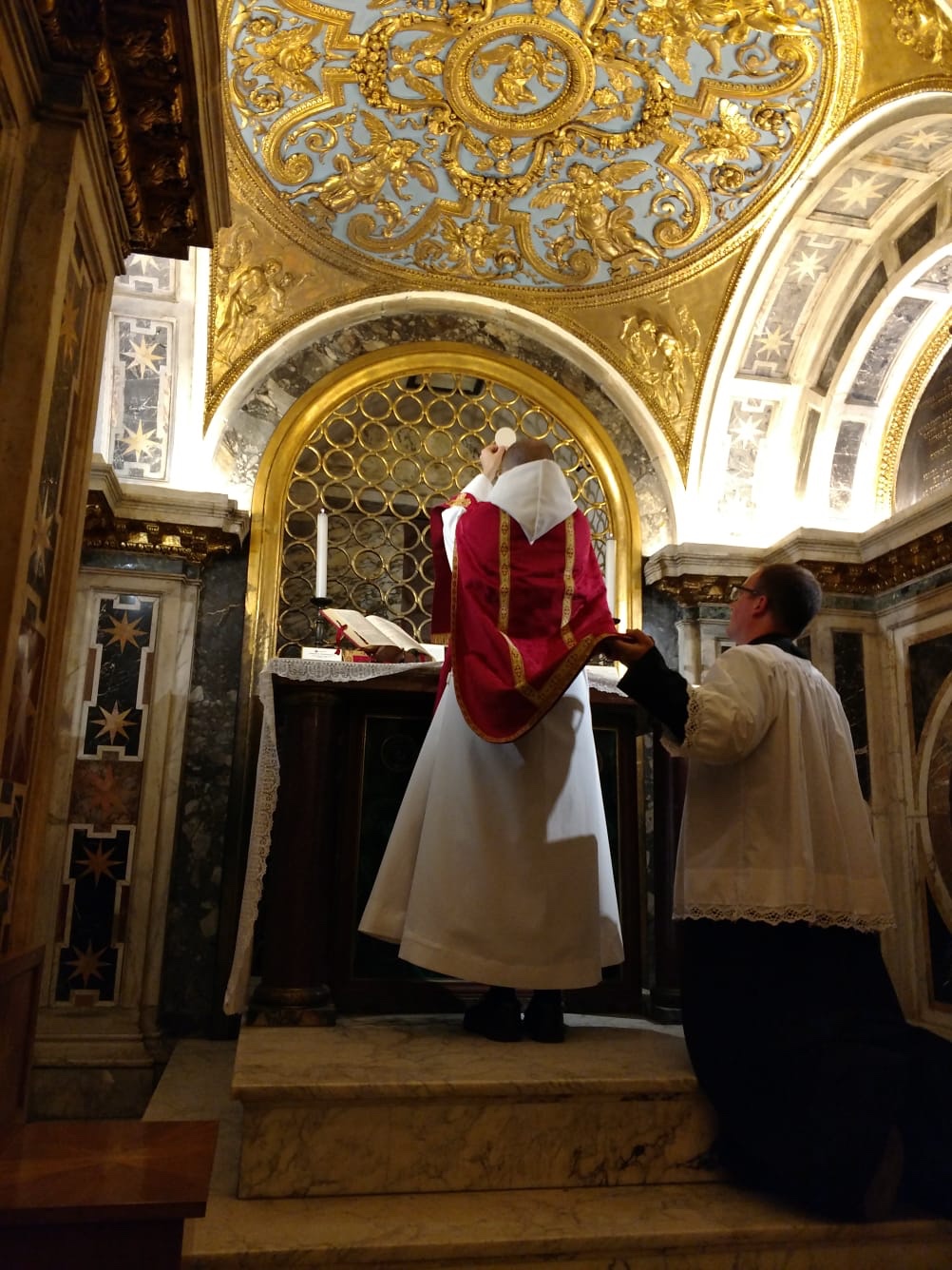
The Lenten Station at the Tomb of Peter
On the Saturday of the First Week of Lent, the Roman stational tradition brings the faithful to San Pietro in Vaticano, the basilica erected over the tomb of Saint Peter the Apostle. From the earliest centuries, this site has marked the apostolic foundation of the Church in Rome. To make station here in the opening days of Lent is to anchor the penitential journey at the grave of the prince of the Apostles, where martyrdom, succession, and universal communion converge.
The original basilica was constructed in the 4th century under Emperor Constantine, directly above the burial place venerated as Peter’s tomb. That Constantinian structure stood for over a millennium before the present basilica was built beginning in the early 1500s. The current church, shaped by Bramante, Raphael, Michelangelo, and Carlo Maderno, preserves the apostolic locus while expanding it into the monumental form known today.
The Lance of Saint Longinus
Distinctive to this Lenten station is the veneration of the Holy Lance of Saint Longinus, traditionally identified as the spear that pierced Christ’s side at the Crucifixion. The Gospel of John recounts that after Jesus had died on the Cross, a soldier thrust a lance into His side, and “immediately there came out blood and water” (Jn 19:34). Early Christian tradition named this soldier Longinus and associated him with conversion after witnessing the events of Calvary.
A relic believed to be part of this lance was brought to Rome in 1492 and has since been preserved in Saint Peter’s Basilica. It is housed within one of the great piers beneath the dome, near the colossal statue of Saint Longinus sculpted by Gian Lorenzo Bernini in the 17th century. The physical placement of the relic under the crossing situates it near the high altar and the tomb of Peter, visually and spatially linking the Passion of Christ with the apostolic foundation of the Church.
The Lenten Exposition Rite
On this Saturday of the First Week of Lent, the lance is solemnly exposed during the station liturgy. The rite includes a formal procession and the presentation of the relic for veneration. The ceremony emphasizes meditation on the Passion in the earliest days of the penitential season. The chanting of traditional hymns, including the Vexilla Regis, reinforces the focus on Christ’s suffering and kingship.
This exposition is not a devotional addition but part of Rome’s inherited Lenten discipline. The early weeks of Lent gradually intensify attention on the Passion, and the veneration of the lance places before the faithful the concrete sign of Christ’s pierced side — the moment from which the Fathers of the Church saw the birth of the sacraments symbolized in blood and water.
Architectural and Liturgical Context
Saint Peter’s Basilica follows a Latin cross plan, crowned by Michelangelo’s dome. Beneath that dome stand the four great pier chapels, each historically associated with Passion relics. The Lance of Longinus occupies one of these chapels, forming part of a carefully constructed devotional axis that integrates relic, sculpture, and liturgical movement.
The high altar, beneath Bernini’s baldachin, stands directly over the tomb of Saint Peter. During the station Mass, the faithful gather within this space where apostolic witness and Passion memory intersect.
The Station Significance
As the station church for this day, San Pietro in Vaticano directs the first week of Lent toward the mystery of Christ’s pierced side. The tomb of Peter recalls apostolic martyrdom; the lance recalls the wound of the Crucified. In Rome’s stational rhythm, Lent advances not abstractly but through places and relics that embody the history of salvation.
Here, at the center of the Church, the faithful contemplate the wound from which redemption flowed — and the season moves steadily toward Holy Week.
Receive these articles daily in your inbox by subscribing here:
And please share this article with your family and friends — every share helps our fellow Catholic brothers and sisters discover Rome’s most ancient treasures, and hopefully brings edification through the liturgical season of Lent.
The full Lenten itinerary can be found here at the sticky post with links to every video tour of the Roman Station Churches available at Crux Stationalis.
I propose two works for your Lenten meditations and beyond Lent to concentrate your prayer on the Passion of Christ and his Love for you in His Passion: 31 Days of Meditations on the Passion written by a Passionist Father and Flowers of the Passion by St. Paul of the Cross.
 Crux Stationalis