The Lenten Station and the Gospel of the Day
On the Second Sunday of Lent, the Roman stational tradition brings the faithful to Santa Maria in Domnica, one of the oldest Marian tituli in the city. The Gospel proclaimed at Mass on this Sunday is the Transfiguration of the Lord — Christ revealed in glory before Peter, James, and John. The station here unites the liturgical proclamation of that mystery with a basilica whose art and architecture visually reinforce themes of divine manifestation.
The Roman Rite assigns the Transfiguration to this Sunday. After the temptations of the First Sunday, the Church presents a foretaste of glory: Christ radiant, the Father’s voice heard, the disciples overshadowed by the cloud. The station at Santa Maria in Domnica situates that proclamation within a church historically associated with Sunday worship.
Video Tour of S. Maria in Domnica
The Meaning of “Domnica”
The title in Domnica is commonly linked to Dominicae Ecclesiae titulus — the “title church of the Lord’s Day.” This association with Sunday liturgy is significant. On the Sunday when the Church hears the Gospel of Christ’s radiant glory, the faithful assemble in a basilica whose name itself evokes the Lord’s Day.
The popular designation alla Navicella comes from the ancient marble boat placed in the piazza before the church. Yet the older liturgical name emphasizes its connection to Sunday worship rather than to the sculpture.
Early Christian Foundation
Santa Maria in Domnica originated as a titulus in the late 4th or early 5th century. It appears in early medieval catalogues of Roman churches and represents one of the early parish foundations of Christian Rome. Its dedication to the Virgin Mary places it within the expanding Marian devotion of late antiquity, particularly after doctrinal clarification of Mary’s role in salvation history.
The church was significantly restored in the 9th century under Pope Paschal I, who commissioned major decorative programs that still define its interior.
Architectural Structure and Mosaics
The basilica follows a traditional early Christian basilican plan: a central nave with side aisles divided by columns, terminating in an apse. The nave is covered by a richly painted coffered wooden ceiling, added in a later period, while the floor and columns preserve the continuity of Roman ecclesiastical architecture.
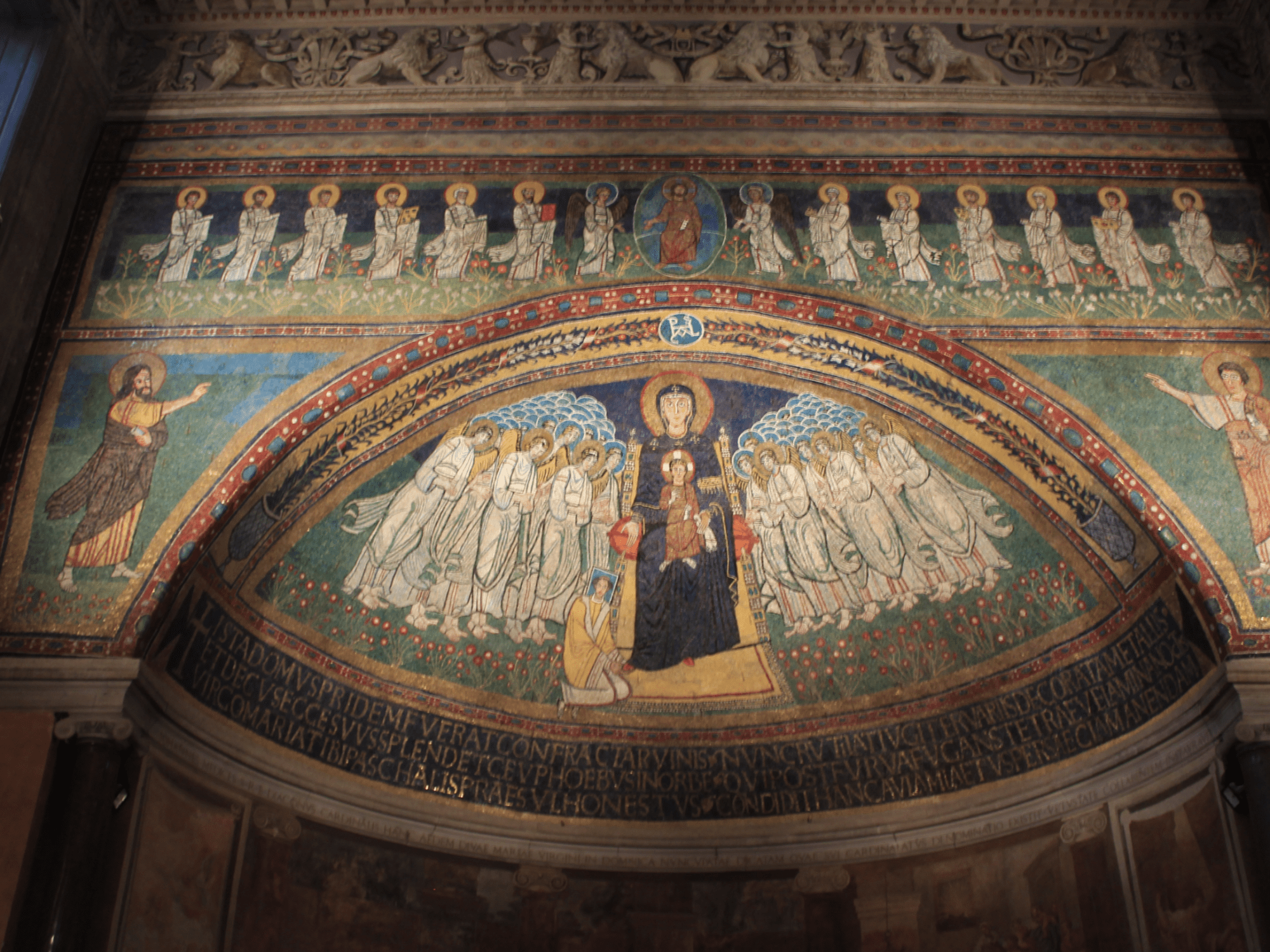
The apse mosaic, dating from the pontificate of Paschal I, depicts the Virgin Mary enthroned with the Christ Child, surrounded by angels. The composition emphasizes heavenly glory and divine kingship.
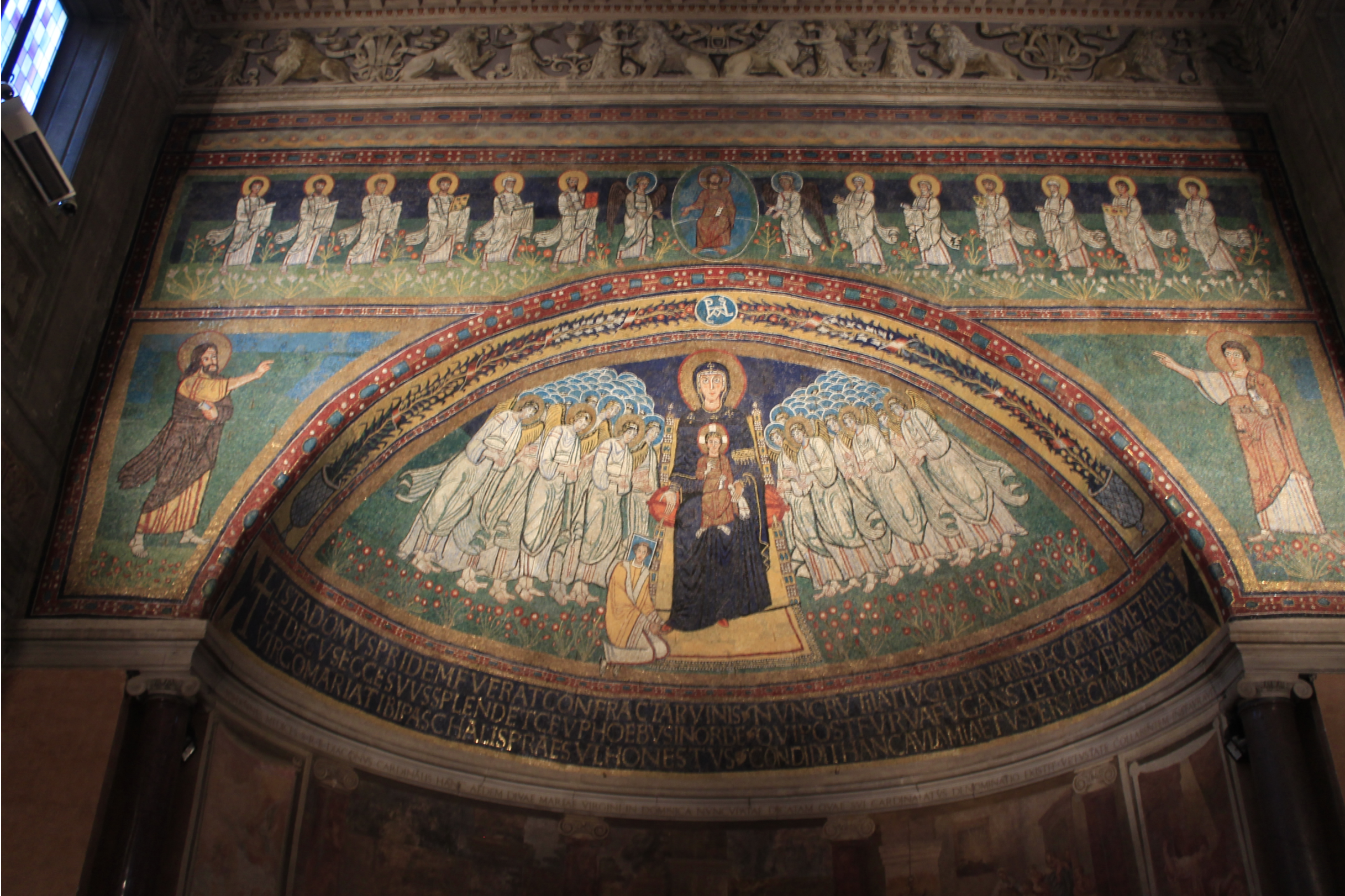
Significantly for this Lenten Sunday, the triumphal arch mosaic also contains imagery associated with the Transfiguration. The arch presents Christ in majesty, radiantly manifested, in a visual language that echoes the Gospel proclaimed on this day. The placement of this imagery at the threshold between nave and apse underscores the theological theme: Christ revealed in glory, yet on the way toward His Passion.
Marian and Transfiguration Themes
The Second Sunday of Lent places before the faithful the mystery of Tabor — light breaking through suffering. In Santa Maria in Domnica, the mosaic program reinforces this dynamic. The Virgin enthroned in the apse points toward the Incarnation; the triumphant Christ on the arch evokes divine revelation. Together, they situate the Transfiguration within the broader mystery of salvation history.
The disciples saw Christ in glory to strengthen them for the Cross. The faithful, hearing the same Gospel in this basilica, contemplate that revelation surrounded by imagery of heavenly kingship.
The Station Significance
As the station church for this Sunday, Santa Maria in Domnica embodies the liturgical ascent to Tabor. The proclamation of the Transfiguration is not isolated from place; it is framed by mosaics that echo its themes and by a basilica whose name recalls the Lord’s Day itself.
Lent continues toward Calvary. But on this Sunday, in this church, Rome contemplates light — the glory of Christ revealed before the Cross.
Receive these articles daily in your inbox by subscribing here:
And please share this article with your family and friends — every share helps our fellow Catholic brothers and sisters discover Rome’s most ancient treasures, and hopefully brings edification through the liturgical season of Lent.
The full Lenten itinerary can be found here at the sticky post with links to every video tour of the Roman Station Churches available at Crux Stationalis.
I propose two works for your Lenten meditations and beyond Lent to concentrate your prayer on the Passion of Christ and his Love for you in His Passion: 31 Days of Meditations on the Passion written by a Passionist Father and Flowers of the Passion by St. Paul of the Cross.
 Crux Stationalis