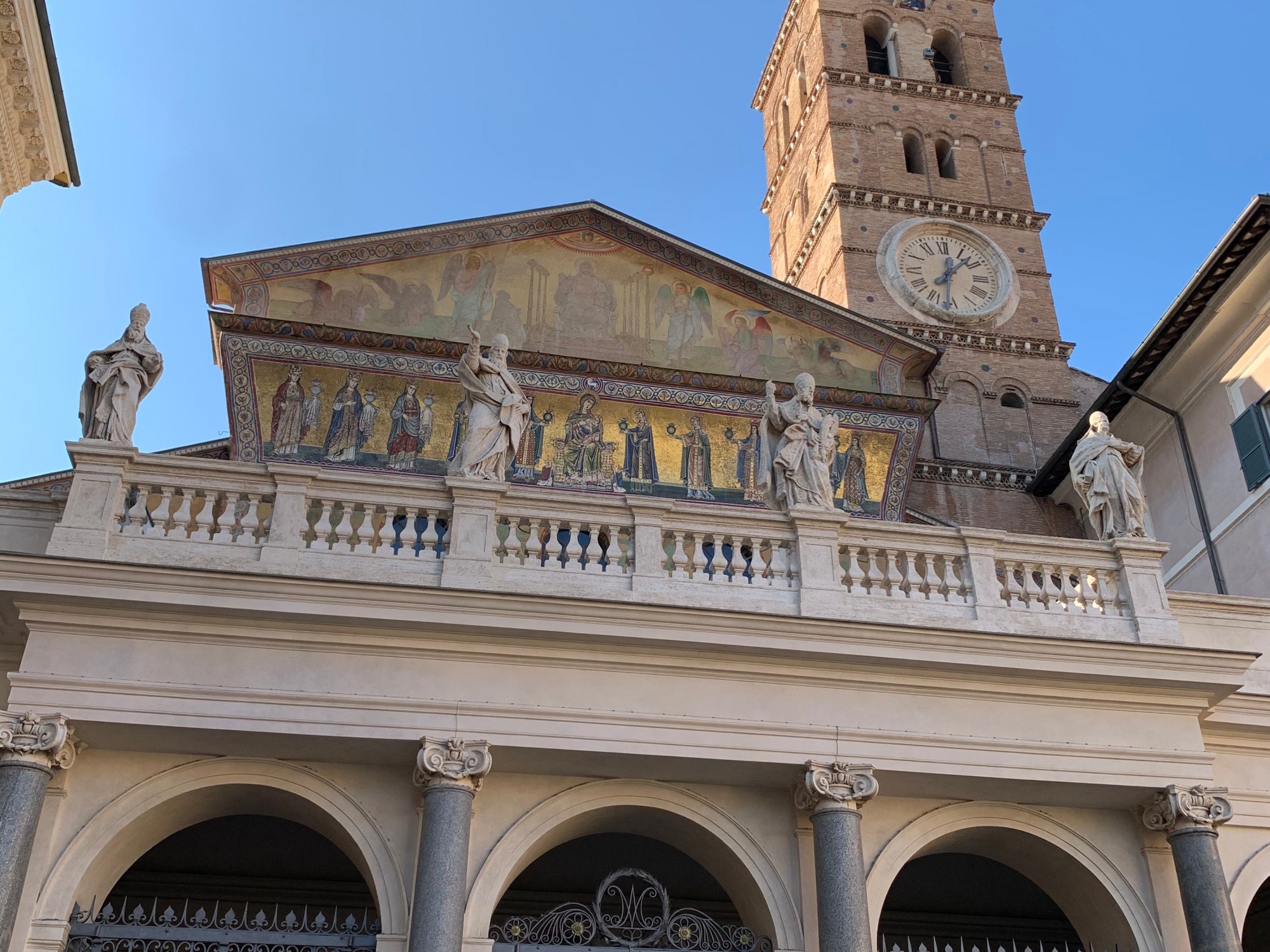
The Lenten Station in Trastevere
On the Thursday of the Second Week of Lent, the Roman stational tradition brings the faithful to Santa Maria in Trastevere, one of the most ancient and historically significant churches in the city. Located in the heart of the Trastevere district on the west bank of the Tiber, the basilica has served for centuries as the principal religious center of the neighborhood and remains a parish, titular church, and minor basilica.
Within the stational cycle, this church anchors the Lenten pilgrimage in a place deeply connected to the earliest public expressions of Christian worship in Rome.
Video Tour of Santa Maria in Trastevere
Origins in the Early Church
The origins of Santa Maria in Trastevere reach back to the 3rd century. According to ancient tradition preserved in the Liber Pontificalis, Pope Callixtus I (c. 217–222) established a Christian house-church here around 220 AD. The site had previously been the Taberna meritoria, a refuge for retired soldiers.
A dispute once arose between local tavern keepers and the Christian community over the use of the property. Emperor Alexander Severus reportedly settled the matter by declaring that the site should belong to those who honored God, regardless of their form of worship.
In the 4th century, Pope Julius I (337–352) expanded the earlier house church into a larger basilica. This made Santa Maria in Trastevere one of the earliest places in Rome where Christian worship could be publicly celebrated.
The Legend of the Fons Olei
A tradition associated with the site predates even the Christian foundation. According to ancient sources, in 38 BC a spring of oil-like liquid suddenly flowed from the ground here. This phenomenon became known as the fons olei (“spring of oil”).
Jewish inhabitants of Trastevere reportedly interpreted the event as a sign announcing the coming of the Messiah. Later Christian interpretation connected the event symbolically to the birth of Christ. The episode is commemorated in the iconography of the basilica’s decorative program.
The Twelfth-Century Basilica
The present structure largely dates from a major reconstruction carried out between 1140 and 1143 under Pope Innocent II. Built on the foundations of the earlier basilica, the church adopted the Romanesque basilican plan still visible today.
The interior consists of a central nave flanked by side aisles, supported by columns taken from ancient Roman buildings. The church measures approximately 56 meters in length and 30 meters in width, with a wide nave leading toward the apse and sanctuary.
A 12th-century campanile rises beside the basilica, while the façade was later restored in 1702 by Carlo Fontana, who also redesigned the fountain in the piazza before the church.
Mosaics and Artistic Program
Santa Maria in Trastevere is particularly known for its medieval mosaics, among the most significant in Rome. The apse mosaics, executed in the late 13th century by Pietro Cavallini, depict scenes from the life of the Virgin Mary, emphasizing the Marian dedication of the basilica.
The façade also displays a medieval mosaic showing the Virgin enthroned with the Child, reinforcing the church’s identity as one of Rome’s earliest Marian shrines.
Within the basilica is the Madonna della Clemenza, one of the oldest surviving Marian icons in Rome and among the earliest monumental depictions of the Virgin Mary.
The Station Significance
As the station church for Thursday of the Second Week of Lent, Santa Maria in Trastevere places the Lenten pilgrimage within a basilica whose history reaches back to the earliest Christian community of the city.
Here the faithful gather in a church born from a house of prayer, expanded in the Constantinian era, and rebuilt in the medieval Church. The station highlights the continuity of Christian worship in Rome — from the first house churches to the great basilicas that still structure the city’s liturgical life.
In the Roman stational tradition, Lent is not only a season of penance but also a journey through the living history of the Church. Santa Maria in Trastevere stands as one of its most ancient witnesses.
Receive these articles daily in your inbox by subscribing here:
And please share this article with your family and friends — every share helps our fellow Catholic brothers and sisters discover Rome’s most ancient treasures, and hopefully brings edification through the liturgical season of Lent.
The full Lenten itinerary can be found here at the sticky post with links to every video tour of the Roman Station Churches available at Crux Stationalis.
I propose two works for your Lenten meditations and beyond Lent to concentrate your prayer on the Passion of Christ and his Love for you in His Passion: 31 Days of Meditations on the Passion written by a Passionist Father and Flowers of the Passion by St. Paul of the Cross.
 Crux Stationalis