The Lenten Station
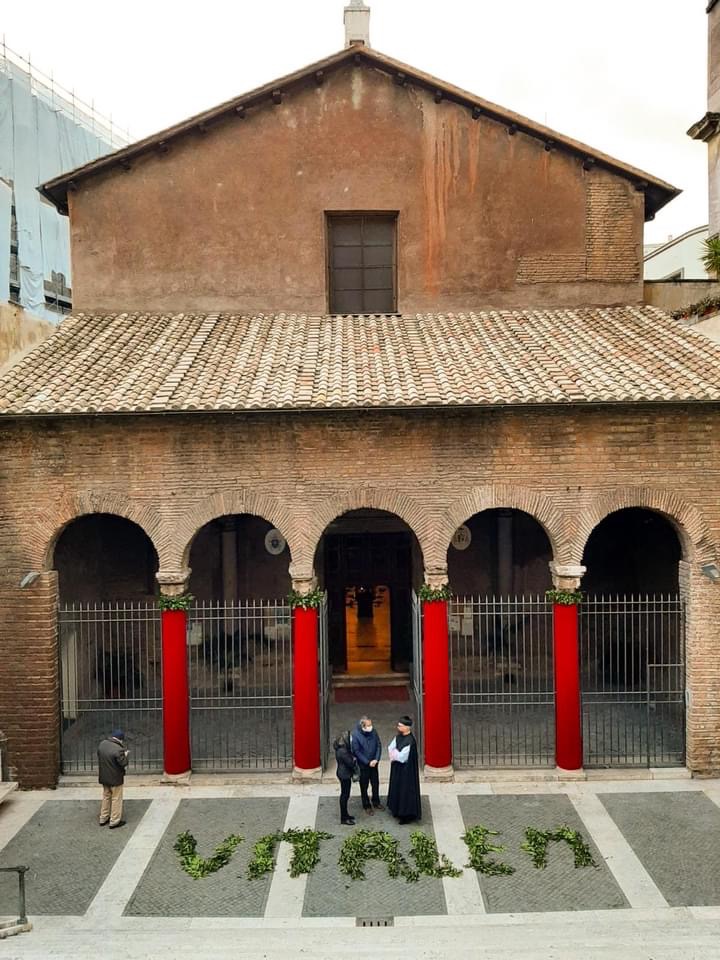
On the Friday of the Second Week of Lent, the Roman stational tradition brings the faithful to San Vitale, one of the oldest surviving Christian basilicas in the historic center of Rome. Located on Via Nazionale in the rione Monti, the church stands several meters below the modern street level, reached by a broad staircase that descends to a small forecourt.
Within the Lenten station cycle, this basilica anchors the penitential journey in the memory of early Christian martyrdom and the growth of the Church in late antiquity.
Video Tour of San Vitale
Foundation in the Early Christian Era
The origins of San Vitale date to the late 4th century, when construction began after 386 AD under Pope Siricius. The church was consecrated around 401–402 by Pope Innocent I.
Funding for the basilica came from a wealthy Roman widow named Vestina, which explains the church’s earliest title: Titulus Vestinae. This made San Vitale one of the original titular churches of Rome, part of the early parish system that structured Christian life in the city after the legalization of the faith.
Unlike many early Roman churches, San Vitale was not built over a pagan temple, making it one of the earliest purpose-built Christian basilicas in the city center.
Dedication to the Martyrs
The church is formally known as Santi Vitale e Compagni Martiri in Fovea. It is dedicated to Saint Vitalis, his wife Saint Valeria, and their sons Saints Gervasius and Protasius, martyrs whose cult spread rapidly in the late fourth century.
The devotion to these saints was closely connected to Saint Ambrose of Milan, who discovered the relics of Gervasius and Protasius in 386. Their veneration soon reached Rome, influencing the dedication of this basilica.
Over time, the church became widely known simply as San Vitale, though its full title still commemorates the entire family of martyrs.
Architectural Development
The original basilica was a three-aisled early Christian structure approximately fifty meters long, with rows of granite columns supporting arcades along the nave.
Major changes occurred during later centuries. In 1475, Pope Sixtus IV ordered a substantial rebuilding ahead of the Jubilee Year. The side aisles were removed, transforming the church into a single-nave hall while preserving elements of the earlier structure such as the apse and parts of the façade.
Additional restorations took place in the 16th century, the 19th century, and again in the 20th century, ensuring the preservation of the basilica while maintaining its early Christian character.
Interior and Artistic Program
The interior of San Vitale is distinguished by its extensive cycle of frescoes depicting scenes of martyrdom. These paintings cover much of the nave walls and reinforce the church’s dedication to the witness of the saints.
In the apse is a fresco representing the Ascent to Calvary, painted by Andrea Commodi, while other frescoes in the sanctuary depict episodes from the martyrdom of the saints honored by the church.
The decorative program emphasizes the suffering and perseverance of the martyrs, aligning the church’s visual message with the penitential themes of Lent.
The Station Significance
As the station church for this day of Lent, San Vitale situates the faithful within a basilica dedicated entirely to the memory of martyrs. The fresco cycles, relic traditions, and early Christian foundation all converge on a single theme: witness through suffering.
In the Roman stational rhythm, this Friday of the Second Week directs attention to the cost of discipleship. The Church gathers in a basilica born in the age of the martyrs and decorated with their stories.
Here the Lenten pilgrimage continues — under the testimony of those who gave their lives for the faith.
Receive these articles daily in your inbox by subscribing here:
And please share this article with your family and friends — every share helps our fellow Catholic brothers and sisters discover Rome’s most ancient treasures, and hopefully brings edification through the liturgical season of Lent.
The full Lenten itinerary can be found here at the sticky post with links to every video tour of the Roman Station Churches available at Crux Stationalis.
I propose two works for your Lenten meditations and beyond Lent to concentrate your prayer on the Passion of Christ and his Love for you in His Passion: 31 Days of Meditations on the Passion written by a Passionist Father and Flowers of the Passion by St. Paul of the Cross.
 Crux Stationalis