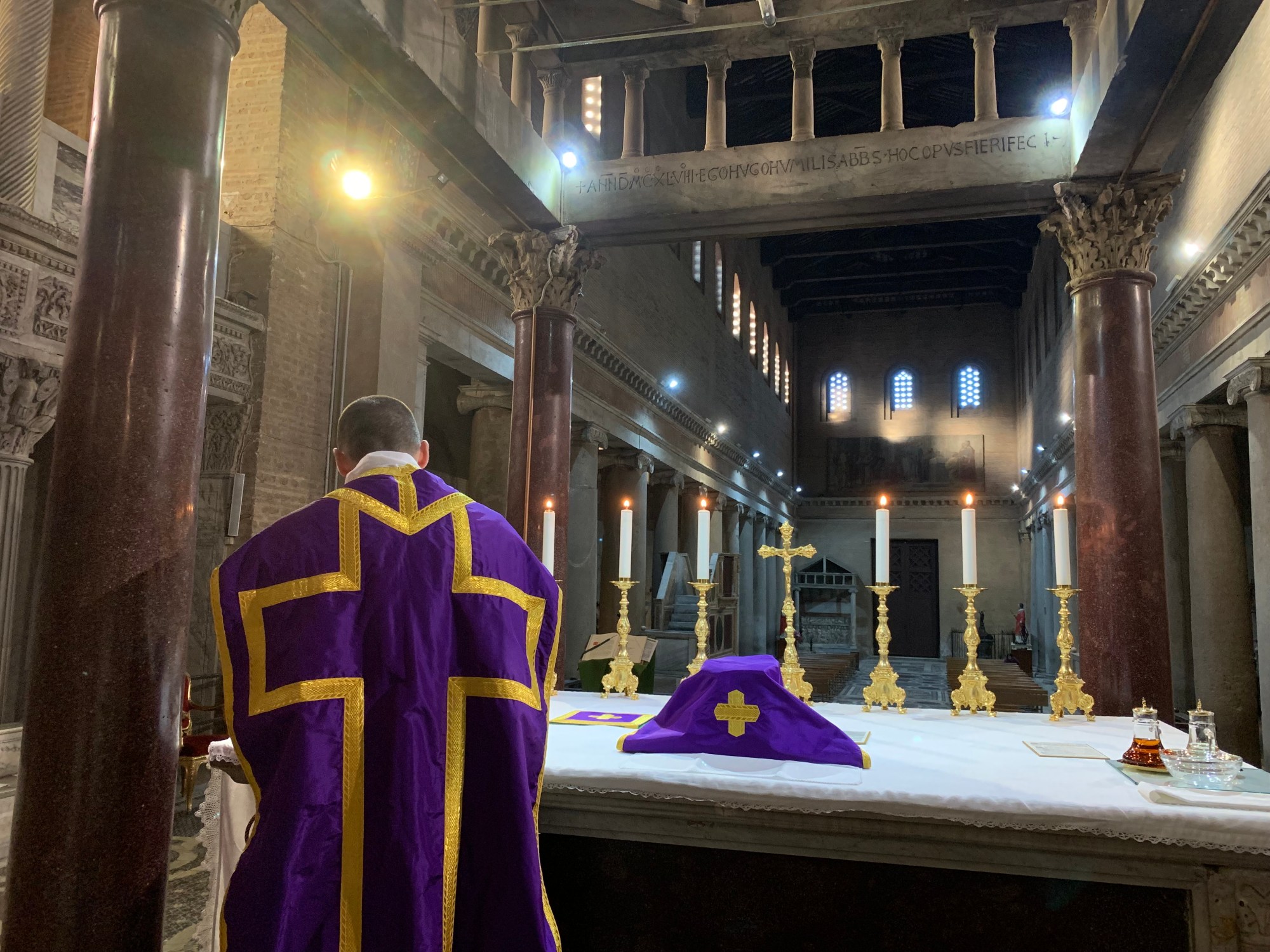
The Lenten Station at the Tomb of a Martyr
On the Third Sunday of Lent, the Roman stational tradition gathers the faithful at San Lorenzo fuori le Mura, the Papal Basilica dedicated to Saint Lawrence, one of the most revered martyrs of the Roman Church. Located along the ancient Via Tiburtina, outside the historic city walls, the basilica stands over the place where Lawrence was buried after his martyrdom in 258 AD during the persecution of Emperor Valerian.
The station for this Sunday directs the Lenten pilgrimage toward the tomb of the deacon who is counted among the great Roman martyrs, after Saints Peter and Paul. His grave quickly became a center of devotion and pilgrimage for the early Christian community.
Video tour of San Lorenzo fuori le mura
[The Station Church for Septuagesima Sunday and the Third Sunday of Lent]
The Martyr Saint Lawrence
Lawrence served as one of the seven deacons of the Church of Rome, responsible for the administration of the Church’s charitable works. During the persecution under Valerian, he was ordered to surrender the treasures of the Church. According to ancient tradition, Lawrence presented the poor of Rome as the true treasure of the Church.
He was subsequently condemned to death and executed on a gridiron on August 10, 258. His martyrdom rapidly became one of the most famous in Christian history, and devotion to him spread widely throughout the Roman world.
The Basilica over the Tomb
The origins of the basilica are closely connected to the saint’s burial. Lawrence was interred in the Cemetery of Cyriaca, an early Christian burial ground along the Via Tiburtina. The veneration of his tomb soon attracted large numbers of pilgrims.
In the 4th century, following the legalization of Christianity, a church was erected over the martyr’s grave. Over time this complex developed into one of the principal shrines of Christian Rome. The basilica that exists today reflects the merging of two earlier churches, one dating from the 6th century and another from the 13th century, which were united into a single structure during the Middle Ages.
The result is an unusual architectural arrangement: entering from the modern façade, the visitor first encounters the medieval nave before reaching the earlier shrine area surrounding the tomb of the saint.
A Major Pilgrimage Basilica
San Lorenzo fuori le Mura is counted among the five papal basilicas of Rome and is also one of the Seven Pilgrim Churches traditionally visited by pilgrims to the city.
The basilica stands beside the Campo Verano cemetery, continuing the ancient Christian custom of burial near the tombs of martyrs. The shrine itself preserves the relics of Saint Lawrence and Saint Stephen, the first martyr of the Church, beneath the high altar.
Several popes are also buried within the basilica, including Saint Zosimus, Saint Sixtus III, Saint Hilarius, Damasus II, and Blessed Pius IX, further reinforcing the church’s importance in Roman ecclesiastical history.
Architecture and Decoration
The basilica preserves many elements of medieval Roman church architecture. The nave features a Cosmatesque floor, intricate marble inlays characteristic of Roman craftsmanship in the Middle Ages. A ciborium dating from 1148, supported by decorated columns, stands over the high altar.
The church also includes a Romanesque campanile from the 12th century and a cloister attached to the monastic complex.
During World War II, the basilica was heavily damaged in the Allied bombing of Rome on 19 July 1943. The façade and portions of the structure were destroyed and later carefully rebuilt in the postwar period.
The Station Significance
Although San Lorenzo fuori le Mura is visited in the Roman liturgical calendar on other occasions, the stational liturgy today belongs to the Third Sunday of Lent. On this day, the faithful assemble at the tomb of one of Rome’s most venerated martyrs.
The location itself reinforces the message of the Lenten season: the Church gathers not only in places of beauty but at the graves of those who witnessed to Christ with their lives.
Here, outside the ancient walls of Rome, the Lenten pilgrimage pauses at the shrine of Saint Lawrence, whose martyrdom became a symbol of charity, courage, and fidelity to the Gospel.
Receive these articles daily in your inbox by subscribing here:
And please share this article with your family and friends — every share helps our fellow Catholic brothers and sisters discover Rome’s most ancient treasures, and hopefully brings edification through the liturgical season of Lent.
The full Lenten itinerary can be found here at the sticky post with links to every video tour of the Roman Station Churches available at Crux Stationalis.
I propose two works for your Lenten meditations and beyond Lent to concentrate your prayer on the Passion of Christ and his Love for you in His Passion: 31 Days of Meditations on the Passion written by a Passionist Father and Flowers of the Passion by St. Paul of the Cross.
 Crux Stationalis