The Lenten Station
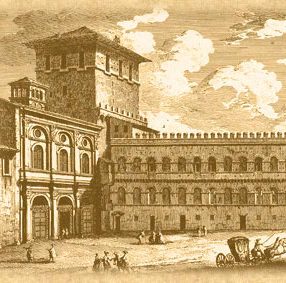
On the Monday of the Third Week of Lent, the Roman stational tradition gathers the faithful at San Marco Evangelista al Campidoglio, located on Piazza San Marco near Piazza Venezia, at the foot of the Capitoline Hill. The basilica is one of the oldest Christian churches in the historic center of Rome and has served for centuries as a parish, titular church, and minor basilica.
Within the stational cycle, this church anchors the Lenten pilgrimage in a place connected to the earliest public Christian presence in the center of the ancient city.
Video Tour of San Marco al Campidoglio
Foundation in the Fourth Century
The origins of San Marco date to the 4th century, when Pope Mark founded a church on this site in 336 AD. According to the Liber Pontificalis, the basilica was constructed at a location known as ad Pallacinas, incorporating earlier Roman structures that may have formed part of a private residence.
Tradition holds that the site may have been associated with the residence of Pope Mark himself, which he donated to the Christian community and converted into a place of worship. This early foundation made San Marco one of the first churches established in the central urban area of Rome after Christianity became legally recognized.
The church was dedicated not to the pope who built it, but to Saint Mark the Evangelist, one of the four authors of the Gospels and a disciple closely associated with Saint Peter.
Early Medieval Reconstruction
The first basilica underwent several reconstructions during the early Middle Ages. Records show that Pope Adrian I carried out repairs in the late 8th century, providing liturgical furnishings and restoring parts of the roof and aisles.
In 833, Pope Gregory IV rebuilt the church on a larger scale. This rebuilding included a new decorative program and the installation of the apse mosaic, which remains one of the most significant artistic features of the basilica.
The mosaic depicts Christ enthroned, with the pope presenting a model of the church. The imagery reflects the early medieval emphasis on Christ’s kingship and the connection between the Roman pontiff and the apostolic tradition.
Renaissance and Venetian Patronage
A major transformation of San Marco occurred in the 15th century under Pope Paul II (1464–1471), who had previously been the titular cardinal of the church. Paul II was Venetian by birth and rebuilt the basilica while constructing the nearby Palazzo Venezia, which eventually surrounded the church complex.
During this reconstruction the façade was redesigned in Renaissance style with a portico and loggia, using materials taken from ancient Roman buildings such as the Colosseum and the Theatre of Marcellus.
Because Saint Mark the Evangelist is the patron saint of Venice, the basilica gradually became the national church of the Venetian community in Rome, a role it maintained for centuries.
Interior and Artistic Elements
The interior of the church reflects layers of decoration from different periods. Baroque renovations in the 17th and 18th centuries reshaped much of the interior appearance while preserving the earlier structure.
One of the most notable features is the 15th-century wooden coffered ceiling, commissioned during the reign of Pope Paul II and bearing his coat of arms. The ceiling is one of the few surviving Renaissance wooden ceilings in Roman churches.
The nave contains large sculpted reliefs of the twelve apostles, added in the eighteenth century, reinforcing the apostolic theme of the basilica’s decoration.
Beneath the high altar are the relics of Pope Saint Mark, the founder of the church.
The Station Significance
As the station church for Monday of the Third Week of Lent, San Marco places the Lenten pilgrimage in a basilica that connects the earliest Christian presence in the center of Rome with centuries of liturgical continuity.
Founded in the fourth century, rebuilt in the early Middle Ages, and reshaped in the Renaissance, the church reflects the layered history of the Roman Church itself.
Here, near the Capitoline Hill where the ancient city once centered its civic life, the Christian community gathers during Lent in a church dedicated to the Evangelist — recalling the proclamation of the Gospel that first brought the faith to Rome.
Receive these articles daily in your inbox by subscribing here:
And please share this article with your family and friends — every share helps our fellow Catholic brothers and sisters discover Rome’s most ancient treasures, and hopefully brings edification through the liturgical season of Lent.
The full Lenten itinerary can be found here at the sticky post with links to every video tour of the Roman Station Churches available at Crux Stationalis.
I propose two works for your Lenten meditations and beyond Lent to concentrate your prayer on the Passion of Christ and his Love for you in His Passion: 31 Days of Meditations on the Passion written by a Passionist Father and Flowers of the Passion by St. Paul of the Cross.
 Crux Stationalis