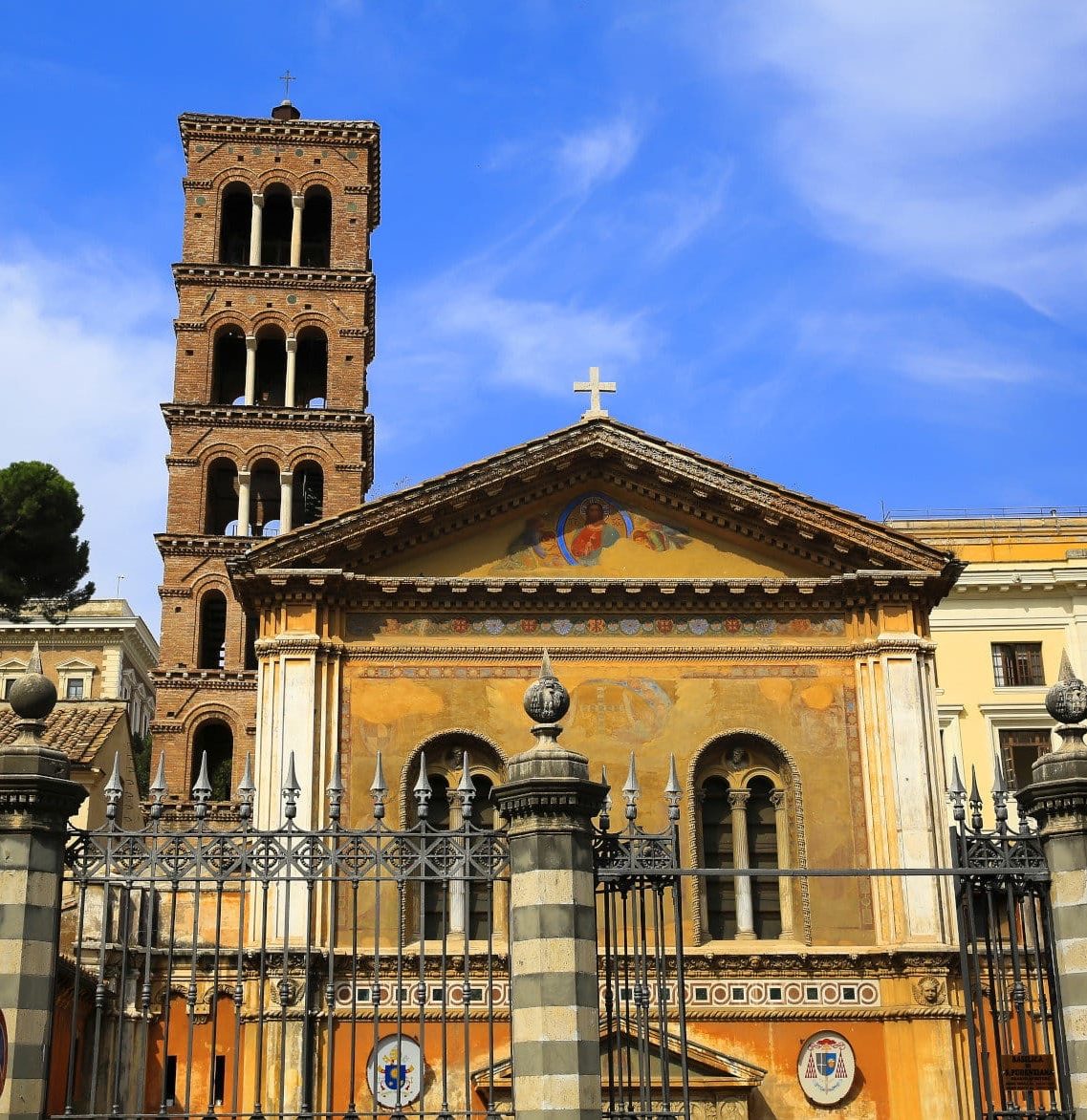
The Lenten Station
On the Tuesday of the Third Week of Lent, the Roman stational tradition brings the faithful to Santa Pudenziana, one of the most ancient Christian sites in Rome. The basilica stands on Via Urbana in the rione Monti, a short distance from Santa Maria Maggiore. The church sits below modern street level and preserves layers of Roman and Christian history that reach back to the earliest centuries of the Church.
Within the stational cycle, this church places the Lenten pilgrimage in a location associated with the earliest Christian worship in the city and with traditions linking the Roman Church directly to the apostolic age.
Origins and Early Christian Worship
The origins of Santa Pudenziana are tied to the house of the Roman senator Pudens, who according to early Christian tradition welcomed Saint Peter when the apostle first came to Rome. The site may have served as a house church in the earliest period of Christianity in the city.
Archaeological evidence shows that parts of the present structure incorporate a 2nd-century Roman bath complex, later adapted for Christian worship. By the late fourth century, during the pontificate of Pope Siricius, the building was formally transformed into a Christian basilica.
The church became known as the Titulus Pudentis, one of the earliest parish churches in Rome. Records from a Roman synod in 499 confirm that the sacraments were administered here, demonstrating the basilica’s early importance in the Christian life of the city.
Saint Pudenziana and Early Devotion
The basilica is dedicated to Saint Pudenziana, traditionally identified as the daughter of Pudens and sister of Saint Praxedes. According to later tradition, the two sisters cared for persecuted Christians and gathered the remains of martyrs during times of persecution.
Although historians debate the details of these traditions, devotion to Pudenziana became firmly rooted in Rome, and the church bearing her name preserved the memory of these early Christian families connected with the apostolic community.
The Apse Mosaic
The most important artistic feature of Santa Pudenziana is the late fourth-century apse mosaic, one of the oldest surviving Christian mosaics in Rome and among the earliest monumental representations of Christ.
The mosaic depicts Christ enthroned as teacher and ruler, seated on a jewel-encrusted throne and dressed in imperial garments. Around him are the apostles, shown wearing senatorial togas, emphasizing their authority as witnesses to the Gospel.
Two female figures stand behind Saints Peter and Paul. These figures are commonly interpreted as Ecclesia ex gentibus and Ecclesia ex circumcisione, symbolizing the Church drawn from the Gentiles and from Israel. Above them appears the heavenly Jerusalem, with a jeweled cross rising above the city.
The mosaic marks an important moment in Christian art: Christ is represented not symbolically but as a human ruler, enthroned in majesty. This iconography would influence later Byzantine depictions of Christ as Pantocrator.
If you want a deeper explanation of the theology and symbolism of this extraordinary mosaic, be sure to watch my YouTube video dedicated entirely to its history and meaning.
Video Tour of Santa Pudenziana
Later Developments
Over the centuries the church underwent several renovations. In the late sixteenth century, major alterations introduced a dome and reduced the original three-aisled basilica to a single nave. Later restorations modified the façade and interior while preserving the ancient apse mosaic.
The basilica also includes the Caetani Chapel, constructed in the late sixteenth century as a family burial chapel and decorated with mosaics and frescoes.
The Station Significance
As the station church for this day of Lent, Santa Pudenziana places the faithful in one of the earliest centers of Christian worship in Rome. The site preserves traces of the apostolic age, the transformation of Roman buildings into Christian churches, and one of the most important monuments of early Christian art.
Here the Lenten pilgrimage pauses before a mosaic that proclaims the kingship of Christ and the unity of the Church gathered from all nations.
Receive these articles daily in your inbox by subscribing here:
And please share this article with your family and friends — every share helps our fellow Catholic brothers and sisters discover Rome’s most ancient treasures, and hopefully brings edification through the liturgical season of Lent.
The full Lenten itinerary can be found here at the sticky post with links to every video tour of the Roman Station Churches available at Crux Stationalis.
I propose two works for your Lenten meditations and beyond Lent to concentrate your prayer on the Passion of Christ and his Love for you in His Passion: 31 Days of Meditations on the Passion written by a Passionist Father and Flowers of the Passion by St. Paul of the Cross.
 Crux Stationalis