The Lenten Station in the Roman Forum
On the Thursday of the Third Week of Lent, the Roman stational tradition gathers the faithful at Santi Cosma e Damiano, a basilica located on the eastern side of the Roman Forum in the rione Monti. The church stands within one of the most historically significant areas of ancient Rome, surrounded by the remains of the imperial fora and the monumental buildings of the classical city.
The station here situates the Lenten pilgrimage directly within the heart of ancient Rome, where structures that once served imperial administration were later transformed into places of Christian worship.
Video Tour of Santi Cosma e Damiano
Foundation in the Sixth Century
The basilica was established as a church in 527 AD by Pope Felix IV, who converted existing Roman structures into a Christian sanctuary. The project was made possible when Theodoric the Great, king of the Ostrogoths, and his daughter Amalasuntha donated buildings from the nearby Forum of Peace to the pope.
Two separate ancient structures formed the core of the church. One was part of the Bibliotheca Pacis, the library complex of the Forum of Peace built under Emperor Vespasian in the first century. The other was the circular structure traditionally called the Temple of Romulus, constructed in the early fourth century during the reign of Emperor Maxentius.
These buildings were unified to create a Christian basilica, making Santi Cosma e Damiano one of the earliest examples in Rome of a church formed directly from imperial architecture.
Dedication to the Physician Martyrs
The church is dedicated to Saints Cosmas and Damian, twin brothers from the eastern Mediterranean who were known as physicians and Christian martyrs. According to early tradition, the brothers practiced medicine without accepting payment and were therefore called “anargyroi,” meaning “without silver.”
Their refusal to renounce the Christian faith during the persecution of Diocletian around 303 AD led to their execution. Their reputation as healers and martyrs made them widely venerated throughout the Christian world, and they became the patron saints of physicians and surgeons.
Architectural Structure
The church complex reflects its unusual origins. The circular vestibule connected with the Temple of Romulus forms part of the original entrance area, while the main basilica occupies the converted structures of the Forum of Peace.
For centuries, the principal entrance to the church was directly from the Roman Forum, emphasizing the physical and symbolic transformation of the ancient civic center into a Christian landscape.
Later modifications altered the arrangement of entrances and levels of the building, but the church still preserves visible elements of the ancient Roman structures that formed its foundation.
The Apse Mosaic
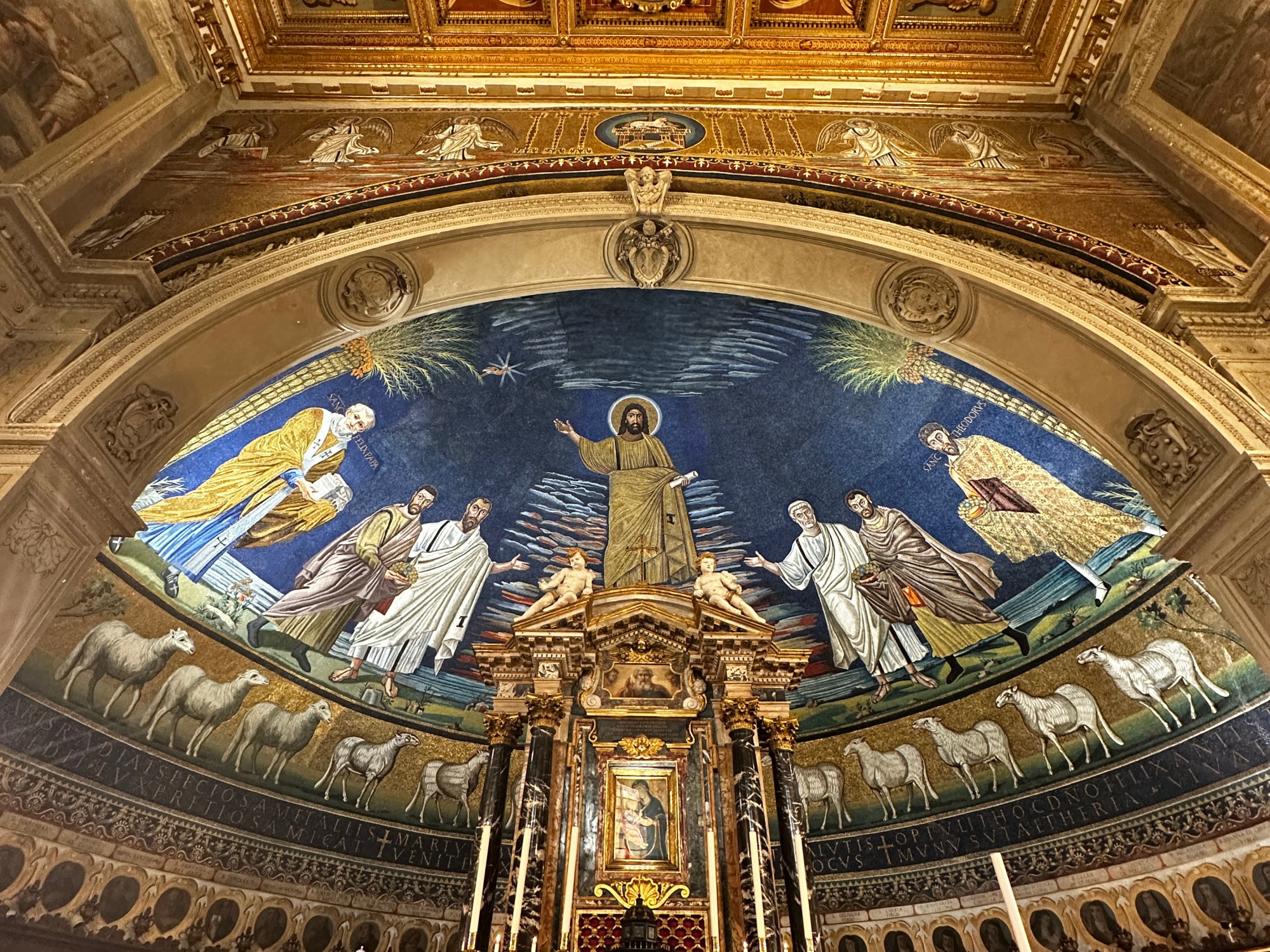
One of the most significant artistic features of Santi Cosma e Damiano is its sixth-century apse mosaic, among the finest surviving examples of early Christian art in Rome.
The mosaic depicts Christ in glory standing above a golden landscape of clouds. He is flanked by Saints Peter and Paul, who present Cosmas and Damian to Christ. Also included in the scene are Saint Theodore and Pope Felix IV, shown offering a model of the church.
Above the triumphal arch is an apocalyptic composition centered on the Mystical Lamb, surrounded by the seven candlesticks and angelic figures, echoing imagery from the Book of Revelation.
Later Developments
Over the centuries the basilica underwent several restorations. The interior was altered in the seventeenth century, when the floor level was raised to protect the building from flooding and new decorative elements were added.
Today the church functions as the conventual church of the Franciscan Third Order Regular and remains a titular church within the Roman ecclesiastical structure.
The Station Significance
As the station church for this day of Lent, Santi Cosma e Damiano places the faithful in a basilica that visibly embodies the transformation of Rome from imperial capital to Christian city.
The ancient walls of the Forum of Peace, the converted temple structures, and the early Christian mosaics together testify to a Church that entered the heart of the empire and reshaped it.
Here, in the center of the Roman Forum, the Lenten pilgrimage pauses beneath the image of Christ in glory, surrounded by the saints who bore witness to Him.
Receive these articles daily in your inbox by subscribing here:
And please share this article with your family and friends — every share helps our fellow Catholic brothers and sisters discover Rome’s most ancient treasures, and hopefully brings edification through the liturgical season of Lent.
The full Lenten itinerary can be found here at the sticky post with links to every video tour of the Roman Station Churches available at Crux Stationalis.
I propose two works for your Lenten meditations and beyond Lent to concentrate your prayer on the Passion of Christ and his Love for you in His Passion: 31 Days of Meditations on the Passion written by a Passionist Father and Flowers of the Passion by St. Paul of the Cross.
 Crux Stationalis