The Lenten Station
On the Friday of the Third Week of Lent, the Roman stational tradition gathers the faithful at San Lorenzo in Lucina, an ancient basilica located in Piazza di San Lorenzo in Lucina, just west of the Via del Corso in the rione Colonna. The church stands in the historic Campus Martius, a district that was heavily developed during the Roman imperial period and later became an important center of Christian worship.
Within the Lenten pilgrimage through Rome’s churches, San Lorenzo in Lucina anchors the station in a place where early Christian worship emerged directly from domestic spaces and gradually developed into a public basilica.
Video Tour of San Lorenzo in Lucina
Origins in a House Church
The name “Lucina” is traditionally associated with a Roman matron who owned the property on which the church stands. According to early tradition, Lucina allowed Christians to gather in her home for worship, forming one of the earliest ecclesiae domesticae—house churches—of the Roman community.
Archaeological excavations beneath the basilica have revealed remains of Roman structures dating to the 2nd century, including floors and domestic spaces that likely formed part of a residential complex. These remains support the tradition that Christian worship developed here within an existing Roman dwelling before the construction of a formal church building.
The site appears in early ecclesiastical records as the Titulus Lucinae, one of the original parish churches of Rome. The election of Pope Damasus I in 366 is traditionally associated with this location, demonstrating its importance within the early Roman Christian community.
The Fifth-Century Basilica
A formal basilica was constructed here in the mid-5th century, during the pontificate of Pope Sixtus III (432–440). This early structure followed the typical basilican plan of the period, with a central nave flanked by aisles and terminating in an apse.
Over time the church became dedicated to Saint Lawrence, the Roman deacon martyred in 258 AD during the persecution of Emperor Valerian. Lawrence’s cult spread widely throughout the Christian world, and his name became attached to several churches throughout Rome.
Medieval Reconstruction
The basilica suffered damage during the Norman sack of Rome in 1084 and was subsequently rebuilt in the early 12th century under Pope Paschal II. The reconstruction introduced features that remain visible today, including the Romanesque campanile and portions of the façade.
The church was consecrated again in 1196 by Pope Celestine III, marking the completion of the medieval rebuilding.
During this period the basilica continued to function as a titular church, forming part of the administrative structure of the Roman clergy.
Baroque Transformation
In the 17th century, the church underwent a major renovation directed by the architect Cosimo Fanzago. The original side aisles of the basilica were converted into a series of chapels, many of which were decorated by noble Roman families.
Further artistic additions followed. The interior includes the Fonseca Chapel, designed by Gian Lorenzo Bernini, as well as numerous Baroque decorations that reshaped the earlier basilican interior.
A later restoration in the 19th century under Pope Pius IX replaced some of the Baroque decoration with frescoes by Roberto Bompiani, giving the nave its present appearance.
Relics and Devotional Features
San Lorenzo in Lucina preserves relics associated with Saint Lawrence, including a reliquary said to contain the gridiron on which the saint was martyred.
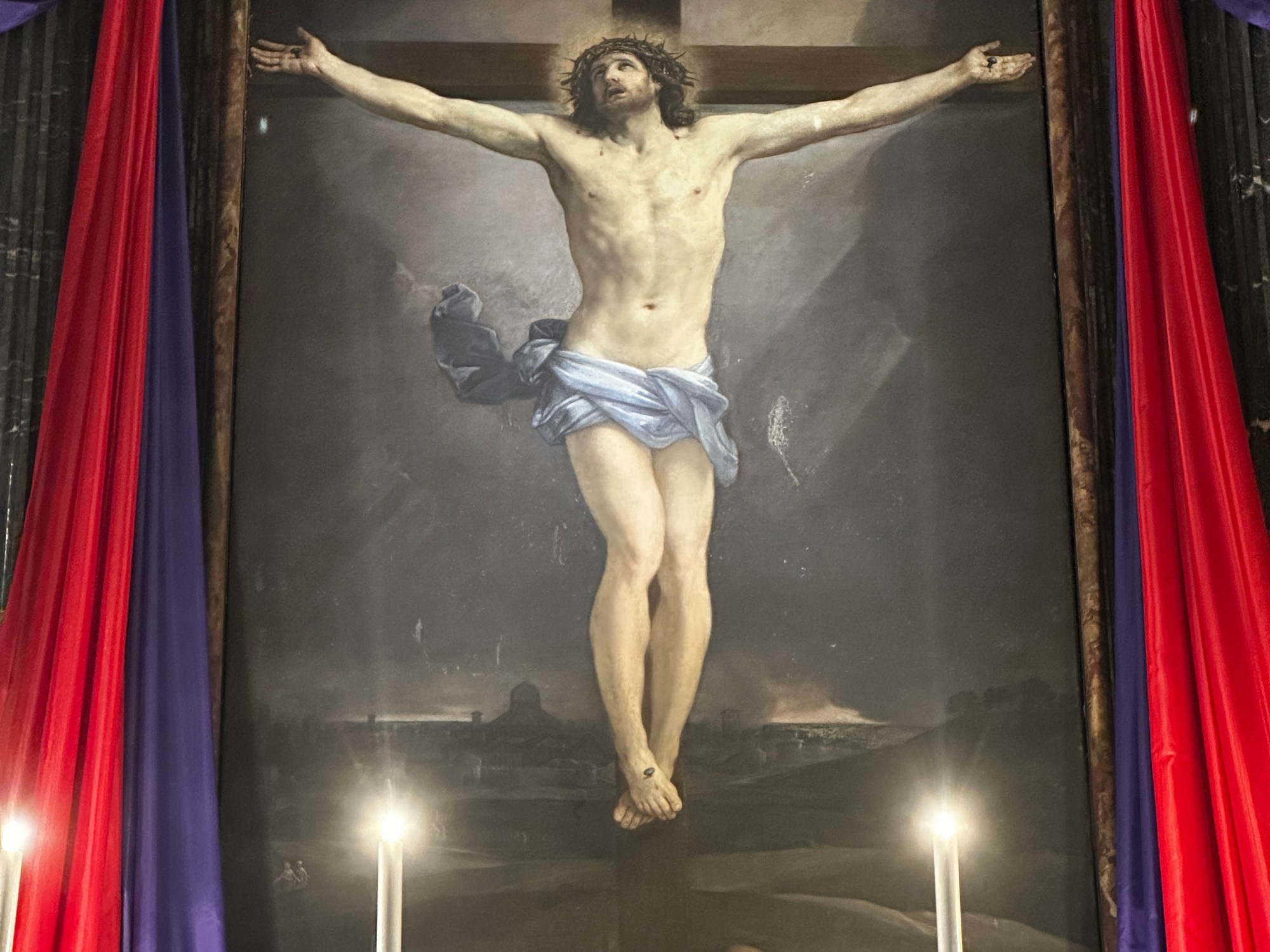
Above the high altar hangs a celebrated painting of the Crucifixion by Guido Reni, emphasizing the Passion of Christ and reinforcing the church’s connection to the martyrdom of Lawrence.
The basilica also contains monuments and tombs of notable figures, including the French painter Nicolas Poussin, who lived and worked in Rome.
The Station Significance
As the station church for the Friday of the Third Week of Lent, San Lorenzo in Lucina places the faithful in one of the earliest centers of Christian worship in Rome. The church’s origins in a house church, its transformation into a basilica, and its dedication to a martyr of the Roman Church reflect the development of Christianity within the city itself.
Here, in the center of the ancient Campus Martius, the Lenten pilgrimage pauses in a place where the early Christian community once gathered quietly for worship and where the memory of Saint Lawrence continues to shape the life of the Church.
Receive these articles daily in your inbox by subscribing here:
And please share this article with your family and friends — every share helps our fellow Catholic brothers and sisters discover Rome’s most ancient treasures, and hopefully brings edification through the liturgical season of Lent.
The full Lenten itinerary can be found here at the sticky post with links to every video tour of the Roman Station Churches available at Crux Stationalis.
I propose two works for your Lenten meditations and beyond Lent to concentrate your prayer on the Passion of Christ and his Love for you in His Passion: 31 Days of Meditations on the Passion written by a Passionist Father and Flowers of the Passion by St. Paul of the Cross.
 Crux Stationalis