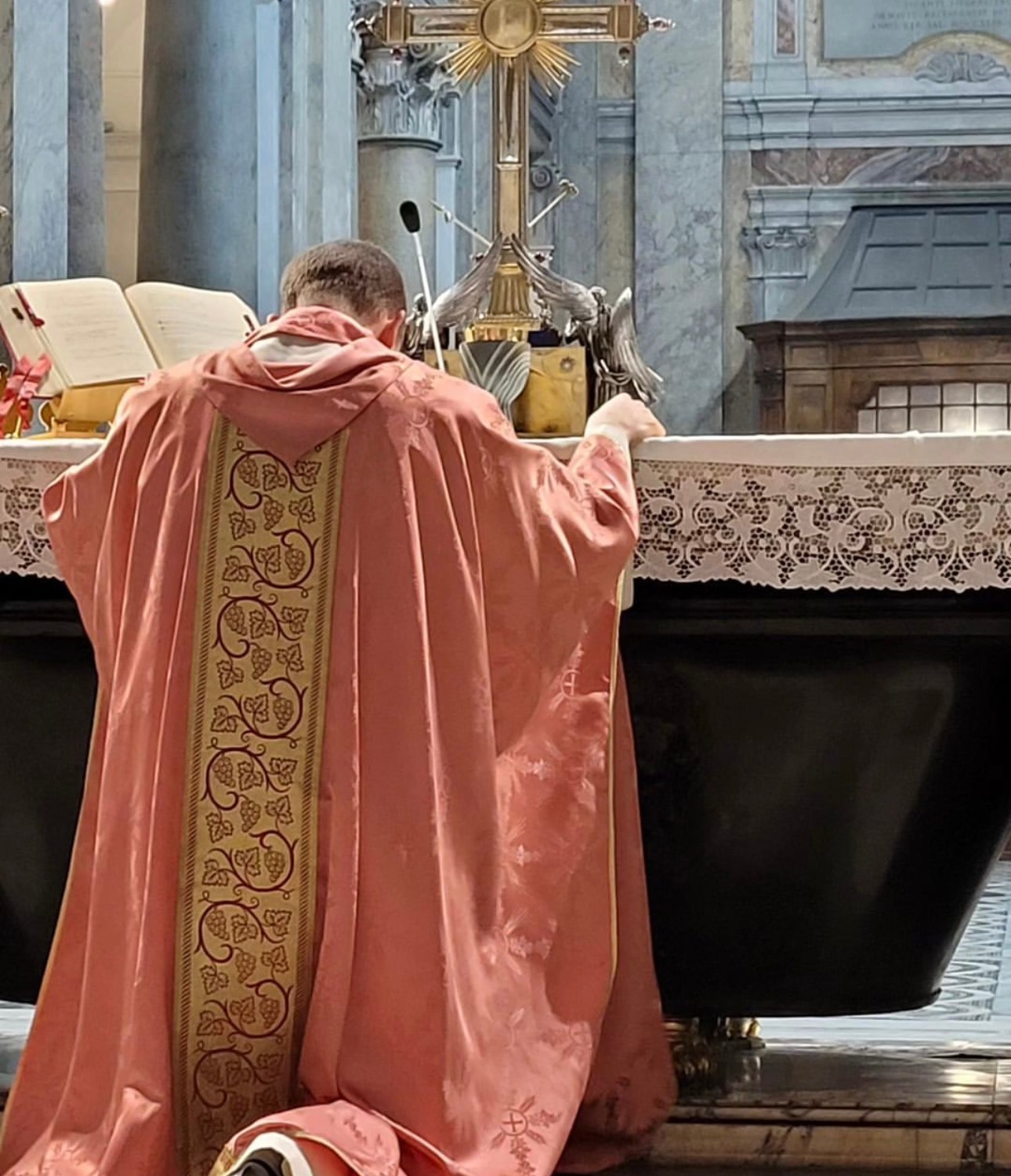
The Lenten Station of the Holy Cross
On Laetare Sunday, the Fourth Sunday of Lent, the Roman stational tradition brings the faithful to Santa Croce in Gerusalemme, one of the most important pilgrimage basilicas in the city. Located in the Esquiline district near the Lateran, the church stands within the remains of the ancient imperial complex known as the Sessorium, once part of the residence of the Roman emperors.
Unlike many Roman basilicas built over the tombs of martyrs, Santa Croce in Gerusalemme was established primarily to preserve relics of the Passion of Christ. Its station on Laetare Sunday situates the Lenten pilgrimage in a place directly connected with the Cross itself.
Video Tour of Santa Croce in Gerusalemme
The Foundation under Saint Helena
The origins of the basilica date to the early fourth century, shortly after the legalization of Christianity in the Roman Empire. The church was founded in connection with Saint Helena, the mother of Emperor Constantine. Helena resided in the imperial palace on this site and converted part of the complex into a Christian sanctuary.
According to ancient tradition, Helena traveled to the Holy Land and discovered relics associated with the Crucifixion of Christ. She brought these relics back to Rome, and the basilica was consecrated around 325 to house them.
The church acquired the unusual title “in Gerusalemme” because soil from Jerusalem was reportedly brought to Rome and spread beneath the floor of the sanctuary. In this way, the basilica was considered symbolically part of the Holy City itself. Pilgrims entering the church were understood to be standing, in a sense, on the ground of Jerusalem.
Relics of the Passion
Santa Croce became one of the principal shrines of Christ’s Passion in the Western Church. The basilica preserves a collection of relics traditionally associated with the Crucifixion. Among them are fragments of the True Cross, a holy nail, thorns from the Crown of Thorns, and a portion of the Titulus Crucis, the inscription placed above Christ on the Cross.
These relics are housed in the Chapel of the Relics, where they are displayed for the veneration of pilgrims. The presence of these objects made Santa Croce one of the most important pilgrimage destinations in Rome from the early Middle Ages onward.
Architectural Development
The basilica underwent several reconstructions and restorations over the centuries. Although the original Constantinian structure established the sanctuary, later centuries reshaped the building according to the architectural styles of their time.
A significant renovation occurred in the eighteenth century under Pope Benedict XIV, who ordered a major restoration that included the creation of the present façade and interior modifications.
The church today follows a three-nave basilican plan, with a long central nave supported by columns and a spacious sanctuary. Despite later modifications, the site still preserves elements of the ancient imperial complex that once formed the residence of Saint Helena.
Pilgrimage and Devotion
Santa Croce in Gerusalemme is one of the Seven Pilgrim Churches of Rome, a traditional itinerary popularized in the sixteenth century by Saint Philip Neri. Pilgrims visiting the church come primarily to venerate the relics of the Passion and to meditate on the mystery of the Cross.
The Station Significance
The assignment of Santa Croce in Gerusalemme to Laetare Sunday carries strong symbolic meaning within the Lenten season. At the midpoint of Lent, when the Church briefly lightens the penitential discipline, the faithful gather at a basilica dedicated to the Cross of Christ.
The station reminds pilgrims that the path of Lent leads ultimately to the Passion and Resurrection of the Lord. In Rome’s ancient stational rhythm, the faithful pause at the relics of the Cross itself — the central mystery toward which the entire Lenten pilgrimage is directed.
Receive these articles daily in your inbox by subscribing here:
And please share this article with your family and friends — every share helps our fellow Catholic brothers and sisters discover Rome’s most ancient treasures, and hopefully brings edification through the liturgical season of Lent.
The full Lenten itinerary can be found here at the sticky post with links to every video tour of the Roman Station Churches available at Crux Stationalis.
I propose two works for your Lenten meditations and beyond Lent to concentrate your prayer on the Passion of Christ and his Love for you in His Passion: 31 Days of Meditations on the Passion written by a Passionist Father and Flowers of the Passion by St. Paul of the Cross.
 Crux Stationalis