The Lenten Station on the Caelian Hill
On the Monday of the Fourth Week of Lent, the Roman stational tradition gathers the faithful at Santi Quattro Coronati, an ancient basilica located on the Caelian Hill, between the Colosseum and the Lateran. The church forms part of a large complex that includes a monastery, cloister, and the remains of medieval fortifications. Though it lies close to some of the most visited areas of Rome, the basilica itself remains secluded behind high walls and courtyards.
This station situates the Lenten pilgrimage within a church dedicated to martyrs whose story reflects the persecutions of the early Christian centuries.
Video Tour of Santi Quattro Coronati
The Four Crowned Martyrs
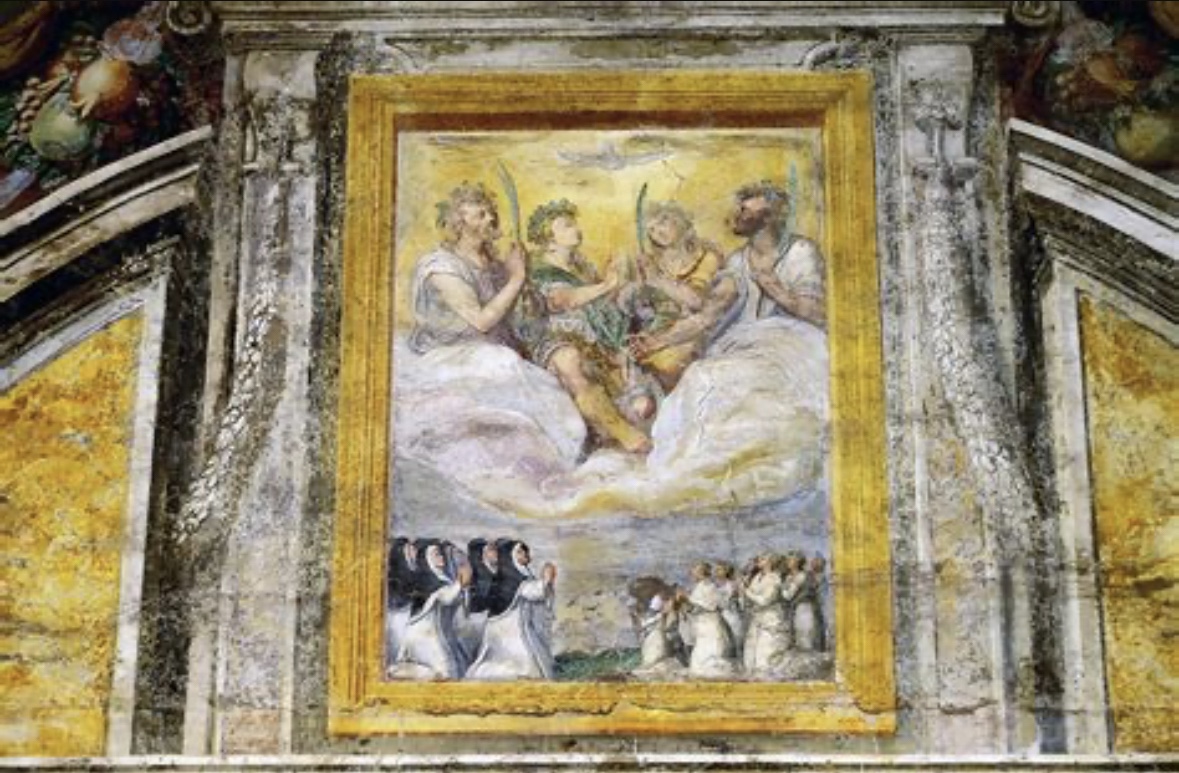
The basilica takes its name from the “Four Crowned Martyrs” (Quatuor Coronati). Tradition associates the title with several groups of Christian martyrs from the time of Emperor Diocletian in the early fourth century. One tradition speaks of four Roman soldiers who refused to sacrifice to pagan gods and were executed for their faith. Another tradition identifies four Christian stonemasons from Pannonia who refused to carve an idol of the god Aesculapius and were martyred for their refusal.
Over time these traditions merged, and the martyrs became collectively known as the “Four Crowned Ones,” crowned not with earthly honors but with the crown of martyrdom. Their feast is celebrated on November 8, and devotion to them spread widely in the early medieval Church.
Early Christian Foundation
The origins of the church date back to the fourth century, making it one of the earliest Christian foundations in Rome. The first church may have been built under Pope Miltiades on the site of a large Roman villa. The early basilica was known as the Titulus Aemilianae, one of the ancient parish churches of the city.
By the ninth century, Pope Leo IV expanded the basilica into a large Carolingian structure with multiple aisles, courtyards, and additional chapels. At this stage the church had grown into one of the most substantial ecclesiastical complexes in Rome.
Destruction and Reconstruction
The large basilica built in the Carolingian period was destroyed during the Norman sack of Rome in 1084. Rather than rebuilding the church at its original size, Pope Paschal II constructed a smaller basilica within the surviving walls. The new church incorporated two courtyards and reused portions of the earlier structure. It was consecrated in 1116.
Parts of the original complex were adapted for other purposes. The former side aisles became part of the cardinal’s residence on one side and the monastery on the other, creating the fortified appearance that still characterizes the complex today.
Medieval Additions and Artistic Heritage
During the thirteenth century, a Cosmatesque cloister was added to the monastery complex, providing one of the most peaceful enclosed spaces in Rome. The cardinal’s palace was expanded and fortified, reflecting the political instability of medieval Rome and the need to protect papal officials near the Lateran.
A notable feature of the complex is the Chapel of Saint Sylvester, consecrated in 1247. The chapel contains frescoes illustrating the story of Pope Sylvester I and Emperor Constantine, including scenes that emphasize the authority of the Church in relation to imperial power. These frescoes were painted during a period of conflict between the papacy and the Holy Roman Emperor and reflect the political theology of the medieval Church.
Later History
When the papacy moved to Avignon in the fourteenth century, the complex fell into decline. Restoration became necessary after the popes returned to Rome, though by then the papal residence had shifted to the Vatican rather than the Lateran.
In 1564, Pope Pius IV entrusted the basilica and monastery to the Augustinians, who continue to care for the complex today. The church remains a titular basilica and part of a cloistered monastic community.
The Station Significance
As the station church for this day of Lent, Santi Quattro Coronati draws attention to the witness of the martyrs in the early centuries of the Church. The basilica’s fortified walls, medieval courtyards, and ancient foundations reflect a long history of faith lived under both persecution and political struggle.
Here, on the Caelian Hill, the Lenten pilgrimage pauses at a church dedicated to those who chose fidelity to Christ over obedience to imperial command — a reminder that the crown promised by the Gospel is won through witness and perseverance.
Receive these articles daily in your inbox by subscribing here:
And please share this article with your family and friends — every share helps our fellow Catholic brothers and sisters discover Rome’s most ancient treasures, and hopefully brings edification through the liturgical season of Lent.
The full Lenten itinerary can be found here at the sticky post with links to every video tour of the Roman Station Churches available at Crux Stationalis.
I propose two works for your Lenten meditations and beyond Lent to concentrate your prayer on the Passion of Christ and his Love for you in His Passion: 31 Days of Meditations on the Passion written by a Passionist Father and Flowers of the Passion by St. Paul of the Cross.
 Crux Stationalis