The Lenten Station
On the Thursday of the Fourth Week of Lent, the Roman stational tradition gathers the faithful at Santi Silvestro e Martino ai Monti, located on the Oppian Hill in the rione Monti, not far from the Colosseum. The basilica stands on one of the oldest continuously used Christian sites in Rome and preserves layers of worship stretching back to the earliest centuries of the Church.
This station places the Lenten pilgrimage in a church that connects the hidden beginnings of Christianity in Rome with its later public and liturgical development.
Video Tour of Santi Silvestro e Martino
Origins in a House Church
The origins of the basilica lie in a 2nd–3rd century Christian gathering place, often identified as a titulus, a house adapted for Christian worship. This early site became known as the Titulus Equitii, named after a Roman priest or patron associated with the property.
In the early 4th century, following the legalization of Christianity, Pope Sylvester I established a formal church on this site around 314 AD, transforming what had been a private place of worship into a recognized basilica.
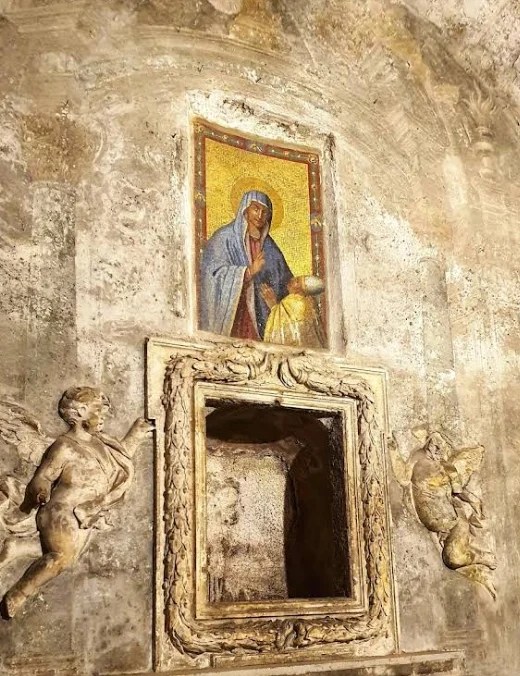
The remains of these early structures are still visible today in the crypt beneath the church, where fragments of the ancient Roman building and early Christian phases can be seen.
Dedication and Early Development
The basilica was later dedicated to Saint Martin of Tours, a 4th-century bishop known for his charity, and to Pope Saint Sylvester I, linking the church both to the age of Constantine and to the broader development of the Church in the West.
During the 6th century, the church was rebuilt and elevated, placing the earlier structure below ground. Additional reconstructions followed under Pope Hadrian I in the 8th century and Pope Sergius II in the 9th century, shaping the basilica into a larger and more defined ecclesiastical complex.
These successive reconstructions reflect the continued importance of the church within the liturgical and pastoral life of Rome.
Medieval and Monastic Development
By the Middle Ages, the basilica had become a significant religious center. In the 13th century, the church was entrusted to the Carmelite Order, which has remained associated with the site ever since.
The complex developed into a combination of parish church, monastic community, and titular basilica. The Carmelite presence contributed to the preservation of the church and its liturgical life through the centuries.
Baroque Transformation and Interior
The present appearance of the church reflects a major 17th-century restoration, particularly under the direction of Filippo Gagliardi, which introduced Baroque elements while preserving the earlier structural framework.
The basilica retains a three-nave plan, with ancient columns separating the nave from the aisles. The interior includes fresco cycles, chapels, and devotional images added over time, reflecting the artistic patronage of different periods.
Beneath the high altar are relics associated with early Christian martyrs, transferred from the catacombs, reinforcing the connection between the liturgy and the memory of the saints.
The crypt remains one of the most significant features of the church, preserving traces of early Christian worship and later medieval modifications.
The Station Significance
As the station church for this day of Lent, Santi Silvestro e Martino ai Monti brings the faithful into direct contact with the transition from hidden, domestic Christianity to the public life of the Church in Rome.
The layered structure of the basilica—house church, early basilica, medieval reconstruction, and Baroque restoration—embodies the historical development of the Christian community itself.
Here, the Lenten pilgrimage pauses in a place where the Church first gathered quietly in private spaces and later emerged into the open, carrying forward the memory of the martyrs and the continuity of worship across the centuries.
Receive these articles daily in your inbox by subscribing here:
And please share this article with your family and friends — every share helps our fellow Catholic brothers and sisters discover Rome’s most ancient treasures, and hopefully brings edification through the liturgical season of Lent.
The full Lenten itinerary can be found here at the sticky post with links to every video tour of the Roman Station Churches available at Crux Stationalis.
I propose two works for your Lenten meditations and beyond Lent to concentrate your prayer on the Passion of Christ and his Love for you in His Passion: 31 Days of Meditations on the Passion written by a Passionist Father and Flowers of the Passion by St. Paul of the Cross.
 Crux Stationalis