The Lenten Station
On the Friday of the Fourth Week of Lent, the Roman stational tradition gathers the faithful at Sant’Eusebio all’Esquilino, located on the Esquiline Hill near Piazza Vittorio Emanuele II. Though surrounded today by later urban development, the church stands on one of the oldest Christian sites in Rome and continues to function as a titular and parish church.
This station brings the Lenten pilgrimage into a place rooted in the earliest parish structure of the Roman Church.
Video Tour of Sant’Eusebio
Origins in the House of Eusebius
The origins of Sant’Eusebio are traditionally connected to the house of a Roman priest named Eusebius, who lived in the 4th century. According to tradition, he suffered for the faith during theological conflicts of the time and died around 357 AD, possibly under house arrest.
The site became known as the Titulus Eusebii, one of the earliest parish churches in Rome. It is documented in the acts of the Roman synod of 499, confirming its role as an established center of Christian worship in the early Church.
Archaeological evidence indicates that the church developed over earlier Roman structures, with remains dating back to the 2nd century, later adapted for Christian use.
Early Construction and Medieval Development
The first formal church building likely dates to the late 4th or early 5th century, making Sant’Eusebio one of the oldest churches in Rome.
The basilica was rebuilt and restored multiple times during the early medieval period. A significant reconstruction took place under Pope Zacharias in the 8th century, followed by another major rebuilding and consecration under Pope Gregory IX in 1238, after which the church was dedicated to Saint Eusebius and Saint Vincent.
Elements of the Romanesque structure from this period survived later modifications, preserving the continuity of the church’s early architectural identity.
Monastic and Later History
In the Middle Ages, Sant’Eusebio became associated with a monastic community, at one point belonging to the Celestine Order. The adjoining monastery played a role in the intellectual life of the city and even housed one of the early printing workshops in Rome.
The complex underwent changes in ownership over the centuries. In the 19th century, after the suppression of certain religious orders, the church passed through different hands before becoming a parish church under diocesan clergy.
A long-standing Roman tradition associated with the church is the blessing of animals on January 17, the feast of Saint Anthony Abbot, a custom transferred here in the modern period and still observed annually.
Baroque and Later Renovations
The present appearance of Sant’Eusebio reflects significant Baroque and later restorations. The façade with its five-arched portico dates to 1711, giving the church its current external form.
Inside, the basilica follows a three-nave plan, with a central nave flanked by aisles. Much of the interior arrangement dates to renovations around 1600, including the presbytery and high altar.
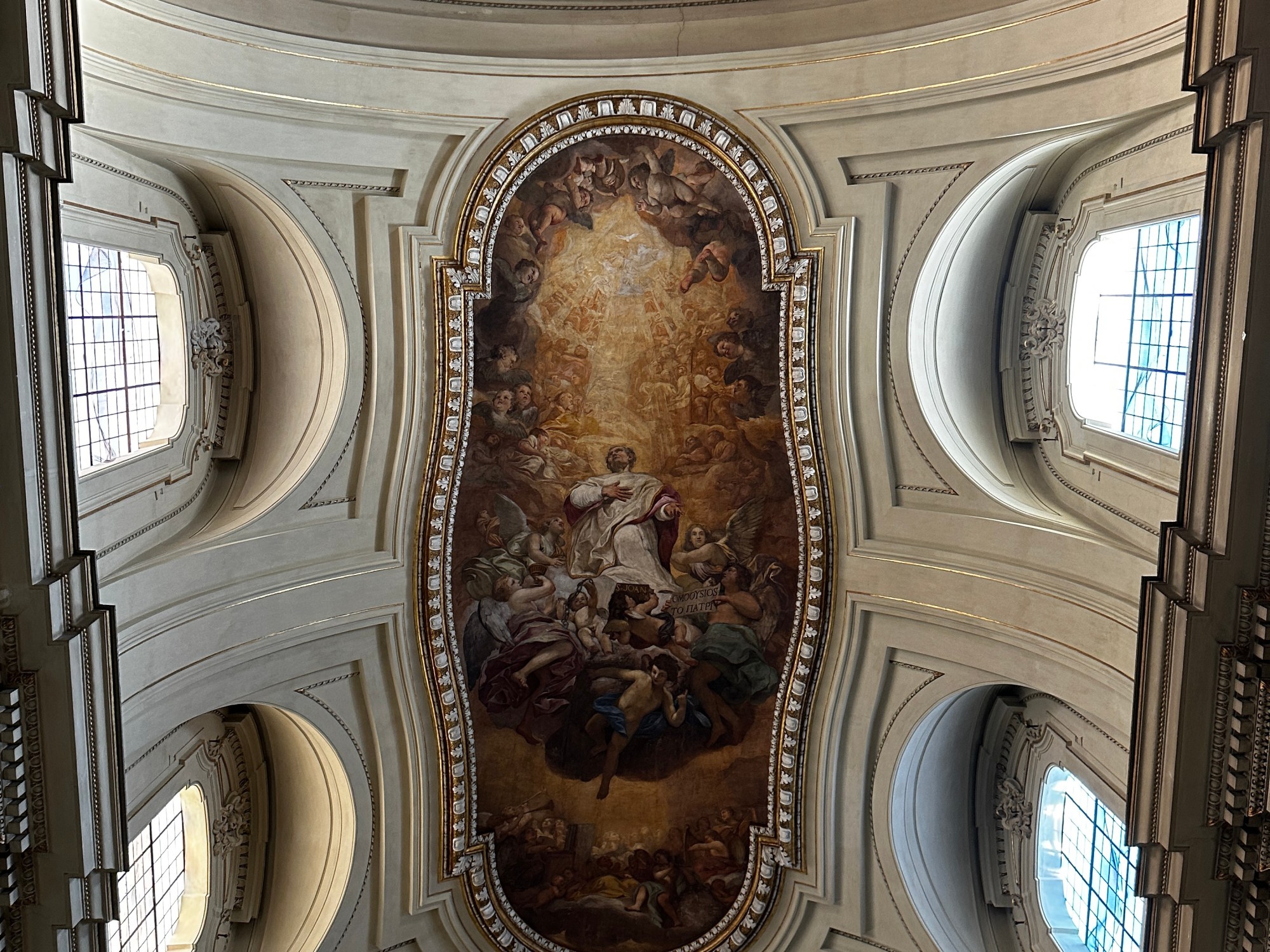
The church contains a range of artistic works from the 17th and 18th centuries. Among them is the ceiling fresco by Anton Raphael Mengs (1757) depicting the Glory of Saint Eusebius, along with paintings attributed to artists such as Pompeo Batoni and others associated with Roman Baroque and later traditions.
Beneath the high altar are preserved the relics of Saint Eusebius, maintaining the connection between the liturgy and the memory of the church’s patron.
The Station Significance
As the station church for this day of Lent, Sant’Eusebio all’Esquilino places the faithful within one of the earliest parish communities of Rome. Its origins in a private residence, its development into a titular church, and its continued liturgical life reflect the growth of the Church from small gatherings to an established presence in the city.
Here, the Lenten pilgrimage pauses in a church shaped by early witness, doctrinal struggle, and centuries of worship — a reminder that the life of the Church in Rome was formed not only by the great basilicas, but by these ancient parish communities where the faith was first lived and defended.
Receive these articles daily in your inbox by subscribing here:
And please share this article with your family and friends — every share helps our fellow Catholic brothers and sisters discover Rome’s most ancient treasures, and hopefully brings edification through the liturgical season of Lent.
The full Lenten itinerary can be found here at the sticky post with links to every video tour of the Roman Station Churches available at Crux Stationalis.
I propose two works for your Lenten meditations and beyond Lent to concentrate your prayer on the Passion of Christ and his Love for you in His Passion: 31 Days of Meditations on the Passion written by a Passionist Father and Flowers of the Passion by St. Paul of the Cross.
 Crux Stationalis