The Lenten Station at the Tomb of Peter
On the Fifth Sunday of Lent, traditionally called Passion Sunday, the Roman stational liturgy gathers at San Pietro in Vaticano, the basilica built over the tomb of Saint Peter the Apostle. This is one of the four major papal basilicas and the central pilgrimage site of the Roman Church.
The assignment of this station is not incidental. As Lent enters its final phase, the Church gathers at the tomb of the Prince of the Apostles, where the liturgy begins to turn explicitly toward the Passion of Christ.
Video Tour of San Pietro in Vaticano
Passion Sunday in the Roman Tradition
In the traditional Roman calendar, Passion Sunday marks a shift in the tone of Lent. The liturgy intensifies, images are veiled, and the focus narrows toward the suffering of Christ.
At Saint Peter’s, this day has long been marked by a solemn stational liturgy, including Vespers (now Holy Mass, since 2023) celebrated with the canons of the basilica. The rites are not limited to the altar but extend through the entire space of the basilica, incorporating procession, chant, and the veneration of relics.
The setting itself reinforces the apostolic foundation of the Church: the liturgy unfolds directly above the tomb of Peter, linking the Passion of Christ with the witness of the apostle who would also be martyred in Rome.
The Veil of Veronica
Central to the station on this day is the Veil of Veronica, one of the most venerated relics preserved in Saint Peter’s Basilica.
According to Christian tradition, Saint Veronica encountered Christ on the road to Calvary and wiped His face with a cloth. The image of His face was miraculously imprinted upon it, giving rise to the name vera icona — the “true image.”
This relic, associated with the Sixth Station of the Cross, became one of the most important objects of devotion in medieval Rome. By the 13th and 14th centuries, it was regularly displayed to pilgrims, and its public exposition contributed to the development of large-scale pilgrimages and even the first Jubilee Year in 1300.
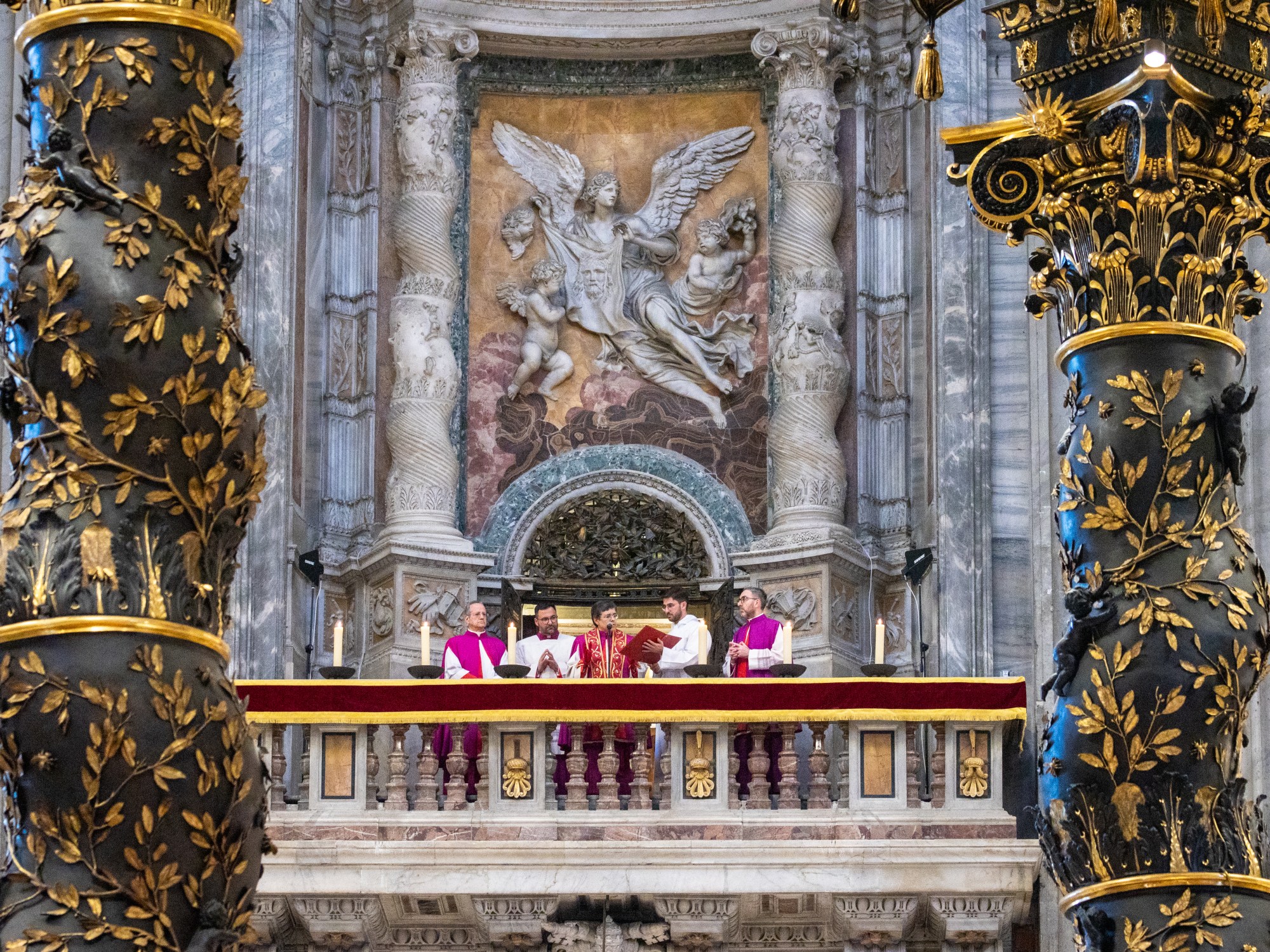
Within the basilica, the veil is kept in a chapel hidden within one of the great piers supporting the dome. Above the pier is a loggia, from which the relic is shown to the faithful on specific occasions.
The Rite of the Ostension
On Passion Sunday, an ancient Roman custom is still observed: the ostension of the Veil of Veronica.
During the liturgy, clergy process through the basilica, and at a designated moment, the relic is displayed from the loggia to the faithful gathered below. This act is not merely devotional but liturgical, integrated into the structure of the station.
Alongside the veil, other relics of the Passion—such as the lance of Saint Longinus and fragments of the True Cross—are also preserved in the basilica and connected to the broader Lenten cycle of veneration.
The Basilica and Its Structure
The present basilica, constructed in the 16th and 17th centuries, stands over the Constantinian church built above the apostle’s tomb. Its vast interior, the longest nave in the world, and the monumental dome create a setting suited to the scale of these liturgical rites.
Bernini’s design incorporated four great piers, each housing a relic of the Passion, with statues and loggias built to facilitate their public display. The pier of Saint Veronica remains one of these focal points.
The Station Significance
As the station church for Passion Sunday, San Pietro in Vaticano unites multiple dimensions of the Lenten journey: the apostolic foundation of the Church, the veneration of the Passion, and the preparation for Holy Week.
The faithful gather at the tomb of Peter, but the liturgy directs their attention upward—to the image of the suffering Christ.
In the Roman tradition, this moment is precise: before entering the events of Holy Week, the Church is given one final act of contemplation — to look upon the Face of Christ, marked by the Passion, and to follow Him to the Cross.
Receive these articles daily in your inbox by subscribing here:
And please share this article with your family and friends — every share helps our fellow Catholic brothers and sisters discover Rome’s most ancient treasures, and hopefully brings edification through the liturgical season of Lent.
The full Lenten itinerary can be found here at the sticky post with links to every video tour of the Roman Station Churches available at Crux Stationalis.
I propose two works for your Lenten meditations and beyond Lent to concentrate your prayer on the Passion of Christ and his Love for you in His Passion: 31 Days of Meditations on the Passion written by a Passionist Father and Flowers of the Passion by St. Paul of the Cross.
 Crux Stationalis