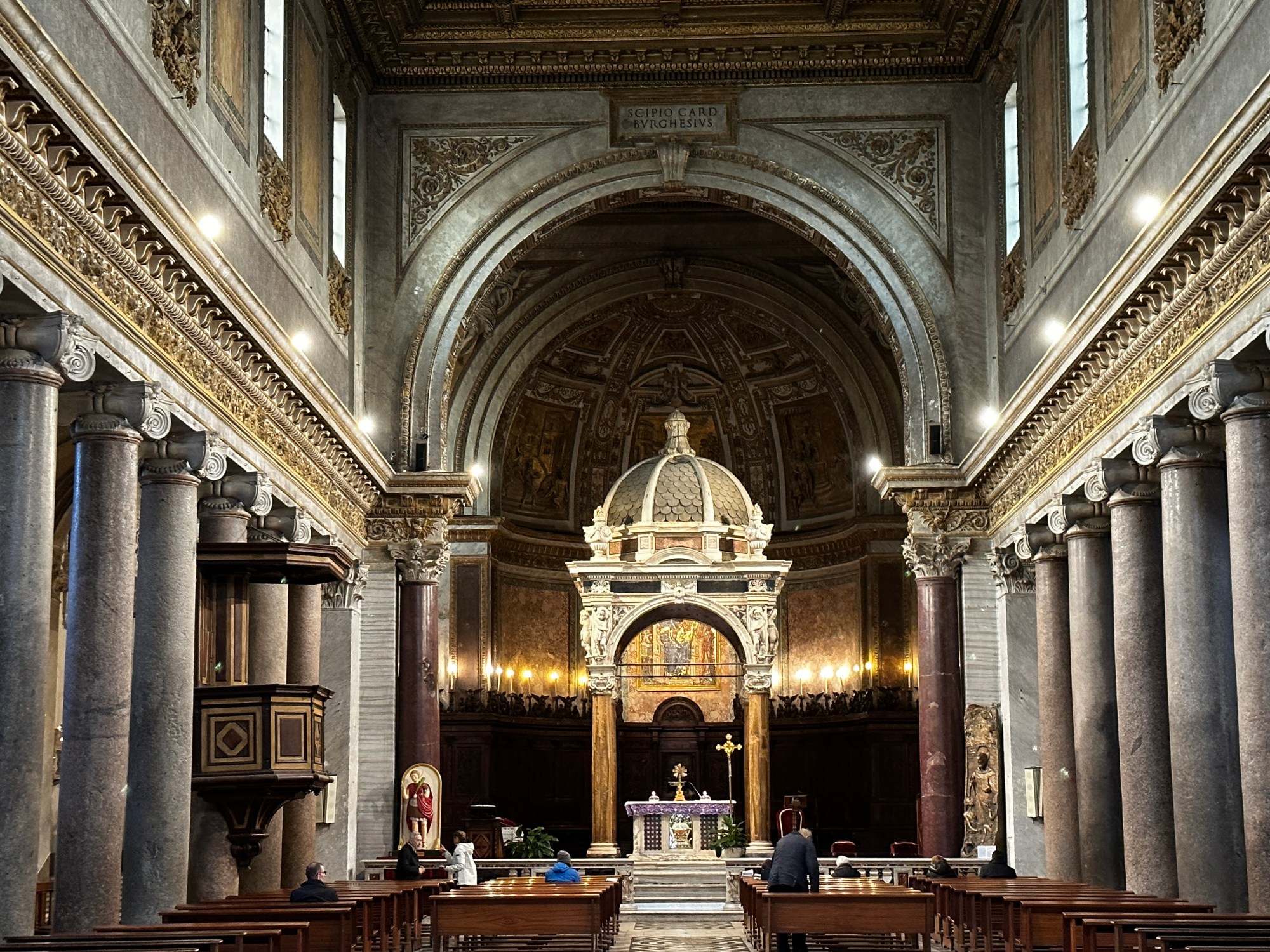
The Lenten Station
On the Monday of the Fifth Week of Lent, the Roman stational tradition gathers the faithful at San Crisogono, located in the Trastevere district, one of the oldest Christian areas of Rome. The basilica stands along the ancient urban fabric of the city, but its true significance lies beneath the present structure, where the remains of one of the earliest parish churches of Rome are preserved.
This station places the Lenten pilgrimage within a church that reflects the continuity of Christian worship from the earliest centuries to the present.
Video Tour of San Crisogono
One of the Oldest Tituli of Rome
San Crisogono is among the earliest titular churches (tituli) of the Roman Church, with origins dating to the 4th century, traditionally associated with the pontificate of Pope Sylvester I.
It is documented in the acts of the Roman synod of 499 as the Titulus Chrysogoni, confirming its role as an established parish community in the early Church.
The first church was built within a Roman domestic structure, likely a large private residence adapted for Christian worship. This reflects the early pattern of the Church in Rome, where liturgical life developed within houses before the construction of monumental basilicas.
The Martyr Saint Chrysogonus
The basilica is dedicated to Saint Chrysogonus, a martyr associated with Aquileia, who suffered during the persecution of Diocletian in the early 4th century.
His cult spread rapidly, and his name was incorporated into the Roman liturgical tradition. The presence of his dedication in one of Rome’s earliest parish churches reflects the strong connection between the Roman Church and the wider Christian world of late antiquity.
The title of the church preserves this devotion, linking the local Roman community to the memory of a martyr venerated across the empire.
The Subterranean Basilica
Beneath the present church lies the most significant feature of San Crisogono: the remains of the early Christian basilica, discovered in the early 20th century.
This lower church preserves the structure of the original place of worship, including a semi-circular apse, sections of the nave, and adjoining rooms. These spaces likely served liturgical and sacramental functions, indicating a fully developed parish life already present in the early centuries.
The existence of this underground basilica provides direct evidence of the transition from domestic worship to organized ecclesiastical structures in Rome.
Medieval Reconstruction
The church underwent significant rebuilding in the early medieval period. In the 8th century, Pope Gregory III restored the basilica and established a monastic presence, reflecting the integration of parish and monastic life.
A further major reconstruction took place in the 12th century, during which the church was rebuilt on a larger scale. From this period remains the Romanesque bell tower, still visible today and marking the medieval phase of the basilica’s development.
These reconstructions preserved the continuity of the site while adapting it to the needs of the growing Christian community.
Baroque Church Above
The present basilica dates largely to a 17th-century reconstruction, completed in 1626 under the patronage of Cardinal Scipione Borghese.
The new church was built above the earlier structures, creating a layered complex in which the ancient basilica remains preserved below ground. The interior reflects Baroque design, while incorporating ancient columns reused from earlier Roman buildings, maintaining continuity with the past.
Later restorations ensured the preservation of both the upper church and the archaeological remains beneath it.
The Station Significance
As the station church for this day of Lent, San Crisogono places the faithful within one of the earliest centers of Christian parish life in Rome.
The church reveals, in a single site, the entire development of the Roman Church: from house church, to early basilica, to medieval reconstruction, to Baroque renewal.
Here, the Lenten pilgrimage pauses in a place where the faith was first lived in hidden domestic spaces and then carried forward through centuries of worship, preserved on the same ground across generations.
Receive these articles daily in your inbox by subscribing here:
And please share this article with your family and friends — every share helps our fellow Catholic brothers and sisters discover Rome’s most ancient treasures, and hopefully brings edification through the liturgical season of Lent.
The full Lenten itinerary can be found here at the sticky post with links to every video tour of the Roman Station Churches available at Crux Stationalis.
I propose two works for your Lenten meditations and beyond Lent to concentrate your prayer on the Passion of Christ and his Love for you in His Passion: 31 Days of Meditations on the Passion written by a Passionist Father and Flowers of the Passion by St. Paul of the Cross.
 Crux Stationalis