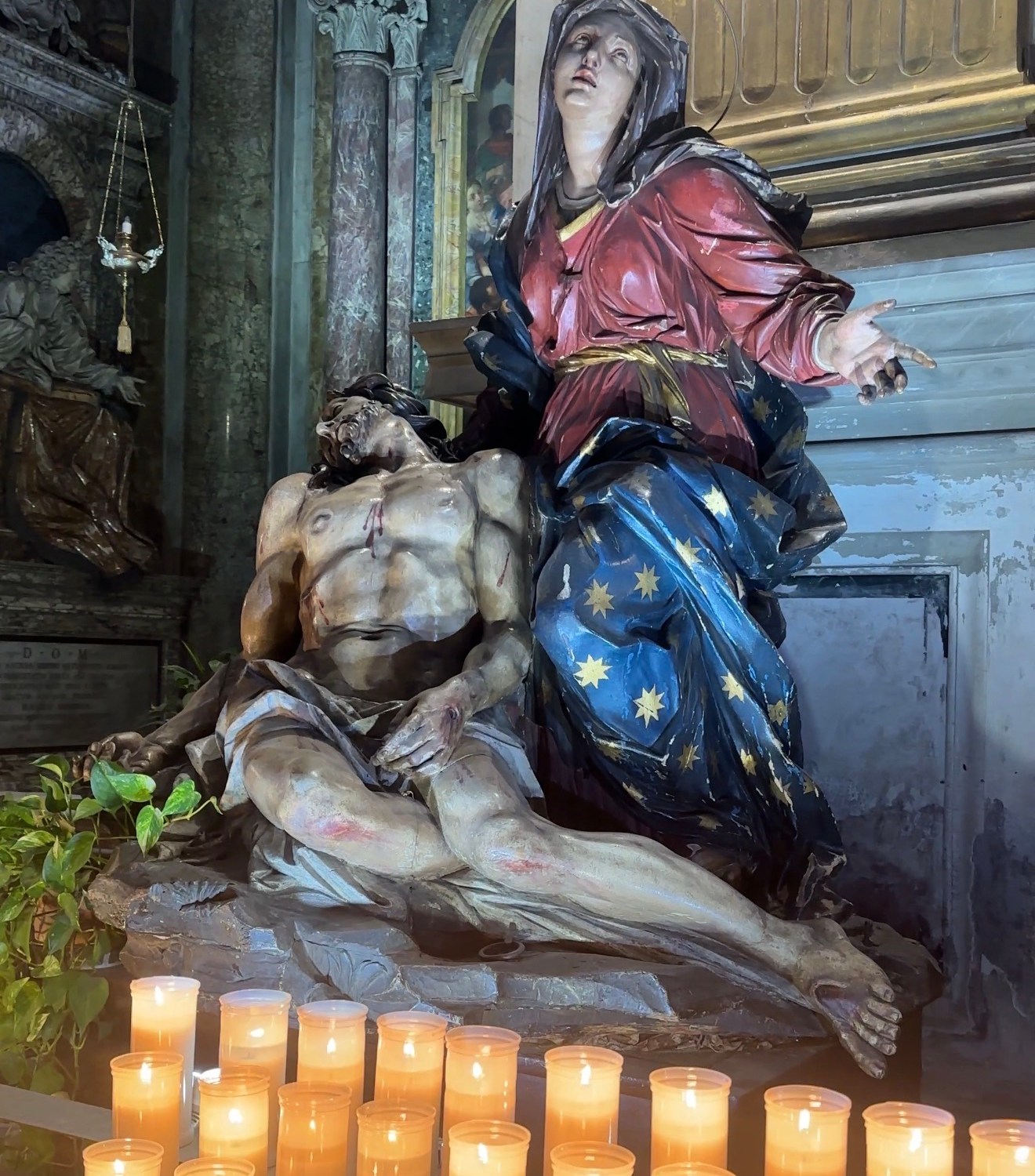
The Lenten Station
On the Tuesday of the Fifth Week of Lent, the Roman stational tradition gathers the faithful at San Marcello al Corso, located along the Via del Corso, the ancient Via Lata, in the rione Trevi. The church stands on one of the principal streets of Rome, but its origins reach back to the earliest centuries of the Christian community in the city.
This station places the Lenten pilgrimage within a church marked by persecution, destruction, and renewal — a fitting context as the liturgy intensifies toward the Passion.
Video Tour of San Marcello al Corso
Origins in the Early Church
San Marcello al Corso is built on 4th-century foundations, making it one of the earliest Christian sites in Rome. It is documented as the Titulus Marcelli by at least 418 AD, when Pope Boniface I was elected there, confirming its importance as an established parish church.
Tradition associates the site with Pope Saint Marcellus I (308–309), who suffered during the persecution under Emperor Maxentius. He is said to have been condemned to forced labor in imperial stables, where he died from exhaustion.
The dedication of the church preserves his memory and links the site directly to the suffering of the early Roman Church.
Medieval Development
In the 8th century, Pope Adrian I rebuilt the church, creating a structure whose remains lie beneath the present basilica.
By the Middle Ages, San Marcello had become a parochial and collegiate church, administered by secular clergy. In 1375, Pope Gregory XI entrusted the church to the Servite Order, who established a convent and have maintained the church ever since.
The church also played a role in the civic life of Rome. In 1354, the body of Cola di Rienzo was displayed here after his execution, demonstrating the church’s place within the public life of the city.
Fire and the Miraculous Crucifix
On May 22, 1519, a devastating fire destroyed the church, leaving it in ruins.
Amid the destruction, a wooden crucifix, dating to the 15th century, survived the flames unharmed. This event was immediately regarded as miraculous and became the center of intense devotion among the Roman faithful.
In 1522, during a severe plague in Rome, the crucifix was carried in procession through the city for several days. According to tradition, the plague subsided afterward, further strengthening devotion to the image.
This crucifix remains one of the most important devotional objects in Rome and is still venerated in the church today.
Reconstruction and Baroque Church
Rebuilding began after the fire, initially under Jacopo Sansovino, but was interrupted by the Sack of Rome in 1527 and further complications, including flooding of the Tiber.
The reconstruction continued under Antonio da Sangallo the Younger and other architects, and the church was finally completed in the late 17th century, with the façade designed by Carlo Fontana between 1692 and 1697.
The present church reflects this Baroque completion, with a monumental façade and richly decorated interior. Beneath the high altar are the relics of Saint Marcellus and other saints, linking the liturgy to the memory of martyrdom.
Interior and Devotional Life
The basilica contains numerous chapels and artworks from the Renaissance and Baroque periods. Among its most important features is the Chapel of the Crucifix, where the miraculous crucifix is preserved and venerated.
The church has long been associated with confraternities and public devotion, particularly centered on the Cross and the Passion of Christ.
The Station Significance
As the station church for this day of Lent, San Marcello al Corso brings the faithful into a place defined by trial, destruction, and renewal.
The survival of the crucifix through fire and its role in times of plague place the Cross at the center of the church’s identity.
Here, in the final weeks of Lent, the Roman pilgrimage pauses before the image of Christ crucified — a reminder that even in destruction, the Cross remains, and through it comes both endurance and deliverance.
Receive these articles daily in your inbox by subscribing here:
And please share this article with your family and friends — every share helps our fellow Catholic brothers and sisters discover Rome’s most ancient treasures, and hopefully brings edification through the liturgical season of Lent.
The full Lenten itinerary can be found here at the sticky post with links to every video tour of the Roman Station Churches available at Crux Stationalis.
I propose two works for your Lenten meditations and beyond Lent to concentrate your prayer on the Passion of Christ and his Love for you in His Passion: 31 Days of Meditations on the Passion written by a Passionist Father and Flowers of the Passion by St. Paul of the Cross.
 Crux Stationalis