The Lenten Station
On the Monday of the Holy Week of Lent, the Roman stational tradition gathers the faithful at Santa Prassede, located on the Esquiline Hill, near the basilica of Santa Maria Maggiore. This church stands within one of the oldest Christian areas of Rome and preserves a direct connection to the earliest generations of the Church.
As the final week of Lent begins, this station brings the pilgrimage into a church defined by the memory of the martyrs and the preservation of their relics.
Video Tour of Santa Prassede
Origins in the Earliest Roman Church
The site of Santa Prassede is associated with one of the earliest Christian communities in Rome. A titulus existed here by at least the 5th century, making it one of the original parish churches of the city.
Tradition connects the site to the household of Pudens, an early Roman convert, whose daughters Praxedes (Prassede) and Pudentiana were associated with the care of persecuted Christians.
According to this tradition, the house served as a place of refuge, where Christians gathered and where the bodies of martyrs were cared for and buried during times of persecution.
The Figure of Saint Praxedes
Saint Praxedes is remembered as a Roman Christian woman who dedicated her life to the service of the persecuted Church. Tradition holds that she collected the bodies of martyrs and arranged their burial, an act that was itself punishable under Roman law.
She is often depicted with a vessel, recalling the tradition that she gathered the blood of martyrs, preserving their memory and honoring their sacrifice.
While historical details are uncertain, the persistence of her cult reflects the importance of those who preserved the witness of the martyrs within the early Roman Church.
The Basilica of Pope Paschal I
The present church dates to the early 9th century, built under Pope Paschal I (817–824).
Paschal undertook a major program of recovering the relics of martyrs from the abandoned catacombs outside the city and translating them into churches within Rome. Santa Prassede became one of the principal sites for this effort.
Thousands of relics were brought here and placed beneath the church, transforming it into a central repository of the memory of the martyrs.
This action was not merely practical. It marked a shift in the life of the Church, bringing the presence of the martyrs into the daily liturgical life of the city.
Byzantine Mosaics and the Carolingian Renewal
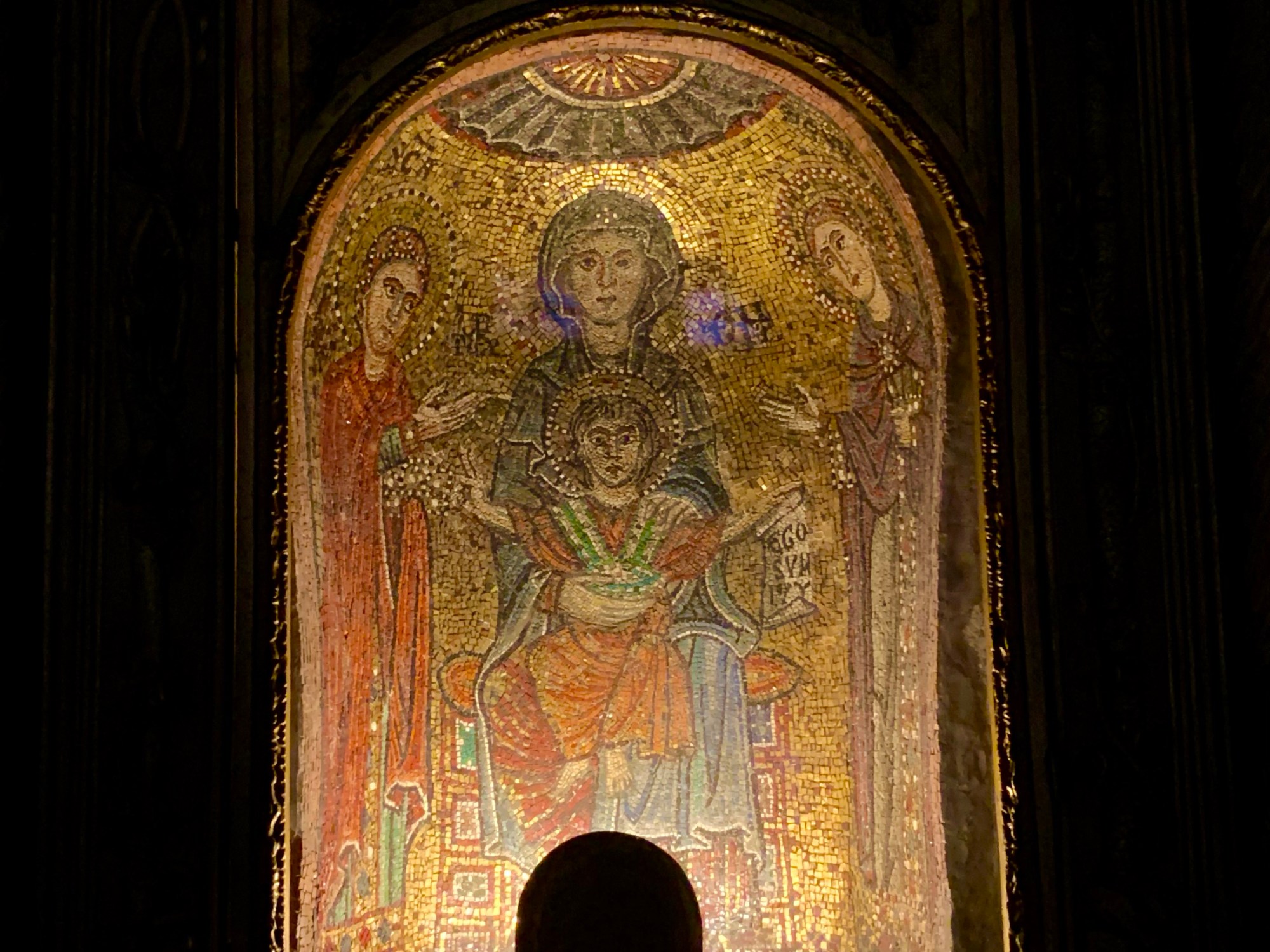
The basilica preserves one of the most important Byzantine mosaic programs in Rome, dating to the 9th century and commissioned by Paschal I.
The apse mosaic depicts Christ in glory, flanked by Saints Peter and Paul, presenting Praxedes and Pudentiana. Paschal himself is included, holding a model of the church, indicating his role in its construction.
The mosaics reflect the influence of the Carolingian renewal, which sought to recover the artistic and theological forms of early Christianity.
One of the most significant spaces within the church is the Chapel of Saint Zeno, entirely covered in mosaics, functioning as a funerary chapel and preserving the visual language of early Christian Rome.
Monastic Continuity
Since the 12th century, the church has been associated with the Vallumbrosian Benedictines, who have maintained the basilica and its liturgical life for centuries.
This continuity reflects the role of monastic communities in preserving the stational tradition and the physical fabric of the churches themselves.
The Station Significance
As the station church for this day of Lent, Santa Prassede places the faithful within a church defined by the memory and presence of the martyrs.
The translation of relics, the preservation of their witness, and the visual program of the mosaics all converge on a single point: the Church is built upon those who gave their lives for the faith.
At the beginning of Holy Week, the Lenten pilgrimage pauses here to recall that the Passion of Christ is not only commemorated—it is continued in the lives of the saints, whose memory is gathered, preserved, and placed at the center of the Church’s worship.
Receive these articles daily in your inbox by subscribing here:
And please share this article with your family and friends — every share helps our fellow Catholic brothers and sisters discover Rome’s most ancient treasures, and hopefully brings edification through the liturgical season of Lent.
The full Lenten itinerary can be found here at the sticky post with links to every video tour of the Roman Station Churches available at Crux Stationalis.
I propose two works for your Lenten meditations and beyond Lent to concentrate your prayer on the Passion of Christ and his Love for you in His Passion: 31 Days of Meditations on the Passion written by a Passionist Father and Flowers of the Passion by St. Paul of the Cross.
 Crux Stationalis