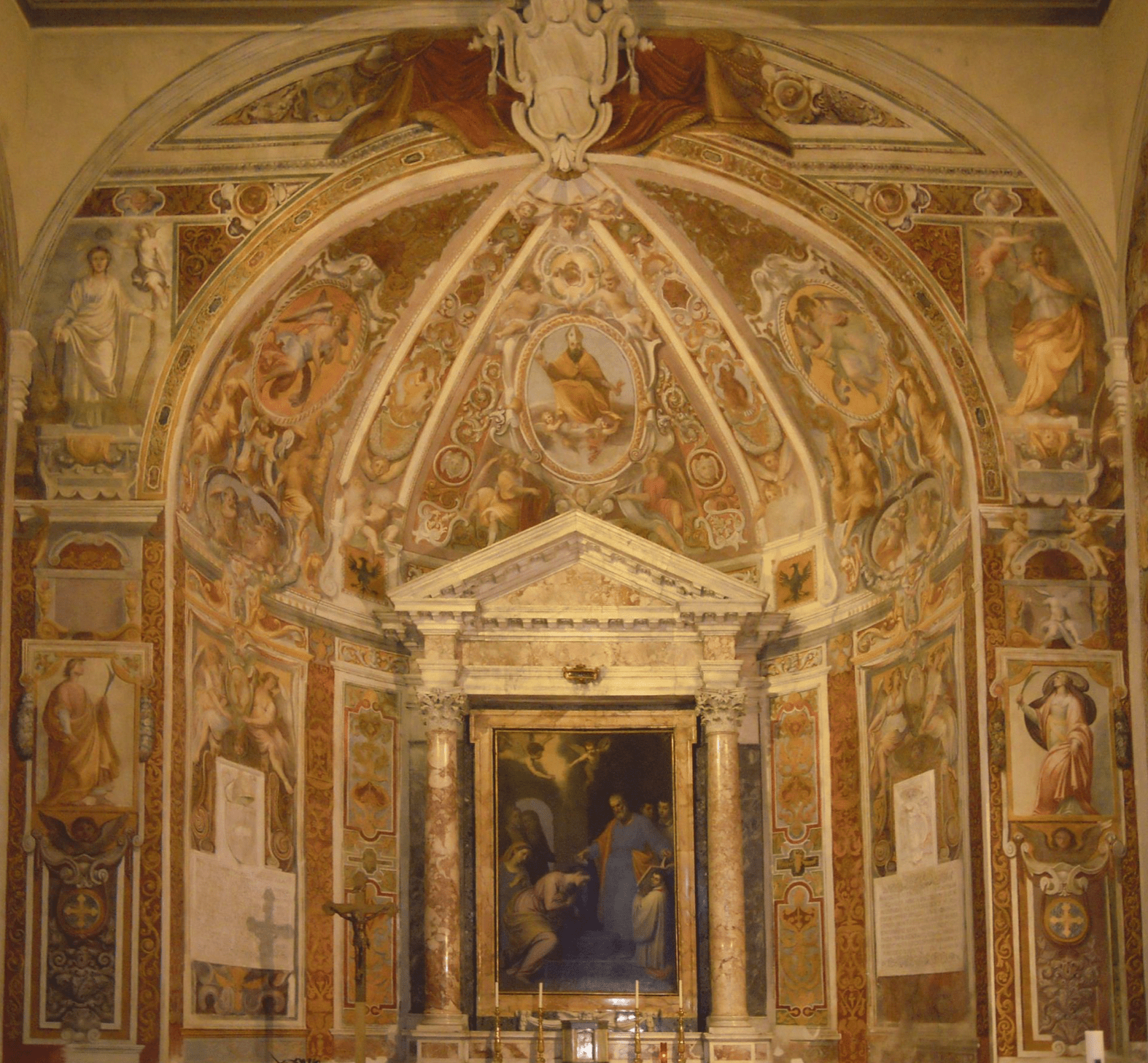
The Lenten Station
On Tuesday of Holy Week, the Roman stational tradition gathers the faithful at Santa Prisca, located on the Aventine Hill, one of the most ancient and symbolically significant areas of Rome. The church stands on a site associated with some of the earliest Christian presence in the city, preserving layers of both pagan and Christian history.
As Holy Week unfolds, this station places the faithful in a location tied directly to the apostolic age and the earliest witness of martyrdom in Rome.
Video Tour of Santa Prisca
The Earliest Christian Presence on the Aventine
The site of Santa Prisca is traditionally identified with the Titulus Aquilae et Priscillae, one of the earliest places of Christian worship in Rome.
According to tradition, this location was connected to Aquila and Prisca (Priscilla), early Christian figures mentioned in the New Testament and associated with the ministry of Saint Paul. It is also linked to the presence of Saint Peter, who is said to have baptized Prisca here.
Archaeological evidence confirms that the church was built over a Roman house dating to the 1st or 2nd century, reflecting the early pattern of Christian worship in domestic spaces.
This continuity—from house to titulus to basilica—places Santa Prisca among the earliest centers of Christian life in Rome.
The Martyr Saint Prisca
The church is dedicated to Saint Prisca, a 1st-century Roman martyr, whose life is preserved primarily through tradition.
She is said to have been baptized as a young girl, to have refused to sacrifice to pagan gods, and to have endured multiple forms of persecution. According to tradition, she was thrown to wild beasts, but they did not harm her; she was then subjected to further torture before ultimately being beheaded on the Via Ostiense.
Her relics are preserved beneath the church, maintaining the connection between the liturgy and the witness of martyrdom.
Built over a Mithraeum
One of the most significant aspects of Santa Prisca is what lies beneath it. The church was constructed over a Mithraeum, a sanctuary dedicated to the cult of Mithras, dating to the 2nd or 3rd century.
This underground complex preserves frescoes, ritual spaces, and inscriptions related to the Mithraic cult, which was widespread in the Roman Empire before the rise of Christianity.
Around the 4th or 5th century, the Mithraeum was abandoned and replaced by a Christian place of worship.
This transformation—from pagan cult site to Christian basilica—makes Santa Prisca a clear example of the reorientation of Roman religious life in late antiquity.
Development and Reconstruction
The church appears in the records of the Roman synod of 499 as the Titulus Priscae, confirming its status as an established parish church.
It was damaged during the Norman sack of Rome in 1084 and rebuilt in the 12th century, with further restorations carried out in later centuries.
The present appearance of the church largely reflects Baroque modifications, particularly the 17th-century façade by Carlo Lombardi.
Inside, only a few elements—such as the columns—remain from the earlier structure, while the crypt preserves frescoes and the altar containing the relics of Saint Prisca.
The Baptismal Font and Apostolic Tradition
One of the most significant elements of Santa Prisca is the ancient baptismal font, traditionally associated with Saint Peter.
According to long-standing Roman tradition, this site was used for the baptism of early converts, including the household connected to Prisca herself. The font is understood not merely as a later liturgical addition, but as a memory of the earliest sacramental life of the Church in Rome.
The presence of this font reinforces the identification of the site as a domus ecclesiae, a house church where the essential acts of Christian life—preaching, baptism, and Eucharistic gathering—took place before the construction of large basilicas.
In this context, baptism was not yet a public, architectural event as it would later become with baptisteries. It was administered within domestic or adapted spaces, marking entry into a persecuted and often hidden community.
The association with Saint Peter situates this site within the apostolic foundation of the Roman Church, linking it not only to martyrdom but to the initial act of Christian initiation.
The Station Significance
As the station church for Tuesday of Holy Week, Santa Prisca brings together multiple dimensions of the early Church: apostolic presence, martyrdom, and the transformation of pagan Rome.
The site holds the memory of Peter and Paul, the witness of a young martyr, and the visible transition from ancient religious practice to Christian worship.
At this stage of Lent, the Church gathers here to recall that the Passion of Christ was first lived and proclaimed in places like this — within houses, under persecution, and in direct confrontation with the religious world of Rome.
Santa Prisca stands as a witness to that beginning: the Gospel taking root, the martyrs giving their lives, and the Church emerging within the structures of the ancient city.
Receive these articles daily in your inbox by subscribing here:
And please share this article with your family and friends — every share helps our fellow Catholic brothers and sisters discover Rome’s most ancient treasures, and hopefully brings edification through the liturgical season of Lent.
The full Lenten itinerary can be found here at the sticky post with links to every video tour of the Roman Station Churches available at Crux Stationalis.
I propose two works for your Lenten meditations and beyond Lent to concentrate your prayer on the Passion of Christ and his Love for you in His Passion: 31 Days of Meditations on the Passion written by a Passionist Father and Flowers of the Passion by St. Paul of the Cross.
 Crux Stationalis