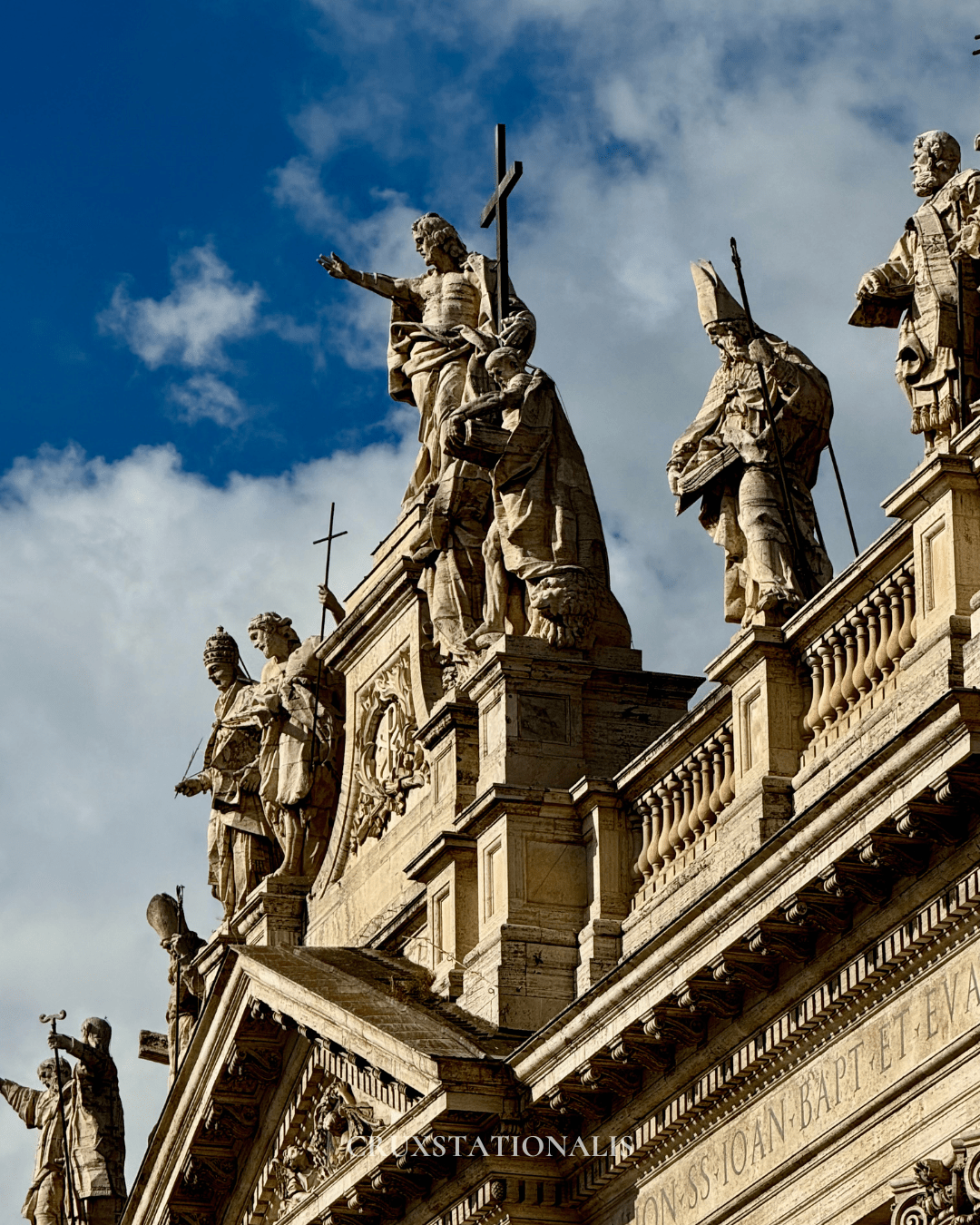
Pope Leo will celebrate the Holy Thursday Mass of the Lord’s Supper at the Roman Station Church of St. John Lateran, Rome’s Cathedral.
The very place in Rome that houses the table of the Last Supper:
Beyond the Station Church liturgies – I also provide you with the beautiful recordings from the FSSP Parish in Rome of the three services of Tenebrae:
Holy Thursday Tenebrae:
Good Friday Tenebrae:
Holy Saturday Tenebrae:
The Triduum in the Roman Station Tradition
The Sacred Triduum—Holy Thursday, Good Friday, and Holy Saturday—forms the summit of the liturgical year. In the Roman station tradition, these days are marked not by a movement across many churches, but by a deliberate concentration at key sites that express the fullness of the Church’s life: the Eucharist, the Passion, and the Resurrection.
The stations of these days—St. John Lateran, Santa Croce in Gerusalemme, and again St. John Lateran—are not incidental. Each is chosen to correspond precisely to the mystery being celebrated.
Holy Thursday: St. John Lateran
On Holy Thursday, the Church gathers at the Archbasilica of St. John Lateran, the cathedral of the Bishop of Rome and the mother church of the city and the world.
Founded in the 4th century under Constantine, the Lateran was the first public Christian basilica in Rome and remains the official seat of the Pope as Bishop of Rome.
The station here is directly connected to the institution of the Eucharist and the priesthood. In the ancient Roman practice, the bishop would celebrate the Mass of the Lord’s Supper in his cathedral, surrounded by clergy and faithful, emphasizing the unity of the Church around the Eucharistic sacrifice.
The Lateran also houses the papal altar, traditionally used only by the Pope or his delegate, reinforcing the connection between this liturgy and the apostolic authority of the Church.
Here, the Triduum begins not in a minor church, but at the central point of ecclesial life: the place where the Church is visibly constituted around the Eucharist.
Good Friday: Santa Croce in Gerusalemme
On Good Friday, the station shifts to Santa Croce in Gerusalemme, a basilica intimately tied to the relics of the Passion.
Founded in the 4th century by Saint Helena, mother of Constantine, the church was built to house relics brought from Jerusalem, including fragments of the True Cross, nails of the Crucifixion, and other instruments of the Passion.
The basilica was constructed using soil from Calvary, symbolically making the site a part of Jerusalem within Rome—hence the name “in Gerusalemme.”
The choice of this station is precise. On the day when the Church does not celebrate the Mass but instead venerates the Cross, the faithful are brought to the very place where the physical remnants of the Passion are preserved.
The liturgy of Good Friday—centered on the proclamation of the Passion, the solemn intercessions, and the veneration of the Cross—finds its natural setting here.
This is not symbolic proximity. It is physical: the Cross that is venerated in the liturgy corresponds to relics present within the church itself.
Holy Saturday: St. John Lateran
On Holy Saturday, the station returns to St. John Lateran for the Easter Vigil, the most solemn liturgy of the entire year.
Historically, this was the night of baptism for catechumens. The Lateran Baptistery, one of the oldest in Christendom, stands adjacent to the basilica and was the site where new Christians were initiated into the Church.
The return to the Lateran reflects the completion of the Triduum: from the institution of the Eucharist, through the Passion, to the new life of the Resurrection given in baptism.
The liturgy of the Vigil—beginning in darkness, moving through the proclamation of salvation history, and culminating in the celebration of the Eucharist—unfolds in the Church’s cathedral, where the full sacramental life is made visible.
The Unity of the Triduum
Taken together, these three stations form a unified theological movement.
At the Lateran, the Church is constituted in the Eucharist.
At Santa Croce, the Church contemplates the Cross.
At the Lateran again, the Church is renewed through baptism and Resurrection.
The Roman station tradition does not scatter these days across the city. It concentrates them, placing each mystery in its proper setting.
The result is not simply a sequence of liturgies, but a coherent movement: from altar, to Cross, to font — the full life of the Church revealed in three days.
Receive these articles daily in your inbox by subscribing here:
And please share this article with your family and friends — every share helps our fellow Catholic brothers and sisters discover Rome’s most ancient treasures, and hopefully brings edification through the liturgical season of Lent.
The full Lenten itinerary can be found here at the sticky post with links to every video tour of the Roman Station Churches available at Crux Stationalis.
I propose two works for your Lenten meditations and beyond Lent to concentrate your prayer on the Passion of Christ and his Love for you in His Passion: 31 Days of Meditations on the Passion written by a Passionist Father and Flowers of the Passion by St. Paul of the Cross.
 Crux Stationalis