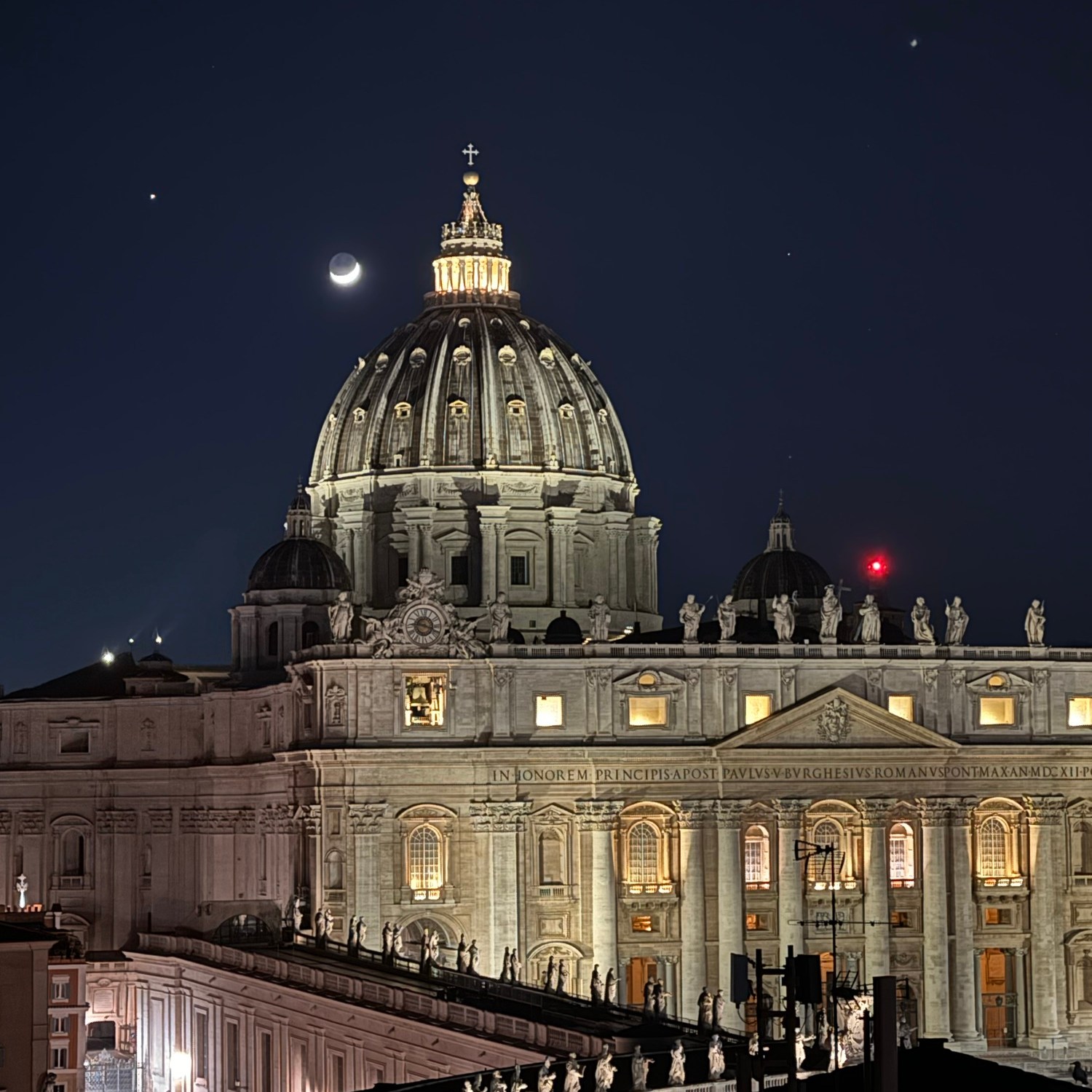
St. Peter’s Basilica, officially known as the Papal Major Basilica of St. Peter in the Vatican, stands as a monumental testament to faith, art, and history. Located in Vatican City, this basilica is traditionally believed to be the burial site of Saint Peter, one of Jesus’ apostles and the first Bishop of Rome. Over centuries, it has evolved into a pilgrimage destination, especially during Jubilee Years, drawing 1.3 million pilgrims in the first month of the Jubilee Year of Hope.
Subscribe here to follow Crux Stationalis during the Jubilee Year of Hope to Rome’s most ancient churches on the Roman Station Church Pilgrim Itinerary:
Historical Foundations
The origins of St. Peter’s Basilica trace back to the martyrdom of Saint Peter around 64 or 67 AD. The area, then known as the Ager Vaticanus, was a suburban expanse dotted with tombs and villas. Notably, the Circus of Caligula and Nero, an ancient chariot-racing stadium, was situated nearby, with the Vatican Hill rising to its north. Following his crucifixion, Peter was interred in this vicinity, with archaeological findings revealing a simple grave beneath the basilica’s current high altar. This humble burial site laid the foundation for what would become one of Christianity’s most significant edifices.
Architectural Evolution
The basilica we see today is the result of centuries of architectural evolution. The original structure, commissioned by Emperor Constantine in the 4th century, underwent numerous modifications. The Renaissance era ushered in a comprehensive reconstruction, with contributions from luminaries like Bramante, Michelangelo, and Bernini. Their combined genius bestowed the basilica with its iconic dome, expansive nave, and the harmonious blend of Renaissance and Baroque artistry that captivates visitors to this day.
Bernini’s Baldacchino
Central to the basilica’s grandeur is Bernini’s Baldacchino, a monumental bronze canopy that gracefully arches over the main altar. Erected between 1624 and 1633, this masterpiece exemplifies the Baroque era’s dramatic flair. The undulating columns and intricate detailing draw the observer’s gaze upward, symbolizing a connection between the earthly and the divine. One 19th century pilgrim eloquently captured its essence, describing it as a “temple within a temple,” underscoring its profound impact on the spatial dynamics of the basilica.
The 2025 Jubilee Year
The year 2025 holds special significance as a Jubilee Year, a tradition in the Catholic Church that offers the faithful opportunities for pilgrimage, penance, and renewal. The Jubilee commenced on December 24, 2024, with Pope Francis ceremoniously opening the Holy Door of St. Peter’s Basilica. This act symbolizes an invitation to spiritual renewal and reconciliation. In the initial weeks, over 1.3 million pilgrims have traversed this sacred threshold, reflecting the basilica’s enduring allure and spiritual magnetism.
Roman Station Church Pilgrimage
During Lent, Rome’s faithful embark on the Roman Station Church Pilgrimage, a tradition that dates back to the early Christian community. This pilgrimage involves visiting specific churches on designated days, fostering communal prayer and reflection. St. Peter’s Basilica holds a prominent place in this itinerary, serving as the station church for significant liturgical celebrations.
Relics of the Passion
Pilgrims visiting St. Peter’s during Lent have the unique opportunity to venerate sacred relics associated with Christ’s Passion. Among these are the Lance of St. Longinus, believed to be the spear that pierced Christ’s side, and the Veil of Veronica, said to bear the image of Christ’s face. These relics are displayed at designated times, offering the faithful moments of deep spiritual connection and contemplation: the Saturday after the first Sunday of Lent (Lance of St. Longinus) and Passion Sunday (Veil of Veronica).
Pilgrimage Experience
For pilgrims journeying to St. Peter’s during the Jubilee, the experience is both profound and transformative. The basilica’s vast interior houses numerous chapels, each adorned with artistic treasures and relics. The Pietà by Michelangelo, a poignant sculpture depicting the Virgin Mary cradling the lifeless body of Christ, remains a focal point of reflection and veneration. Ascending to the dome offers panoramic vistas of Rome, allowing pilgrims to contemplate the city’s rich tapestry of history and faith.
Liturgical Significance
Beyond its architectural splendor, St. Peter’s Basilica serves as the epicenter of numerous liturgical ceremonies, especially during the Jubilee. Masses, vespers, and special blessings are held regularly, providing the faithful with opportunities for communal worship and personal reflection. Daily Mass and pr
Artistic and Cultural Impact
The basilica’s influence extends beyond the religious realm into art and culture. Its design has inspired countless structures worldwide, and its artworks have been subjects of study and admiration. The 2025 Jubilee has also ushered in cultural events, including exhibitions and performances, celebrating the intersection of faith and creativity. These events underscore the basilica’s role as a beacon of artistic expression and human achievement.
Enduring legacy of faith
St. Peter’s Basilica stands as a monumental testament to the enduring legacy of faith, art, and history. Its evolution from a modest grave to a grand basilica encapsulates the spirit of resilience and devotion. As the 2025 Jubilee unfolds, the basilica continues to draw pilgrims and visitors, offering a sanctuary for reflection, inspiration, and spiritual renewal. Whether one is drawn by faith, art, or history, St. Peter’s remains a beacon of human aspiration and divine grace.

