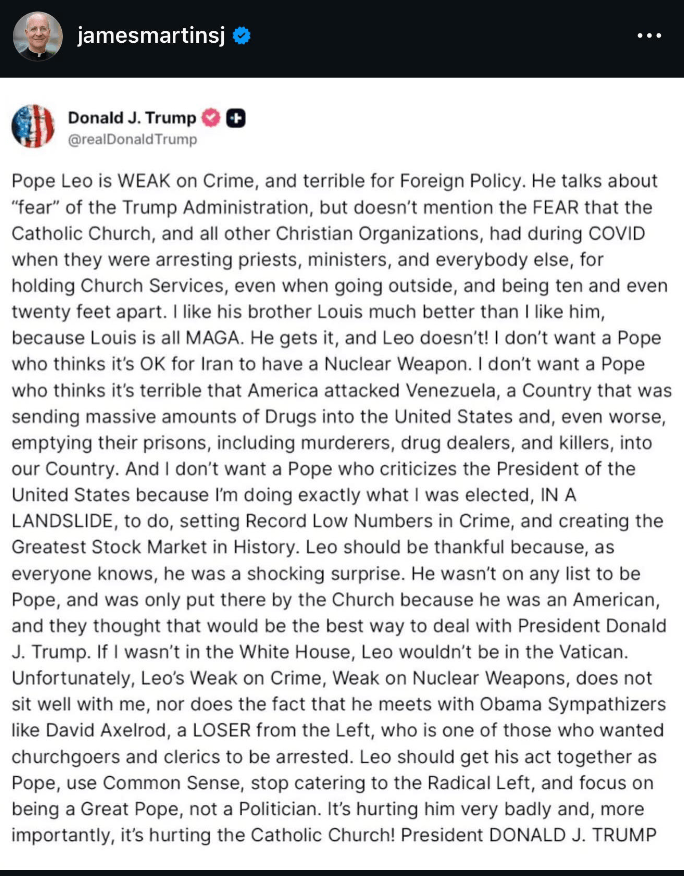
Aboard the papal flight to Africa, Pope Leo XIV offered a strikingly clear and unambiguous reflection on his role in a world increasingly shaped by political tension and global conflict. Responding to questions that inevitably touched on world leaders and current affairs after Trump’s Truth Social post, the Holy Father resisted any attempt to draw him into partisan debate. His answer was simple, but deeply revealing: “I am not a politician.”
The remark was not evasive—it was clarifying. Pope Leo XIV did not deny the urgency of the issues at hand, nor did he retreat from speaking about them. Instead, he placed his mission firmly within its proper horizon: the Gospel.
“I have no intention of entering into a debate with him,” the Pope said, referring to U.S. President Donald Trump. “Rather, let us always seek peace and put an end to wars.” In an age when even religious voices are often drawn into ideological camps, the Pope’s insistence on remaining outside the machinery of political contestation is both countercultural and deeply traditional.
He continued: “I am not afraid of the Trump administration. I speak about the Gospel, I am not a politician.” These words are not merely defensive—they are programmatic. They reveal a pontificate determined to speak with moral clarity, but without becoming entangled in the shifting allegiances of political life.
At the heart of his concern is something far more urgent than political rivalry: human suffering. “Too many people are suffering in the world,” he said. It is this reality—not political strategy—that drives his voice. For Pope Leo XIV, the Church cannot afford to become another actor in the arena of power when the stakes are measured in lives lost, families displaced, and nations torn apart by war.
He warned, too, against the instrumentalization of religion: “I do not think the message of the Gospel should be abused in the way some people are doing.” This is a subtle but firm rebuke of attempts—on any side—to co-opt Christian language for political ends. The Gospel, in his view, is not a tool to be wielded, but a truth to be proclaimed.
And what is that truth? He answers by returning to the words of Christ Himself: “Blessed are the peacemakers.” This is not a slogan, but a mandate. It defines the Church’s mission in every age, and especially in one marked by fragmentation and conflict.
“I will continue to speak out loudly against war,” the Pope affirmed, “to try to promote peace, multilateral dialogue between states in order to seek the right solution to problems.” Here again, his position is clear: not neutrality in the face of injustice, but a refusal to reduce moral witness to political maneuvering.
In distancing himself from political debate, Pope Leo XIV is not withdrawing from the world—he is engaging it on deeper terms. His authority does not come from office or influence, but from fidelity to the Gospel. And in that fidelity, he finds both his voice and his mission.
In the end, his words on the plane echo far beyond the confines of that conversation. They are a reminder that the Church speaks most powerfully not when it competes with politics, but when it transcends it—pointing always toward the peace that the world cannot give, but so desperately needs.
 Crux Stationalis