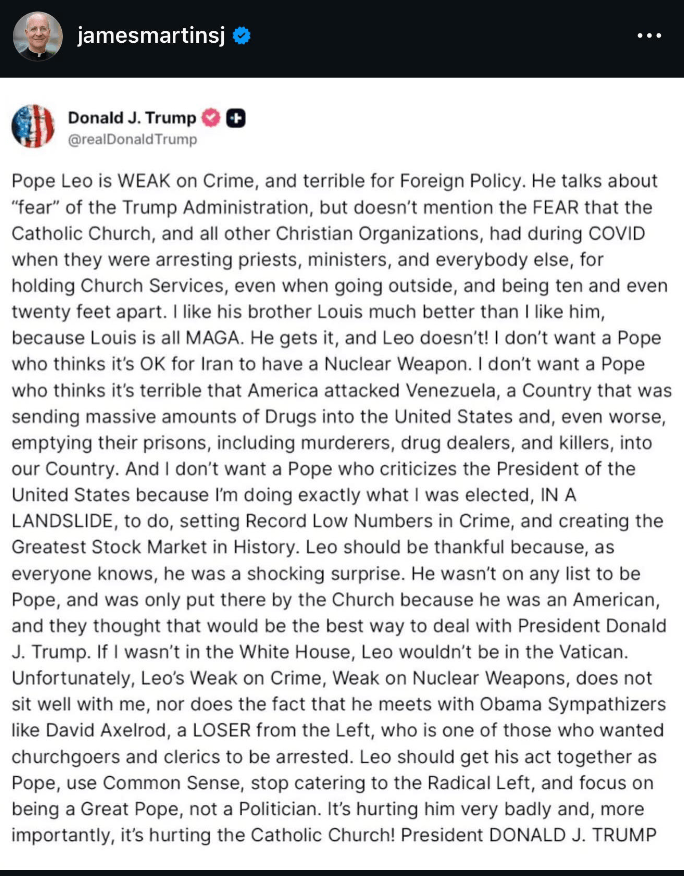
Aboard the papal flight to Africa, Pope Leo XIV offered a strikingly clear and unambiguous reflection on his role in a world increasingly shaped by political tension and global conflict. Responding to questions that inevitably touched on world leaders and current affairs in the wake of President Donald Trump’s Truth Social post, the Holy Father resisted any attempt to draw him into partisan debate. His answer was not evasive—it was clarifying.
“I have no fear of neither the Trump administration nor of speaking out loudly about the message of the Gospel,” the Pope said. “And that’s what I believe I am called to do and what the Church is called to do.”
In a single stroke, he dismissed both fear and political entanglement. His position is not one of retreat, but of confidence—confidence rooted not in power, but in mission. The Pope does not deny the gravity of the present moment; rather, he situates it within a higher frame. The Church’s voice, he insists, is not conditioned by political pressure, nor softened by it.
“We’re not politicians,” he continued. “We’re not looking to make foreign policy, as he calls it, with the same perspective that he might understand it.” The distinction is essential. Pope Leo XIV is not claiming irrelevance to world affairs, but rejecting the premise that the Church must operate according to the logic of political strategy. His concern is not leverage, but truth.
At the heart of that truth stands the Gospel itself—uncompromising, and often inconvenient. “But I do believe that the message of the Gospel, ‘blessed are the peacemakers,’ is a message that the world needs to hear today.”
This is not a slogan, nor a diplomatic gesture. It is a theological claim with concrete implications. In a world marked by escalating conflict and hardened rhetoric, the Beatitude is both a challenge and a summons. It calls into question the assumptions of power, retaliation, and national interest that so often dominate public discourse.
Speaking to other journalists, in English and Italian, Pope Leo highlighted the gravity of the loss of life.
The Pope’s refusal to enter into political debate, then, is not silence—it is a reorientation. He does not engage on the level of personalities or policies, but on the level of principles that precede them. His focus remains fixed on the suffering that underlies the headlines: the lives lost, the families displaced, the quiet devastation of war that rarely fits within political talking points.
By grounding his response so firmly in the Gospel, Pope Leo XIV draws a clear boundary around the Church’s mission. It is not to compete with political authority, nor to mirror it, but to speak a word that stands above it—a word that judges, invites, and ultimately heals.
In the end, his remarks aboard the plane offer more than a reaction to a passing controversy. They articulate a vision of the papacy—and of the Church itself—that refuses both fear and partisanship. It is a vision rooted in fidelity to Christ’s command, and in the conviction that even now, amid division and violence, there remains a better way: the way of the peacemaker.

