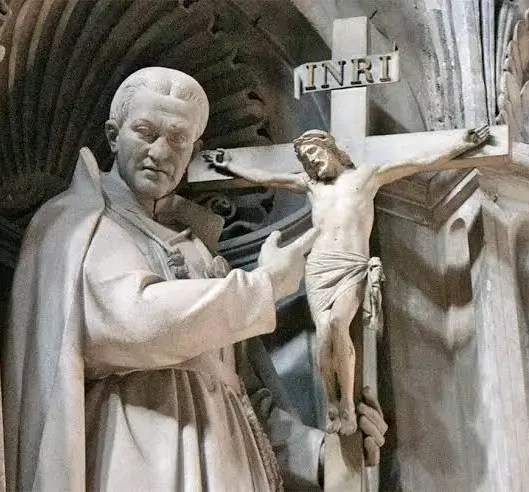
On April 28, the traditional Roman calendar commemorates one of the Church’s great mystics of the Passion: St. Paul of the Cross (1694–1775), founder of the Congregation of the Passion, known more simply as the Passionists. Though his feast is kept on October 19 in the modern calendar, this older date preserves an earlier liturgical memory of the saint whose life burned with a singular, consuming devotion: to keep alive in the Church the remembrance of the sufferings of Jesus Christ.
To understand St. Paul of the Cross is to enter into a spirituality at once austere and luminous, severe and deeply tender. He was not merely a preacher of penance, nor only a mystic of suffering; he was, above all, a lover—one who saw in the Passion of Christ the fullest revelation of divine love, and who sought to draw souls into that same transforming fire.
A Life Marked by the Cross
Born Paolo Francesco Danei in Ovada, in northern Italy, he grew up in a devout but materially poor family. From an early age, he exhibited a serious temperament and an inclination toward prayer and penance. Like many saints of his era, he passed through periods of uncertainty regarding his vocation, even briefly considering a military life. Yet the decisive turning point came in 1720, when he received what he understood to be a divine inspiration: to found a religious congregation dedicated to meditating on and preaching the Passion of Christ.
This inspiration was not abstract. Paul clothed himself in a simple black habit marked with a heart and cross, bearing the words Jesu XPI Passio—“The Passion of Jesus Christ.” The symbol itself was a theological statement: the Passion is not merely an event in the past, but a living mystery inscribed upon the heart of the Church.
He withdrew for a time into solitude, living as a hermit and composing the Rule of what would become the Passionist order. During this period, he underwent intense spiritual trials—darkness, dryness, and profound interior suffering. Yet these trials did not diminish his zeal; rather, they deepened his conviction that union with God is found precisely in fidelity amid desolation.
Eventually ordained a priest, Paul spent decades preaching missions throughout Italy, calling sinners to conversion not through fear alone, but through a vivid presentation of Christ crucified. His preaching was known for its emotional power, often moving listeners to tears. But this was no theatrical display. It flowed from a life steeped in contemplation of the Passion.
The Heart of Passionist Spirituality
At the center of Passionist spirituality lies a simple but inexhaustible truth: the Passion of Jesus Christ is the greatest work of divine love. For St. Paul of the Cross, this was not merely a doctrine to be affirmed, but a mystery to be lived, tasted, and interiorized.

He urged souls to meditate constantly on the sufferings of Christ—not as an exercise in morbid introspection, but as a way of entering into love. The wounds of Christ are not only signs of pain; they are openings through which divine charity pours into the world.
This spirituality is marked by three key elements:
1. Loving Remembrance of the Passion
Paul insisted that the faithful should frequently recall the sufferings of Christ throughout the day. This remembrance is not forced or rigid, but gentle and loving:
“In times of aridity arouse your spirit gently, by acts of love; then rest in the will of God. It is thus that the soul gives the strongest proof of her fidelity to God. Make a bouquet of the sufferings of Jesus, and place it on the bosom of your soul, as I have told you. You can from time to time call them to mind, and say sweetly to your Saviour: ‘Oh good Jesus, how swollen, bruised, and defiled with spittle do I behold Thy countenance! Oh my Love! why do I see Thee all covered with wounds? Oh Infinite Sweetness! why are Thy bones laid bare? Ah, what sufferings! what sorrows! O my God! for what are Thou all wounded! Ah, dear sufferings! dear wounds! I wish to keep you always in my heart’.”
This “bouquet” of sufferings is a striking image. It suggests that even the most terrible aspects of the Passion become, in the soul transformed by love, something fragrant—something offered, cherished, and held close.
2. Intimate Dialogue with the Crucified
For Paul, the crucifix was not merely a devotional object, but a living teacher. He encouraged a deeply personal engagement with Christ crucified:
“When you are alone in your room, take your crucifix, kiss its five wounds reverently, tell it to preach to you a little sermon, and then listen to the words of eternal life that it speaks to your heart; listen to the pleading of the thorns, the nails, the precious Blood. Oh, what an eloquent sermon!”
Here, Passionist spirituality reveals its profoundly contemplative character. The Passion is not only to be studied or remembered; it is to be listened to. The wounds of Christ speak—silently, yet with overwhelming clarity—to the soul that is attentive.

3. Joy in Suffering Through Union with God
Perhaps the most paradoxical aspect of Paul’s teaching is his insistence that suffering, when united to Christ, becomes a source of joy and peace. This is not a denial of pain, but a transformation of its meaning:
“On awaking, keep your heart under control, by the remembrance of God, your Love, your only Good. When God inspires you with a sentiment of love, stop and taste it, as the bee sips the honey…. Ah! when I reflect that my soul is the temple of God, that God dwells in me, how my heart rejoices! All sufferings and afflictions appear to me sweet and light…. What a fruitful source of meditation! Live in the joy and the peace of the divine Majesty. Live lost in divine love. Live for divine love and of divine love. Oh cherished cross! Through thee my most bitter trials are replete with graces!”
This is the heart of the saint’s paradox: the Cross, which appears as defeat, becomes the very place of victory; suffering, which seems bitter, becomes sweet when suffused with love.
The Passion and the Holy Mass
For St. Paul of the Cross, the Passion is not confined to private devotion. It reaches its highest expression in the liturgy, especially in the Holy Mass. There, the sacrifice of Calvary is made present, and the faithful are invited to unite themselves to it.
He writes:
“The Mass is the most favorable occasion to speak with the eternal Father, because then we offer Him His only Son as a victim for our salvation. Before celebrating, reflect on the sufferings of your Redeemer, commune peaceably with Him, even in the midst of dryness; carry to the altar the needs of the entire world.”
This insight reveals the profoundly ecclesial dimension of Passionist spirituality. The contemplation of the Passion is not an escape from the world, but a way of interceding for it. At the altar, the soul does not stand alone; it carries with it the burdens, sorrows, and needs of all humanity, offering them through Christ to the Father.
A Saint for Our Time
In an age often marked by distraction, superficiality, and an aversion to suffering, the message of St. Paul of the Cross may seem at first difficult. Yet it is precisely in such an age that his witness becomes most necessary.
He reminds us that love is not sentimental, but sacrificial; that true peace is not found in avoiding suffering, but in embracing it with Christ; and that the deepest joys are discovered not in self-indulgence, but in self-gift.
His life also offers a corrective to a purely external religiosity. The Passion, he teaches, must be interiorized. It must penetrate the heart, shaping thoughts, desires, and actions. Only then does it become a source of transformation.
Jesus loves you
The Feast of St. Paul of the Cross invites us to rediscover the central mystery of our faith: that we are saved not by an abstract principle, but by a Person who loved us unto death. The Passion is not merely a past event, but a present reality, continually offered to the Father and continually inviting our response.
To follow St. Paul of the Cross is to take up this invitation—to gaze upon the Crucified, to listen to His silent sermon, and to allow His love to reshape our lives. It is to gather, as he says, a “bouquet” of His sufferings, and to place it within the depths of our soul, where it may blossom into charity.
In doing so, we discover the secret that animated the saint himself: that the Cross, far from being an obstacle, is the surest path to union with God—and that in the wounds of Christ, we find not only sorrow, but the inexhaustible joy of divine love.
Buy now the collection of this spiritual “flowers” in my publication called Flowers of the Passion.
Your free subscription and your book purchase support the work of Crux Stationalis — providing access to Rome’s most ancient churches across social media.
Find all of my published works HERE.

